Welcome to the GCTLC Library. Use the search and filter options below to find green chemistry education resources and curriculum materials from community members from across the world. You can also submit a new resource to the library. For information for authors and reviewers, please consult the Guidelines for Submission and Review of Learning Objects.
ChemFORWARD Module Unit 1: Introduction to ChemFORWARD, and Use of ChemFORWARD to Find Safer Chemical Alternatives
This unit provides details on the organization and use of the ChemFORWARD platform, the information that can be obtained using the platform, and how to use the platform to find safer chemical alternatives for chemicals of concern. Details are provided in the ChemFORWARD How-To Guide. Pertinent slides with screenshots are provided. Students can be directed to the diethyl phthalate example ...
ChemFORWARD Module Unit 2: Avoiding Regrettable Substitutions, Natural Is Not Always Safer
This unit reiterates the importance of avoiding regrettable substitutions, emphasizes the importance of data gaps, and also cautions that naturally-occurring chemicals are not always safer, regardless of the many claims made in some consumer products.
This module unit was reviewed by Julian Silverman (Ph.D.) and Sarah Prescott (Ph.D.).
The inspiration of this work began with a Forsythia ...

Chemical Hazard Awareness Module
The Chemical Hazard Awareness Module is designed to be used in conjunction with a laboratory exercise that you currently use in your classroom or laboratory. We have outlined this exercise for use with Beyond Benign’s laboratory exercise “Reactions Lab” (found online here: http://www.beyondbenign.org/K12education/highschool.html). The Reactions Lab allows students to observe different types of ...
Chemical Kinetics
This module teaches fundamental concepts in chemical kinetics for General Chemistry using examples of water quality and water treatment. Key chemistry topics include concentration vs. time data; rate constants (k); reaction order; rate law expressions (including integrated rate laws); determining rates, rate laws, and rate constants from graphical and/or tabulated data; half-life; Arrhenius ...
Chemical or Physical Change?
This lab replaces traditional reactions involving chemicals such as cupric chloride (copper (II) chloride), 6 M hydrochloric acid, potassium hydroxide, and copper (II) sulfate. Students will understand the difference between chemical and physical changes while using all greener materials.
This lab is designed for when for students have minimal lab experience. The goal is to use observations of ...
Chemical Substitution and Alternatives Assessment Module
This module is one from the Global GreenChem Toolkit (https://www.globalgreenchem.com/toolkit-and-resources). There are four links associated with this module that include presentation slides on "Chemical Substitution and Alternatives Assessment", a hazard screening activity, an alternatives assessment activity, and a document with additional links to websites and reading materials.
The attached ...
Chemistry Education for a Sustainable Future
Now and in the years ahead, we need to sustain all life on our planet. How do we do this? Chemistry, the science of materials, provides part of the answer to this question. Practicing chemistry in a green and sustainable manner is essential to achieving a sustainable future. However, sustainability concepts seldom are taught in the chemistry classroom. For example, the connections between ...
Chemists' role in the fight against disease
Chemists design, create and modify molecules to produce new and useful materials such as pharmaceuticals. Research and development of new medicines and vaccines against communicable and non-communicable diseases is vital in helping to achieve the UN’s sustainable development Goal 3: ensure healthy lives and promote well-being for all at all ages.
Chiral Compounds and Green Chemistry in Undergraduate Organic Laboratories: Reduction of a Ketone by Sodium Borohydride and Baker's Yeast
Chiral compounds can have unique properties and are becoming increasingly important in pharmaceutical, chemical, and agricultural industries. In this laboratory exercise, students compare and contrast chemical vs. enzyme-mediated procedures for introducing chirality into a molecule and gain experience with the principles and experimental techniques used to prepare and separate enantiomers. Over ...
Chlorinated Solvents: Their Advantages, Disadvantages, and Alternatives in Organic and Medicinal Chemistry
This published article provides a comprehensive overview of chlorinated solvents in medicinal and organic chemistry, including the numerous properties that have made them a historically popular choice, their significant disadvantages and health and safety considerations, and recommendations for choosing viable alternatives for numerous common reactions and laboratory applications.
Cinnamon Oil: An Alternate and Inexpensive Resource for Green Chemistry Experiments in Organic Chemistry Laboratory
We report a series of experiments based upon cinnamon oil that were developed to provide a practical integration of green and sustainable chemistry concepts for the organic chemistry laboratory. Five experiments centering around cinnamaldehyde as a green, plant-based chemical were performed by undergraduate students in a second-year organic chemistry class. Cinnamon oil was obtained through ...
Climate Change Chemistry
This curriculum unit is focused on exploring the scientific concepts of climate change, specifically within the field of chemistry. The unit aims to provide students with a foundational understanding of the chemistry involved in climate change models, predictions, and policy. The focus is on removing political connotations associated with the term “greenhouse gases” and restoring its scientific ...
Cocrystal Controlled Solid-State Synthesis. A Green Chemistry Experiment for Undergraduate Organic Chemistry
In this set of experiments, students will be introduced to condensation reactions, green chemistry, and cocrystal-controlled solid-state synthesis. This type of solid-state synthesis is performed by first making cocrystals of the two reactants (in this case an anhydride and an amine) which brings the reactive functional groups in close proximity to one another, allowing for a reaction to occur ...
Colorful and Creative Chemistry: Making Simple Sustainable Paints with Natural Pigments and Binders
This activity presents a simple method for producing sustainable, nontoxic, and environmentally friendly paints from materials purchased at a local grocery store and offers suggestions for experiments to test the properties of the student-made paints. This activity has been used to engage elementary, middle, and high school students in scientific outreach efforts aimed at teaching chemical ...
Comparative Methylation of 1,8-Dihydroxy-9,10-anthraquinone: Chemoselectivity in the Organic Chemistry Laboratory
This experiment demonstrates chemoselectivity in various reaction conditions. The mono or di-methylation of 1,8-dihydroxy-9,10-anthraquinone can be controlled by either refluxing the reagents in tetraglyme or by simply heating without solvent. Also, this ether synthesis has been made greener by eliminating flammable THF and dangerous sodium hydride and by using a less toxic methylating agent. ...

Comparing Industrial Amination Reactions in a Combined Class and Laboratory Green Chemistry Assignment
In this published article (J. Chem. Educ., 2019, 96, 1, 93-99), we describe a green chemistry combined in-class and laboratory module for upper-year organic chemistry students. Through completing this combined module, students will compare and contrast the greenness of two industrially-relevant amination reactions to create the same target molecule. One of these amination reactions will be ...
Comparison between Sunflower Oil and Soybean Oil as Gear Lubricant
This study evaluates the use of sunflower oil and soybean oil as eco-friendly alternatives to synthetic gear lubricants in helical gear systems. Conducted using a gear test rig, the research measured kinematic viscosity and viscosity index of both oils over 80 hours of operation. Findings revealed that while both oils possess high viscosity indices and perform well at high temperatures, sunflower ...
Cooperative Organic Chemistry Laboratory
This laboratory curriculum uses project-based learning to engage second-year organic chemistry students in investigations which incorporate green chemistry decision-making. The basis for this laboratory curriculum is to experience science from the perspective of an organic chemist. Working in groups, students are tasked with a project requiring them to design and carry out an investigation ...
Desalination Design Challenge: 01 Water, Water Everywhere
In this introductory lesson of the Desalination Design Challenge unit, students explore the limited availability of Earth’s fresh water through a hands-on visual demonstration using containers of varying sizes. By modeling the distribution of salt water, frozen fresh water, and accessible fresh water, students develop a concrete understanding of global water scarcity. The lesson prompts students ...
Desalination Design Challenge: 02 How Do Animals Conserve Water?
In this lesson (which builds off lesson 1), students explore how animals have evolved adaptations to conserve water and manage salt in high-salinity or arid environments. Through guided reading, discussion, and comparison of animal adaptations, students learn how nature solves water scarcity challenges without relying on energy- or resource-intensive processes. The lesson introduces biomimicry ...
Desalination Design Challenge: 03 Focus on Filtering
In this lesson, students investigate how water filtration improves access to clean drinking water and protects public health. After reviewing real-world filtration devices used globally, students apply ideas from biomimicry and sustainability to design their own water filter using readily available materials. Through sketching, peer feedback, and design revision, students practice the engineering ...
Desalination Design Challenge: 04 Fresh Filters: Get the Mud Out
In this hands-on engineering laboratory lesson, students build, test, and improve water filtration systems designed to remove mud and salt from water. Using readily available materials, students evaluate how effectively their prototypes separate mixtures and solutions, collect observational and quantitative data, and apply the engineering design process to revise their designs. The lesson ...
Desalination Design Challenge: 05 Salty Solutions
In this lesson, students explore how nature removes salt from water and apply this understanding to the design of a sustainable desalination device. Students examine biological strategies used by animals and plants to manage salt, learn about three main desalination methods (crystallization, filtration, and distillation), and review evaporation using particle models. Working in teams, students use ...
Desalination Design Challenge: 06 Desalination Design
In this multi-day culminating lesson, students construct, test, and evaluate their own desalination devices using the engineering design process. Building on prior lessons about water scarcity, filtration, evaporation, and biomimicry, students collect data on device performance, assess sustainability and efficiency using defined criteria, and propose evidence-based design improvements. Through ...
Designing 3 experiments from Vinegar and an Antacid
In this activity, students explore how much Carbon Dioxide is produced from varying combinations of reactants. Students use stoichiometric calculations to determine the theoretical anticipated amount of CO2. Students record observations and measurements of mass of reactants before and after the reaction. Students use the recorded measurements to calculate the amount of Carbon Dioxide produced.In ...
Determination of the Formula of a Hydrate: A Greener Alternative
The determination of the formula of a hydrate is an experiment that introduces students to many fundamental chemical concepts including stoichiometry, the notion of a mole, and nomenclature. In this experiment, the authors replaced the previously used calcium and barium salts because the latter is considered poisonous and tumorigenic, and both were considered waste after only one use. Instead ...
Determination of the Heat of Combustion of Biodiesel Using Bomb Calorimetry. A Multidisciplinary Undergraduate Chemistry Experiment
This lab teaches important basic chemistry skills in the context of utilizing renewable feedstocks. In a three-week series of experiments, students will synthesize biodiesel from peanut oil and determine the heat of combustion, density, and cloud point of their product. Students will then use this information to evaluate the viability of biodiesel when compared to petroleum diesel.
Physical ...
Developing and Disseminating NOP: An Online, Open-Access, Organic Chemistry Teaching Resource To Integrate Sustainability Concepts in the Laboratory
In order to instill an increased awareness of sustainability issues in future generations of scientists, the concepts and content of science courses must be changed. While important chemical concepts must be preserved, outdated, dangerous, and wasteful chemistry should be replaced by current, more sustainable alternatives. With these beliefs in mind, six German universities combined forces and ...
Dissolved Substances in Tap Water and Seawater
The experiment "Dissolved Substances in Tap Water and Seawater" involves students evaporating tap water, distilled water, and seawater to observe solid residues. They also witness an instructor-led demonstration where gases are released from boiling these waters, collected, and tested. This practical activity helps illustrate the different dissolved substances in various water types, showcasing ...
Dye-Sensitized Solar Cell
There is a growing need to investigate alternative energy resources due to the depletion of petroleum, a widely used energy source. Solar energy, or energy from the sun, is a free, readily available, plentiful resource that can be collected by solar cells to generate electricity.
Although solar cells have been around for a long time, their use for energy generation is not widespread. This is ...
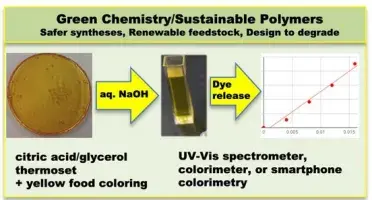
Dyeing to Degrade: A Bioplastics Experiment for the College and High School Classroom
The experiment was published in the Journal of Chemical Education @ https://pubs.acs.org/doi/abs/10.1021/acs.jchemed.9b00461 by co-authors Knutson, C. M.; Hilker, A.; Tolstyka, Z. P.; Wilbon, P. A.; Mathers, R. T.; Anderson, C. B.; Perkins, A. L.; Wissinger, J. E.
E-factor
E-factor is a metric that measures the overall efficiency in terms of waste generation of a chemical reaction. E-factor stands for the "Environmental Impact Factor" and is the ratio of how much waste is produced per unit of product made:
E factor= (mass of waste produced (g))/(mass of isolated product (g))
As a result, the lower the E-factor, the more sustainable and less wasteful the reaction ...
E10 petrol and climate change | 14–16 years
This resource includes teacher notes and a student worksheet about E10 petrol, which became the standard 95-octane fuel in Great Britain in 2021 and Northern Ireland in 2022. Students read an extract from a news article and answer related questions. Sue Ali, from the Royal Society of Chemistry, is the author of this resource.
Effects of a CURE Laboratory Module on General Chemistry Students’ Perceptions of Scientific Research, Green Chemistry, and Self-Efficacy
This study describes the effects of implementing a Course-Based Research Experience (CURE) module involving materials science research with a green chemistry synthetic method on student's scientific research, green chemistry, and research skills self-efficacy. The CURE was implemented in a second-semester general chemistry laboratory course.
Effects of a CURE Laboratory Module on General ...
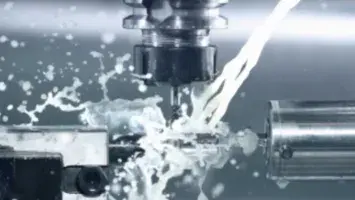
Effects of the use of soybean oil as cutting fluid on the surface finish for turning operations
This learning object investigates the use of soybean oil as a sustainable alternative cutting fluid in machining processes. Conventional mineral oil–based cutting fluids pose environmental and health concerns due to their non-biodegradability and potential toxicity. In this study, soybean oil, a renewable and biodegradable resource, is applied during machining to evaluate its effects on surface ...
Empirical Formula
Traditional labs used to teach the concept of empirical formula, such as the synthesis of magnesium oxide, reactions between sulfur and copper or iron, or the decomposition of silver oxide, require high energy and may result in the production of dangerous compounds. This alternative method uses greener reactants and produces rust at ambient temperatures. Student results may vary depending on the ...
Enantioselective Reduction by Crude Plant Parts: Reduction of Benzofuran-2-yl Methyl Ketone with Carrot (Daucus carota) Bits
Biocatalysis and biotransformations are important alternatives to consider when one is looking to substitute a conventional method with a greener one. One of the many advantages of using biotransformation as a synthetic method is that they are usually done in water and at ambient conditions. In addition, the reagents themselves are readily available, safe, and inexpensive to both buy and dispose ...
Encyclopedia of Green Chemistry
This comprehensive encyclopedia of green chemistry covers a wide range of topics in 146 review chapters. It is meant to be a large reference work for academic, industrial, and government scientists. Each chapter is authored by an expert in the specific topic, who brings together current research while highlighting challenges and discoveries that are most important. Volume 1 covers fundamentals ...
Enhancing chemistry understanding and attitudes through an outreach education program on circular plastic economy: a case study with Thai twelfth-grade students
This study examines the impact of an outreach education in chemistry for circular plastic solutions (OEC-Circle) program on enhancing Thai 12th-grade students’ understanding of plastic-related chemistry and fostering positive learning attitudes. The program integrates the circular plastic economy through inquiry-based learning, including citizen inquiry and guided inquiry activities. The ...
Environmental Activities for the Classroom: Product Life-Cycle Analysis
Consumption of products drives an array of extraction, manufacturing, processing, transportation, and disposal operations. An analysis of these operations, called life-cycle or cradle-to-grave analysis, documents the inputs (water, energy, raw materials) and outputs (products and wastes), for these various steps. The objective of this lesson is to have students become aware that the products they ...
Environmental Chemistry
This module is part of a collection of nine green chemistry teaching modules developed in the early 2000s by a team of faculty (Donna Narsavage-Heald, Trudy Dickneider, David Marx, Timothy Foley, Joan Wasilewski) led by Michael Cann at the University of Scranton and has been migrated to the GCTLC. The subjects of the modules are based on winners of the Green Chemistry Challenge Awards. The modules ...
Environmentally Responsible Redox Chemistry: An Example of Convenient Oxidation Methodology without Chromium Waste
Oxidations and reductions are among the most commonly performed reactions in organic chemistry. Consequently, it is vital that redox chemistry is taught in our undergraduate chemistry courses. Unfortunately, many oxidations are classically and currently performed with toxic, carcinogenic chromium (VI) metals and require time-consuming and wasteful aqueous work-up.
All of these abovementioned ...
Enzyme-based processing of soybean carbohydrate: Recent developments and future prospects
The work highlights the underutilized potential of soybean carbohydrates, which constitute 26–30% of the dried bean. Unlike protein and oil, soybean carbohydrates are difficult to process and can cause anti-nutritional effects in food and feed. The review details how enzyme-based processing—particularly carbohydrases and related enzymes—offers sustainable and efficient alternatives to conventional ...
Equality, education and science
This resource is part of the Royal Society for Chemistry's sustainability in chemistry series. It is for high school teachers to help them link their lessons about energy sources, water resources, nanochemistry, health, and climate change to the United Nation's Sustainable Development Goals of inclusive education and equality.
Equilibrium/Le Chatelier’s Principle
Green chemistry principles emphasize the importance of sustainability in chemical processes and aim to reduce the environmental impact of chemistry. One way to apply these principles is by using equilibrium experiments and Le Chatelier's Principle with environmentally friendly reagents that are minimally toxic. In the past, these principles have been demonstrated using chemicals that change color ...
Essential Oil Extraction using Liquid CO2
Many fruits and vegetables contain essential oils, which are hydrophobic liquids responsible for their distinctive fragrance. These oils are commonly extracted for use in various industries such as perfume, cosmetics, food, medicine, and cleaning products. The traditional extraction involves steam distillation followed by liquid-liquid (solvent) extraction, which is energy-intensive and often ...
Ethers and sulfides
This learning module covers synthesis and reactivity of ethers and epoxides. Students will connect these to the larger sustainability goals of UNSDG 3: Good Health and Well-being, 9: Industry, Innovation, and Infrastructure, 12: Responsible Consumption and Production, and 13: Climate Action. This module is designed to be taught in consecutive class periods of one week in the later part of Organic ...
Ethics of Chemistry: The Design, Delivery, and Assessment of a Third-Year Course
This journal article discusses a third-year undergraduate chemistry course focused on ethics. Despite chemistry’s broad societal impact, ethical training is often lacking in undergraduate programs. This course aimed to fill that gap by teaching students to identify ethical issues and justify moral decisions using a practical analytical framework applied to real-world case studies. The discussion ...