Welcome to the GCTLC Library. Use the search and filter options below to find green chemistry education resources and curriculum materials from community members from across the world. You can also submit a new resource to the library. For information for authors and reviewers, please consult the Guidelines for Submission and Review of Learning Objects.

Re-casting traditional organic experiments into green guided-inquiry based experiments: student perceptions
This article uses Green Chemistry principles to recast traditional Organic chemistry experiments into more guided inquiry-based experiments. It provides an overview of how traditional labs have been revamped to allow Green Chemistry principles to be taught through the labs. Lee, D. B. (2019). Recasting traditional organic experiments into green guided inquiry-based experiments: student perceptions ...
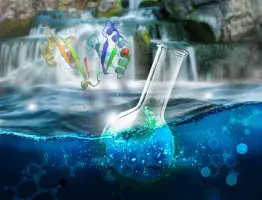
Reações em cascata enzimática, quimioenzimática e fotoenzimática: perspectivas para uma síntese orgânica mais sustentável
As substâncias químicas raramente são o resultado de uma única transformação; ao contrário, sua obtenção geralmente envolve diversas etapas de reações individuais. Tradicionalmente, essas etapas são realizadas de forma sequencial, incluindo o isolamento e a purificação dos intermediários. Entretanto, optar pela realização de reações em cascata pode trazer inúmeros benefícios, como: (i) ...
Reactions Lab
This lab discusses types of reactions and replaces traditional reaction experiments involving chemicals such as lead (II) nitrate, barium chloride, and silver nitrate. This lab challenges students to identify types of chemical reactions and distinguish between reactions that use safer, less hazardous chemicals from the more hazardous. Students will participate in the decision making by choosing ...
Recycling plastic bottles
The article discusses steps in recycling plastic bottles, focusing on polyethylene terephthalate (PET). The steps required to separate the PET bottles from other types of plastics such as polyvinyl chloride (PVC) using optical methods and density are described. The article further describes the chemical methods used to remove other contaminants including food residues and depolymerize the ...
Recycling Polylactic Acid
We have an ongoing plastic problem. This is not news, but also not the end of the story.
Half of the plastics being produced are single-use plastics, meaning they are only intended to be used once. Compared to how long plastics take to break down, or degrade, there is a large time difference between the time the product is in use versus the time the product degrades.
Plastics are made up of ...
Reductive Amination: A Remarkable Experiment for the Organic Laboratory
There are many tools that a synthetic organic chemist can use to synthesize amines; one of which is reductive amination. This common method of introducing the amine functionality is especially crucial for the synthesis of pharmaceuticals and biomolecules.
A typical reductive amination is a one-pot reaction involving a solvent, an aldehyde or ketone, an amine, and a weakened reducing agent. This ...
Replacement of Less-Preferred Dipolar Aprotic and Ethereal Solvents in Synthetic Organic Chemistry with More Sustainable Alternatives
This review article provides an overview of dipolar aprotic and ethereal solvents and their use in synthetic organic chemistry, as well as recent legislative changes being imposed on their usage, and alternative, safer and more sustainable alternatives to consider as well as case study examples of where less desirable solvents have been successfully replaced with greener options.
Reprocessable Networks from Vegetable Oils, Salts, and Food Acids: A Green Polymer Outreach Demonstration
This educational resource presents a hands-on outreach demonstration to explore the concepts of green polymer chemistry and sustainability. The lesson focuses on reprocessable polymer networks—a key innovation in sustainable material development—using common household ingredients such as vegetable oils, citric acid, and baking soda. Students learn about the environmental challenges posed by ...
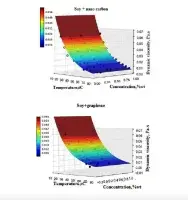
Rheological Properties of Soybean Oil with Nano Additives: A Comprehensive Analysis
This Learning Object introduces students to the rheological behavior of soybean oil with nano-additives (graphite, graphene, and nanocarbon) as a pathway to developing biodegradable lubricants. Using experimental data and mathematical modeling (power law and temperature-dependent viscosity equations), the study examines how nano-additives influence viscosity, thixotropy, and flow properties. This ...
Roles of Systems Thinking within Green Chemistry Education: Reflections from Identified Challenges in a Disadvantaged Context
Systems thinking is currently envisaged as a useful educational approach to teaching about sustainability (including green chemistry education) because of the high number of interrelated factors involved and the need of learners to acquire the ability to identify all of the factors and their relationships. After recalling the way in which key concepts are understood and utilized in this work, the ...
Rudolph Diesel Meets the Soybean: “Greasing” the Wheels of Chemical Education
This article explores the role of biodiesel as a sustainable alternative to petroleum-based fuels, highlighting its historical context, chemical principles, and practical applications. It discusses the contributions of Rudolph Diesel, who originally designed his engine to run on vegetable oil, and examines the modern shift toward biodiesel as an environmentally friendly solution to energy ...
rxnSMILES4AtomEco: Teaching Atom Economy with Reaction SMILES
This Learning Object introduces rxnSMILES4AtomEco, a computational tool for calculating atom economy (AE) using reaction SMILES. It includes Jupyter notebooks with examples (e.g., acetone synthesis) to enhance green chemistry education. Educators can use it to teach AE metrics and process design, fostering sustainability in curricula.
Article abstract: Green chemistry demands efficient ...
Safer Stuff: Green Chemistry Gets Down to Business
This resource is an introduction to green chemistry and is episode 1 of a 7 episode documentary series, Safer Stuff: Green Chemistry Gets Down to Business, which is an upbeat exploration of solutions to the problem of toxic chemicals in everyday products and the part green chemistry plays.
The inspiring story of green chemistry is told through interviews with the originators of the field (Paul ...
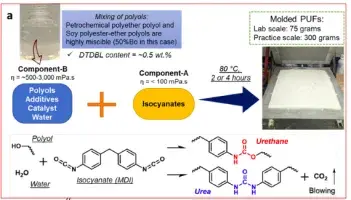
Scalable manufacturing and reprocessing of vitrimerized flexible polyurethane foam (PUF) based on commercial soy polyols
This Learning Object introduces students to Green Chemistry principles through a case study on recyclable flexible polyurethane foams (PUFs) using renewable soy-based polyols. Based on “Scalable manufacturing and reprocessing of vitrimerized flexible polyurethane foam (PUF) based on commercial soy polyols” the study demonstrates how commercial soy polyols can partially replace petrochemical ...
Secrets of Sharks’ Skin: 01 Grammar Sharks
This lesson sets the stage for talking about both sharks and biomimicry by introducing fun shark facts through a grammar-correcting challenge, then by considering examples of technologies modeled after sharks’ dermal denticles. In the upcoming lessons, dermal denticles will be discussed as the inspiration for Sharklet film, a micro-texture that prevents the growth of bacteria without the use of ...
Secrets of Sharks’ Skin: 02 Geometry in Our World
In this lesson, students are introduced to the patterns and shapes found in Sharklet film. Then students are asked to apply their understanding of geometry by drawing pictures of both the natural and man-made world, and labeling lines, angles and shapes.
Secrets of Sharks’ Skin: 03 Shape or Size?
In this lesson, students will begin to explore how Sharklet film works to prevent the growth of bacteria. They will be considering two major properties of the micro-texture: the shape of the pattern and the size of the pattern.
Secrets of Sharks’ Skin: 04 Prototype Testing: Binder Clip Bacteria
In this lesson, students will evaluate their puffy-paint Sharklet surface models they made in Lesson 3. Students will use sticky notes and binder clips to simulate the accumulation of bacteria on both the Sharklet surface and a flat surface. As students compare their three models, they will collect data to compare with the rest of the class in Lesson 5.
Secrets of Sharks’ Skin: 05 Data and Denticles
In this culminating lesson of The Secrets of Sharks’ Skin unit, students analyze and interpret class-generated data from Sharklet-inspired surface models to determine how surface structure affects bacterial attachment. Using tables and graphs, students compare results across different pattern sizes and shapes and conclude that spacing and surface area matter more than shape in preventing adhesion ...
Separating Salts from Seawater
The experiment "Separating Salts from Seawater" demonstrates the process of separating various salts from seawater. Students heat seawater to evaporate the water and precipitate solids. The procedure involves boiling seawater, allowing solids to settle, and using filtration and further evaporation to isolate different salts, primarily calcium carbonate, calcium sulfate, and sodium chloride. This ...

Separation of Food Colorings via Liquid–Liquid Extraction: An At-Home Organic Chemistry Lab
This ACS resource is an accessible and safe organic chemistry lab experiment that teaches liquid-liquid and acid-base extraction. The experiment can be completed entirely at home. Students are tasked with separating an unknown mixture of food colorings. The separation can be accomplished using only water, vegetable oil, white vinegar, and baking soda.
Separation of Food Colorings via Liquid ...
Slot sustainable energy into your teaching
This resource provides ideas and tips for teaching students about sustainable energy sources which connects to the UN Sustainable Development Goal 7. The activities presented in this resource also connect the ideas of scientific discovery using energy production as a context to promote students' interests in sustainable energy.
So you think you want to teach Green Chemistry?
This is a webinar from the Beyond Benign webinar archive about teaching green chemistry in higher education.
Andy Dicks, David Laviska & Nick Kingsley share tips & tricks for bringing Green Chemistry to their departments and beyond. This discussion covers approaches to transforming chemistry education as well as developing, expanding, and strengthening Green Chemistry connections within the ...
Social and Environmental Justice in the Chemistry Classroom
This is a free-to-read article published in the Journal of Chemical Education that provides an overview of how green chemistry curricular resources can help faculty discuss social, health, and environmental justice in their classrooms. Emphasis is placed on providing relevancy to students looking to learn how their chemistry knowledge can help them solve and/or prevent global justice crises.
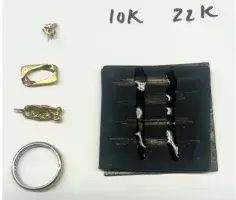
Solve et Coagula: Exploring Alchemy and Sustainability with Gold
The acid test has been used for centuries to determine whether metals are real gold or not. In this laboratory activity, students practice handling strong acids and testing alloys to determine whether they contain noble, coinage, and precious metals, such as gold, silver, and platinum. By exploring the gold in our jewelry and electronics, we can explore green chemistry principles and sustainable ...
Solvent Selection for SN1 and SN2 Reactions in Green and Sustainable Chemistry
This module explores nucleophilic substitution reactions and how solvent selection correlates to reaction mechanisms for SN1 and SN2 reactions (i.e., reaction product, selectivity, and stereochemistry). Solvents are discussed with respect to environmental, health, safety, and life-cycle considerations. This module can be used when nucleophilic substitution reactions are introduced and is designed ...
Solvent-Free Synthesis of Chalcones
Chalcones represent a group of compounds with interesting biological activities that are formed from an aldol condensation between a benzaldehyde and an acetophenone in the presence of NaOH as a catalyst. Although typically synthesized using organic solvents, in this exercise students prepare 20 different chalcones using a solventless procedure. The scale of these reactions can be easily modified ...
Solvent-Free Wittig Reaction: A Green Organic Chemistry Laboratory Experiment
Carbon-carbon bond formation is arguably one of the most crucial transformations in organic chemistry. In this experiment, students will simultaneously transform carbonyl groups into olefins via the Wittig Reaction while learning principles of green chemistry. While the Wittig is not normally known for its "greenness" (due to its poor atom economy), this lab seeks to bolster the reaction's green ...
Some Exercises Reflecting Green Chemistry Concepts
This series of exercises enforces green chemistry concepts while also introducing students to the balancing of equations and stoichiometry. The concept of conservation will likely already be familiar to most students, but these drills give students a chance to analyze different synthetic pathways and decide which path is the most green. The three target compounds given in this article are aluminum ...
Soy-Based Chemicals and Materials: Growing the Value Chain
This review chapter "Soy-Based Chemicals and Materials: Growing the value chain" documents the use of soy as a biomaterial and green alternative to traditional feedstocks. Within this article, current industrial uses of soybeans are discussed including solvents, oleochemicals and surfactants, paints, coatings, inks, plastics, plasticizers and others are highlighted. Then, four of the Presidential ...
Soybean carbohydrate as fermentation feedstock for production of biofuels and value-added chemicals
Overview: This comprehensive review explores how carbohydrate-rich byproducts from soybean processing—such as soybean hulls, meal, molasses, and okara—can be repurposed as fermentation feedstocks to produce biofuels, enzymes, and specialty chemicals. The paper emphasizes the potential of these underutilized materials in building a sustainable, soy-based biorefinery platform.
Citation: Brentin, R ...
Soybean Oil: Powering a High School Investigation of Biodiesel
This lab series challenges students to make and analyze biodiesel using soybean oil as a renewable fuel. It aligns with the NGSS Energy standards for K-12 classrooms. The lesson encourages students to tackle global issues with evidence and scientific reasoning. This lab enhances discussions on energy by exploring biodiesel as an alternative to petroleum-based diesel.
Full citation: Rosa, P. D. L ...
Stereochemistry: Introduction to Chirality
This module has been designed to introduce second-year organic chemistry students to the concepts of stereochemistry through the lens of the World Health Organization’s Model List of Essential Medicines. PowerPoint slide decks, homework assignments, instructor notes, activities, and a summative assessment are included in this module. Students should be able to represent and classify stereoisomeric ...
Stoichiometry Challenge
This lesson introduces the concept of green chemistry by replacing a conventional aluminum to alum stoichiometry lab with a more sustainable precipitation reaction using sodium carbonate and calcium chloride. Green chemistry is an approach that aims to design chemical processes and products that minimize the use and generation of hazardous substances, while also reducing waste and improving ...
Stoichiometry: Combustion, Fuels, and Green Chemistry Metrics
This module connects ideas across topics in a first semester introductory chemistry course to explore the impacts of combustion reactions. By motivating students to understand the relationship between reaction completion and yield, and molar enthalpies and reaction efficiency in the context of selecting fuels for a fire, educators can explore both safety and sustainability without additional ...
Stoichiometry: Reaction of Iron with Copper(II) Sulfate
Students use stoichiometry to deduce the appropriate equation for the reaction between solid metallic iron and a solution of copper(II) sulfate. This reaction produces solid metallic copper, which is precipitated as a finely divided red powder in a single displacement reaction. During the reaction, atoms from a solid metal exchange with different metal ions in a salt solution. The iron produced ...
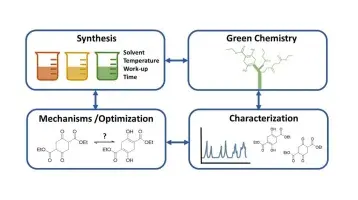
Structure Determination in the Green Undergraduate Laboratory
This learning object focuses on the green and sustainable condensation reaction of diethyl succinate and can be scaffolded depending on needs and equipment. The unexpected product of this reaction works well for a challenging structure determination lab and the nature of the starting materials points to responsible sourcing and alignment with UNSDGs.
Co-author Hannah Snider contributed ...
Student participation in a coastal water quality citizen science project and its contribution to the conceptual and procedural learning of chemistry
The study by J. L. Araújo examines how a year-long citizen science initiative—PVC: Perceiving the Value of Chemistry—engaged 442 Portuguese middle school students and 9 chemistry teachers in monitoring coastal water quality and detecting microplastics. Through hands-on analysis of physicochemical parameters (such as pH, turbidity, salinity, nitrate/nitrite levels, and dissolved oxygen) and ...
Students Learn Green Chemistry by Taking On Real-World Sustainability Challenges
In this episode, Professor Glenn Hurst takes his students at the University of York out into the world so they can see firsthand how their training in chemistry and chemical engineering can be channeled to help tackle sustainability challenges.
Along the way, the students learn the value of community engagement and evaluate their green chemistry and green engineering solutions in the context of ...
Styrene-Free Soybean Oil Thermoset Composites Reinforced by Hybrid Fibers from Recycled and Natural Resources
This study introduces a sustainable, styrene-free thermoset composite derived from acrylated epoxidized soybean oil (AESO) and reinforced with hybrid fibers sourced from recycled PET, bamboo, polyester, and ethylene-propylene (ES) fibers. To replace toxic and volatile styrene, the researchers synthesized glyceryl trimethacrylate (GTMA) from biodiesel-derived glycerol as a bio-based reactive ...
Substitution of carcinogenic solvent dichloromethane for the extraction of volatile compounds in a fat-free model food system
This published article looks at alternative solvent options to dichloromethane (DCM) for extraction of volatile compounds. By exploring the physico-chemical properties and hazard characteristics of the solvents and analyzing their efficiency in extracting volatile compounds from a fat-free model food product, safer options to DCM were identified.
Full citation: Cayot, N.; Lafarge, C.; Bou-Maroun ...
Sustainable Chemistry Definition
The Expert Committee on Sustainable Chemistry (ECOSChem)—representing a broad set of constituencies has developed a clear and actionable definition for "sustainable chemistry" along with a set of criteria that may be adopted and adapted to different constituencies and decision contexts, including in policy, education, corporate, and investment decision making.
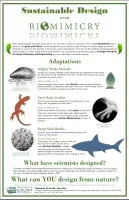
Sustainable Design with Biomimicry Poster
This poster explains what biomimicry is and introduces the idea of sustainable design. It provides examples of biomimicry and mentions an innovation developed in the Pacific Northwest that won a green chemistry award. A supplemental document also mentions some lessons and resources that could be taught in the classroom. It was developed by the Washington State Department of Ecology.
Sustainable Invention: An Exploration of Bioplastics - Module 1
*This is Module 1 of a 4 Module, multi-lesson unit. Sustainable Invention: An Exploration of Bioplastics is a unit that has been developed to introduce middle school students and educators to sustainable invention and green chemistry principles. The Sustainable Invention unit seeks to address the challenges of integrating invention education into middle school science curricula and advance STEM ...
Sustainable Invention: An Exploration of Bioplastics - Module 2
* This is Module 2 of a 4-Module, multi-lesson unit. Sustainable Invention: An Exploration of Bioplastics is a unit that has been developed to introduce middle school students and educators to sustainable invention and green chemistry principles. The Sustainable Invention unit seeks to address the challenges of integrating invention education into middle school science curricula and advance STEM ...
Sustainable Invention: An Exploration of Bioplastics - Module 3
*This is Module 3 of a 4 Module, multi-lesson unit. Sustainable Invention: An Exploration of Bioplastics is a unit that has been developed to introduce middle school students and educators to sustainable invention and green chemistry principles. The Sustainable Invention unit seeks to address the challenges of integrating invention education into middle school science curricula and advance STEM ...
Sustainable Invention: An Exploration of Bioplastics - Module 4
*This is Module 4 of a 4-Module, multi-lesson unit. Sustainable Invention: An Exploration of Bioplastics is a unit that has been developed to introduce middle school students and educators to sustainable invention and green chemistry principles. The Sustainable Invention unit seeks to address the challenges of integrating invention education into middle school science curricula and advance STEM ...
Sustainable Preparation of an Earth-abundant Metal Acetylacetonate Complex
This experiment highlights the synthesis of the Earth-abundant metal complex, Fe(acac)3 (acac = acetylacetonate), using an approach that is greener than traditional published syntheses. Students will also have an opportunity to determine the magnetic susceptibility of this complex and to learn about NMR spectroscopy.