Scalable manufacturing and reprocessing of vitrimerized flexible polyurethane foam (PUF) based on commercial soy polyols

Scalable manufacturing and reprocessing of vitrimerized flexible polyurethane foam (PUF) based on commercial soy polyols
Contributors

Habitable
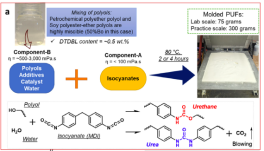
Synthesize and fabrication of soy-PUFs. Image from publication website-open access
Summary
This Learning Object introduces students to Green Chemistry principles through a case study on recyclable flexible polyurethane foams (PUFs) using renewable soy-based polyols. Based on “Scalable manufacturing and reprocessing of vitrimerized flexible polyurethane foam (PUF) based on commercial soy polyols” the study demonstrates how commercial soy polyols can partially replace petrochemical polyols to create recyclable, reprocessable PUFs via vitrimer chemistry.

Students will explore renewable feedstocks, catalysis, material property testing, and dynamic covalent networks for recycling. The resource emphasizes bio-based materials, waste reduction, and product circularity.

Authors & Citation
Authors: Wangcheng Liu, Yaqiong Zhang, Peter Chen, Lin Shao, Yiding Cao, Baoming Zhao, Ellen C. Lee, Xiaojiang Wang, and Jinwen Zhang*

Citation: Liu, W., et al. (2025). Industrial Chemistry & Materials. DOI: 10.1039/d4im00117f

Teaching Use
Ideal for teaching renewable materials, catalysis, polymer recycling, and Green Chemistry life cycle thinking.
Learning Goals/Student Objectives
After completing this activity, students will be able to:

-Explain how soy-based polyols can replace petrochemical polyols in polyurethane foam production.

-Describe the role of vitrimer chemistry and catalysts in enabling material reprocessing.

-Analyze the environmental benefits and trade-offs of using renewable feedstocks in polymer products.

-Compare mechanical and thermal properties of bio-based vs. conventional polyurethane foams.

-Evaluate how dynamic covalent bonds contribute to recyclability and material circularity.

-Apply Green Chemistry principles to assess sustainable materials and product life cycles.

-Discuss industrial challenges and opportunities for recycling polymeric materials using bio-based alternatives.
Object Type
Laboratory experiment
Case studies
Journal articles
Audience
Introductory Undergraduate
Upper/Advanced Undergraduate
Common pedagogies covered
Blended learning
Hands-on learning
Multimedia-based learning
Green Chemistry Principles
Waste Prevention
Less Hazardous Chemical Syntheses
Designing Safer Chemicals
Design for Energy Efficiency
Use of Renewable Feedstocks
Design for Degradation
Real-Time Pollution Prevention
U.N. Sustainable Development Goals (SDGs)
Zero Hunger
Industry, Innovation and Infrastructure
Sustainable Cities and Communities
Responsible Consumption and Production
Climate Action
Safety Precautions, Hazards, and Risk Assessment
1. Safety Precautions
To ensure safe handling of materials and equipment used in the synthesis and reprocessing of vitrimerized polyurethane foams (PUFs), the following precautions should be observed:

Personal Protective Equipment (PPE): Always wear lab coats, chemical-resistant gloves, and safety goggles. Respiratory protection is recommended when handling isocyanates or during hot-pressing operations.
Ventilation: Perform all mixing, curing, and solvent-handling steps in a well-ventilated fume hood or with local exhaust ventilation, especially when working with MDI (methylene diphenyl diisocyanate) and DBTDL (dibutyltin dilaurate).
Temperature Control: Closely monitor hot-pressing temperatures (∼160 °C) to prevent overheating and degradation of soy-based segments.
Catalyst Handling: DBTDL is toxic and should be handled with care. Avoid skin contact and inhalation; store in sealed containers and use in small quantities.
Waste Disposal: Dispose of polyurethane waste, catalyst residues, and solvents (e.g., MEK, toluene) in accordance with institutional hazardous waste protocols.

2. Hazards
Several chemical and physical hazards are associated with the materials and processes used:

Chemical Hazards:
MDI is a known respiratory sensitizer and skin/eye irritant.
DBTDL is toxic and potentially a reproductive hazard.
DEA (diethanolamine) is corrosive and can cause burns.
Solvents like MEK and toluene are flammable and harmful if inhaled.
Thermal Hazards:
Hot molds and presses pose burn risks.
Decomposition of soy-based segments may release volatile compounds at high temperatures.
Mechanical Hazards:
High-speed mixers (2500–3000 rpm) and compression molding equipment (up to 15 MPa) can cause physical injury if not operated properly.

3. Risk Assessment
Mixing of Polyols and Isocyanates: High risk due to reactive chemicals. Use full PPE and conduct in a fume hood.
Handling of DBTDL and DEA: High risk due to toxicity and corrosiveness. Use gloves, goggles, and avoid direct contact.
Hot-Pressing Operations: Medium risk. Use heat-resistant gloves and monitor temperature to avoid burns or degradation.
Solvent Extraction (MEK, Toluene): Medium to high risk. Use in a fume hood with proper waste handling.
Foam Shredding or Pulverizing: Medium risk. Use dust masks and eye protection to avoid inhalation or eye injury.
NGSS Standards, if applicable
This Learning Object supports high school and undergraduate learning aligned with NGSS Physical Science and Engineering Standards:

HS-PS1-3: Investigate chemical structures and properties to explain material behavior and recyclability.

HS-PS1-6: Design solutions for chemical systems, focusing on renewable feedstocks and reprocessing.

HS-ETS1-3: Evaluate sustainable solutions considering trade-offs in environmental impact and material performance.

Crosscutting Concepts:

Energy and Matter:
Examines flows and conservation during material reprocessing.

Structure and Function:
Links molecular structure to material recyclability and mechanical properties.

Science & Engineering Practices:
-Analyzing and interpreting data
-Developing and using models
-Designing solutions

Share This

Submitted by

Published on
Moderation state
Published