- "Students are given the opportunity to assess chemical products and processes and design greener alternatives when appropriate."
- "Students understand and can evaluate the environmental, social, and health impacts of a chemical product over the life cycle of the product, from synthesis to disposal."
At the highest level of the ACS guidelines, students are expected to have a deeper understanding of and critical thinking skills around developing and designing greener chemical products and processes. This can include the various environmental, social and health aspects of a chemical product, in particular as it pertains to life cycle analysis.
GCTLC Library
Below are resources from the GCTLC library that are tagged with any of the following Green Chemistry Principles:
- #3 (Less Hazardous Chemical Syntheses)
- #4 (Design Safer Chemicals)
- #5 (Safer Solvents and Auxiliaries)
OR have been tagged with keyword "Life Cycle Assessment".
The variety of resources below should provide educators with numerous options to help tailor their lectures and courses with more green and sustainable chemistry content. However, if you have additional suggestions for resources, you can always submit them for inclusion in the GCTLC library, or you can post them in the forum "Green Chemistry Resources for Addressing the ACS Guidelines" on the GCTLC.

Case study: Microplastics in cosmetics
This case study involves a young engineering student on an industrial placement year at a firm that manufactures cosmetics. The student has been working hard to impress the company as they are aware that this may lead to them being offered a job upon graduation. They are involved in a big project that focuses on alternative, more environmentally friendly cosmetic chemistries. When they notice a ...
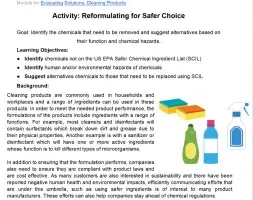
Reformulating for Safer Choice: Cleaning and Disinfecting Products
In this activity, you will evaluate a cleaning product formulation to see if it could qualify for the US EPA Safer Choice Fragrance-Free label, relate those ingredients that don’t qualify to specific health and environmental impacts, and suggest safer functional alternative chemicals using the EPA Safer Chemical Ingredient List to replace for those that need to be replaced. Both a slide deck and ...
"Greening Up" the Suzuki Reaction
An aqueous Suzuki reaction is described which highlights the facile preparation of a non-steroidal anti-inflammatory (NSAID) drug analog under green conditions. While palladium-catalyzed cross-coupling reactions are common in most modern organic chemistry labs, they are often performed with hazardous solvents and large amounts of corrosive additives. Undertaken at the mid-undergraduate level ...
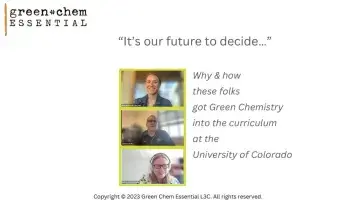
"It's Our Future to Decide" - How a Student & Two Professors Got Green Chemistry into the Curriculum at the Univ. of Colorado
In this episode of Green Chem Essential, with host James Rea: Learn how – and why — a motivated student and two professors at CU Boulder successfully worked to get green chemistry into the curriculum at their school.
Guests in this episode include; Brinn McDowell, Dr. Kathryn Ramirez Aguilar and Dr. Matthew E Wise
00 Soy Chemistry Curriculum Overview - Instructor Notes
This overview provides information about the student learning objectives, target audience, an overview of each module and its content and additional information instructors need for a successful implementation of the curriculum for classroom and laboratory use.
This resource was made possible with support from the United Soybean Board (USB).
Any opinions, findings, and/or interpretations of data ...
01 - History and Principles of Toxicology - (Toxicology for Chemists Curriculum - Module 1)
This module serves as a good first introduction to toxicology. In the first part of the module, students will learn and understand: the history of toxicology and its underlying principles; the progression of toxicology as a science; the development of regulatory agencies; key case studies that developed the field; and the paradox of uncertainty. In the second part of the module, students will ...
02 - Understanding Hazard and Risk (Toxicology for Chemists - Module 2)
This module is an introduction to understanding the principles of hazard and risk. The lectures are designed with a “choose your own adventure” format: you can take any slides and use them in any order to build your lecture! Using these materials, students will understand the basic concepts of hazard, exposure, and risk; be able to perform a simple chemical hazard assessment; be able to compare ...
03 - Toxicokinetics and Toxicodynamics (Toxicology for Chemists - Module 3)
This module is an introduction to toxicokinetics and toxicodynamics. The module is split into five lectures addressing: absorption, distribution, biotransformation, excretion, and toxicodynamics. Using these materials, students will be able to: explain and describe ADME; learn introductory biochemistry, chemistry, and anatomy to explain ADME; and explain and describe toxicodynamics. The lecture ...
04 - Reaction Mechanisms (Toxicology for Chemists - Module 4)
This module gives an overview of the main reaction mechanisms seen in toxicology studies. Students will learn primarily about the main electrophilic reactions that bind toxicants to proteins, in addition to a brief introduction to reactive oxygen species and radical reactions. This module pairs well with Module 11 – Structure-Activity Relationships, and these lecture slides are also included for ...
06 - Toxicity of Metals (Toxicology for Chemists - Module 6)
This module is a good introduction to metal toxicity. Students will learn about the toxicity of metals in the body, metal pollution, the difference between metals and metalloids, mechanisms of heavy metal toxicity, and factors that affect metal toxicity. These lecture slides are heavily case-study based and provide an applied outlook on the chemistry with reference to many global incidents and ...