Structure Determination in the Green Undergraduate Laboratory

Structure Determination in the Green Undergraduate Laboratory
Contributors
Professor | Rose-Hulman Institute of Technology
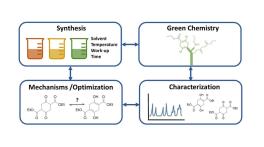
figure shows four cartoon boxes, the first shows beakers illustrating sustainable synthesis, the second shows green molecule representing green chemistry optimization, the third shows a hypothetical mechanism illustrating the importance of theory and practice, and the fourth shows a spectra illustrating the importance of characterization and instrumental analysis
Summary
This learning object focuses on the green and sustainable condensation reaction of diethyl succinate and can be scaffolded depending on needs and equipment. The unexpected product of this reaction works well for a challenging structure determination lab and the nature of the starting materials points to responsible sourcing and alignment with UNSDGs.

Co-author Hannah Snider contributed significantly to this project with the "This or That" handout as well as her student thesis work. Stephanie Poland contributed the Job Hazard Analysis linked workbook. Mark Brandt has contributed as a collaborator in the characterization of the tautomeric equilibrium. A special thanks to Rachel Shubella, who was the first undergraduate to work on this project.
Digital Object Identifier (DOI)
https://doi.org/10.59877/WXPS1330
Learning Goals/Student Objectives
This activity allows students to acquire problem-solving and critical-thinking skills by drawing upon experimental evidence and theoretical concepts.

This laboratory exercise connects students with hands-on training through instrumental analysis.

Due to the nature of the starting materials, this lab aligns with the UNSDG goal of responsible consumption and helps to educate global citizens for a sustainable world.
Object Type
Laboratory experiment
Audience
Upper/Advanced Undergraduate
Common pedagogies covered
Hands-on learning
Problem-based learning
Student-centered learning
Green Chemistry Principles
Designing Safer Chemicals
Safer Solvents and Auxiliaries
Design for Energy Efficiency
Use of Renewable Feedstocks
Design for Degradation
U.N. Sustainable Development Goals (SDGs)
Responsible Consumption and Production
Safety Precautions, Hazards, and Risk Assessment
Potassium tert-butoxide is a flammable solid that can react violently with water. Diethyl succinate is a flammable liquid. Both reagents can cause severe skin burns or eye damage. The ignition of the solventless synthesis mixture of potassium tert-butoxide and diethyl succinate paste may occur during mixing. It is important to ensure that all reactions take place in a properly ventilated environment and that students monitor the temperature of the reaction. If students hear a popping noise, see flames, or observe smoke the reaction should be placed immediately in an ice-water bath in a closed, ventilated hood. Students are required to wear goggles and protective gloves while performing the experiment.
Teacher Recommendations or Piloting Data (if available)
The materials provided can be used to support students through a simple reaction analysis by melting point or by full complimentary DEPT spectral analysis.

The references for sourcing information allow students to connect this reaction to the UNSDGs.

Share This

Submitted by

Reviewed by
Published on
Moderation state
Published
Time required (if applicable)
1-4 hours and up to overnight