Solve et Coagula: Exploring Alchemy and Sustainability with Gold

Solve et Coagula: Exploring Alchemy and Sustainability with Gold
Contributors
Assistant Professor | Fashion Institute of Technology
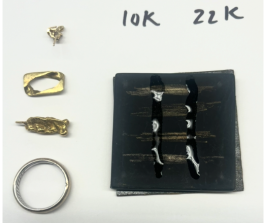
A photograph of four pieces of gold jewelry and a black slate which they have been drawn across. On top of the metal scratches are acids showing that some of the items are not gold, and some are atleast 10k gold.
Summary
The acid test has been used for centuries to determine whether metals are real gold or not. In this laboratory activity, students practice handling strong acids and testing alloys to determine whether they contain noble, coinage, and precious metals, such as gold, silver, and platinum. By exploring the gold in our jewelry and electronics, we can explore green chemistry principles and sustainable development goals related to safety, and responsible consumption and production.
Digital Object Identifier (DOI)
https://doi.org/10.59877/RKWT7742
Learning Goals/Student Objectives
Compare the predicted and observed outcomes of precipitation reactions

Use observations from chemical reactions to identify metals in jewelry

Safety handle strong acids to identify metals

Object Type
Laboratory experiment
Audience
High School (Secondary School)
Introductory Undergraduate
Common pedagogies covered
Hands-on learning
Student-centered learning
Green Chemistry Principles
Safer Chemistry for Accident Prevention
U.N. Sustainable Development Goals (SDGs)
Responsible Consumption and Production
Safety Precautions, Hazards, and Risk Assessment
Aqua regia is a hazardous mixture of nitric and hydrochloric acids. It should be used as directed in the 'acid test kit' and neutralized before being disposed of. The laboratory manual explores and discusses the use of PPE. The following test is from the submitted resource:

Strong acids are highly corrosive and require careful handling to avoid injury and damage to lab equipment. Proper protective gear, including gloves, goggles, and a lab coat, should always be worn when working with strong acids. If a spill does occur, immediately spread sodium bicarbonate (baking soda) on the spill to neutralize the acid and clean it up with a paper towel. If strong acid does come into contact with the skin, it should be washed thoroughly with water. Overall, careful attention and adherence to proper handling procedures are essential for the safe handling of strong acids.
Teacher Recommendations or Piloting Data (if available)
Instructor notes are provided in the resource and summarized here:

This experiment can be performed with a single item of jewelry that contains gold (e.g. 14k ring or necklace) and other samples made of base metals (iron, copper, etc.).

It may also be reformatted to focus on silver versus sterling silver, which is easy to acquire at a flea market.

Before performing the acid test, students are shown the precipitation of potassium iodide and lead nitrate to foster a discussion of how lead might be turned into gold and introduce the philosopher’s stone.

Aqua regia is a mixture of strong acids and should be carefully handled. In the case where students do not yet have experience handling acids, they may handle the metals, and the instructors may add the acid to the slate.

Acid test kits are available online, and a single kit may be used with roughly 20 students at a time in small groups. Note that the acids can degrade over time, and a new kit or freshly prepared acid solutions should always be used for best results. Many of these kits contain not only different acid concentrations for different caratages of gold, but also acids for testing silver and platinum.

Always begin by using the lowest concentration of acid (e.g. 10k solution) and then increase the concentration and work up to higher percentages of gold (e.g. 22k).

Note that most commercial samples of jewelry are not above 18k, so a quick test is to perform the 10k and 22k, to first determine if it is gold, and then if it is a high percentage or not.

Neutralize the acids on the black slate by sprinkling baking soda until the mixture no longer reacts. The resultant water and salt may be safely rinsed down the drain.

As the metal is drawn onto the black slate by scratching it, students are invited to test jewelry of their own, but must note that it will scuff and may damage the item.

Be careful when performing this experiment on items of jewelry that may have sentimental value. Participants may be sad to know their jewelry is not real (or as real) as they previously thought.

Share This

Submitted by

Reviewed by
Published on
Moderation state
Published
Time required (if applicable)
1 hour