Upper/Advanced Undergraduate or Graduate Students

Greener Air Monitoring by Thermal Desorption (April 10)
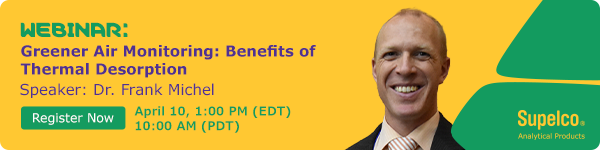
webinar banner image with title and time as well as speaker headshot with yellow and green background
Event Date
-
Event Type
Hosting Organization(s)
Merck Life Science Srl

Event Description

This webinar will take place at 1pm Eastern Time (7pm Central European Time). The same webinar is also being presented on April 9th at 10am Central European Time (see separate event listing here).

Air Monitoring is a very important analytical field in environmental analysis and industrial hygiene. It is a discipline whose sole aim is to ensure the air we breathe is safe and free from hazardous VOCs (Volatile Organic Compounds). VOCs can be emitted from products of daily use or emitted during the manufacturing of polymers, adhesives, paints, petroleum products or pharmaceuticals.

To monitor such compounds in the air, these are trapped in collection devices such as tubes or badges with adsorbents. For analysis, the trapped compounds need to be desorbed from the adsorbents. This could be achieved using a solvent (solvent desorption) or by heat (thermal desorption).

This webinar discusses the details of thermal desorption, its benefits and limitations compared to solvent desorption. In particular, it demonstrates why thermal desorption is the much greener approach for air monitoring using different application examples and metrics based on the 12 Principles of Green Analytical Chemistry for the greenness of analytical methods.

In this webinar, you will learn:

  • Theory and background of Thermal Desorption in Air Monitoring
  • 12 Principles of Green Analytical Chemistry
  • Approaches to assess the greenness of analytical methods
  • Sustainability advantages of Thermal Desorption


Speaker:

Frank Michel, Scientific Education & Sustainability, Merck KGaA, Darmstadt, Germany

Frank Michel received his diploma and PhD in Analytical Chemistry at University of Muenster/Germany. At Bernina Biosystems, a biopharmaceutical company, he developed and validated analytical HPLC and other methods for Active Pharmaceutical Ingredients (APIs), including excipients and drug products. Later Frank changed to Sigma-Aldrich and had various roles in Product Development, Marketing and Customer Education in Analytical Chemistry. After an engagement at HWI Analytik, an analytical service provider for the pharmaceutical industry, he returned in 2010 to Sigma-Aldrich (since Nov. 2015 part of Merck KGaA, Darmstadt, Germany) as Scientific Advisor for Analytical Chemistry. During his career, Frank focused already on Green Analytical Chemistry, e.g. by miniaturization in HPLC for solvent savings and the solvent-free extraction technology SPME. Since 2022 he is responsible for sustainability and training in Chemistry.

Frank is a member of both the Sustainable Chemistry and the Separation Science working group in the German Chemist Society (GDCh), member of the IUPAC project team “Greenness of official standard sample preparation methods” and in the EuChemS-DAC Sample Preparation Study Group and Network.

Green Chemistry as the Foundation of Sustainability and the Circular Economy

Green Chemistry Webinar with John Warner on 04/03/2025
Event Date
-
Event Type
Hosting Organization(s)
Merck Life Science Srl

Event Description

While there is a lot of discussion about WHY we need sustainability (Climate Change, Forever Chemicals, Human Toxicity, Ecosystem Degradation…) and WHAT we should do to measure and characterize sustainability (LCA’s, UN SDGs, Circular Economy, Safe and Sustainable by Design, Planetary Boundaries…) It is especially important to discuss HOW we should make these changes. This is the domain of Green Chemistry.

When a researcher contemplates a new experiment, when an inventor imagines a new product, he or she makes several small and large decisions that will have profound impact on the ultimate sustainability of what they do. If they do not have the skills and tools to understand the sustainability implications at the mechanistic molecular level (green chemistry), it is unlikely that they will successfully achieve sustainability objectives. This presentation will discuss how green chemistry can be integrated into the earliest stages of research and development to ensure maximum sustainability. Real world, commercialized examples will be used to illustrate key points.

In this webinar, you will learn:

  • The Why’s and the What’s of sustainability are important, but solutions come from How (green chemistry).
  • It is not enough to simply WANT to create sustainable technologies, there are certain critical skills required, as defined by the 12 principles of green chemistry.
  • Not only does green chemistry have moral and ethical implications, but it is also a pathway to accelerate R&D and lower costs. (If you truly understand green chemistry).
  • Several commercialize products illustrate the reality of green chemistry’s successful implementation in the real world.


Speaker:

John C. Warner

CEO & CTO, Technology Greenhouse, LLC


John Warner is one of the founders of the field of green chemistry. He wrote the book that provides the definition and 12 principles of green chemistry with Paul Anastas in 1998.He received his B.Sc. from UMASS Boston and his PhD from Princeton University.As an industrial chemist, he has over 350 patents and has worked with hundreds of companies worldwide and serves on the sustainability advisory boards of several multinational companies. He received the Perkin Medal in 2014 from The Society of Industrial Chemistry.As an educator, he was a tenured full professor of chemistry and a tenured full professor of plastics engineering at the University of Massachusetts where he started the world’s first PhD program in Green Chemistry. He has over 120 publications in synthetic methodologies, noncovalent derivatization, polymer photochemistry and metal oxide semiconductors. In 2004 he received the Presidential Award for excellence in science mentoring (PAESMEM) from the US National Science Foundation (NSF) and President George W Bush and in 2022 he received the August Wilhelm von Hofmann Medal from the German Chemical Society. In 2007 he cofounded Beyond Benign, a nonprofit green chemistry education organization with Dr. Amy Cannon.As an entrepreneur, John’s inventions have led to the founding of many companies in the fields of photovoltaics, neurochemistry, construction materials, water harvesting and cosmetics. In 2016 he received the Lemelson Invention Ambassadorship from the Lemelson Foundation and the American Association for the Advancement of the Sciences (AAAS).

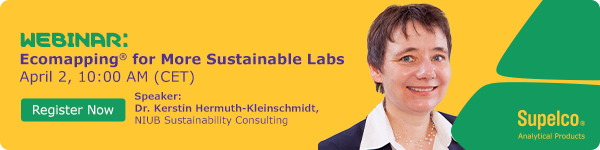
Ecomapping® – A Practical Approach to Implement Sustainability in Your Lab

Ecomapping webinar on 04/02/2025
Event Date
-
Event Type
Hosting Organization(s)
Merck Life Science Srl

Event Description

Laboratory work is resource intensive. Large equipment such as -80°C freezers use on average as much energy as a single-family home, plastic consumables are necessary but leave a huge amount of waste, and water consumption is also immense. So, the question is what to do? After all, samples have to be stored safely, experiments cannot be easily changed, and desirable measures are often simply not possible for safety reasons. Checklists and green lab guides can help and are a good starting point. However, every laboratory is different and has its own questions, hurdles and problems. A suggestion that is easy to implement for one lab may be difficult or even impossible for a neighboring group.

This is where Ecomapping® comes in. With its help, laboratories create an individual action plan. The core of the method is to focus on the environmental impacts of laboratory work, such as waste, water and energy consumption, emissions, chemicals and consumables, but safety aspects are also taken into account. This presentation explains the key features of the methodology and uses practical examples to give an insight into the improvements that laboratories can achieve using it.

After attending the webinar you can expect to:

  • Understand the concept of Ecomapping® and how it can be tailored to address the unique sustainability challenges in different laboratory environments.
  • Learn about the significant environmental impacts of laboratory operations, including energy consumption, waste generation, and water usage, and how to assess these factors effectively.
  • Discover practical strategies and actionable steps for implementing sustainability measures in your laboratory.
  • Learn about the successful application of the Ecomapping® method through best practice examples.


This webinar will be recorded and will be available on demand later, if the time doesn't fit to your time zone!


Speaker:


Dr. Kerstin Hermuth-Kleinschmidt

NIUB Sustainability Consulting


Kerstin Hermuth-Kleinschmidt graduated in chemistry and holds a PhD in microbiology from the university of Freiburg, Germany. She worked for several years in sales and technical customer service in the life science industry, before she turned her attention to the topic of sustainability. As an independent consultant, speaker and author of publications on various aspects of sustainability, her focus is now on the implementation and monitoring of sustainability processes and the practical implementation of sustainability in scientific work and research. She offers workshops and lectures on specific aspects of sustainability in laboratory and research work and the context of life sciences companies as well as individual support. In her daily work with labs, she uses the Ecomapping® method that helps labs to develop their individual action plan to make lab work more sustainable.

Since 2017, she has also been teaching as part of the “Studium Generale. Forum Wissenschaft und Gesellschaft” (FORUM) at KIT Karlsruhe as part of the Sustainable Development degree programme to pass on her knowledge to the younger generation.

Canadian Chemistry Conference and Exhibition (CSC 2025)

decorative image
Event Date
-
Event Type

Event Description

Canadian Chemistry Conference and Exhibition is the premier conference for the Canadian Society for Chemistry. The mission of the chemistry conference is to be your forum; a venue where you can embrace learning, exchange knowledge, build innovative ideas, advance your career, and advance the chemistry profession.


Taking part in the Canadian Chemistry Conference and Exhibition is an opportunity to grow, learn, connect, and celebrate all that Canadian chemistry has to offer.

This is the first year of the inaugural Green Division and there will be tons of green chemistry-related symposia and workshops throughout the conference!! Several will be led by Beyond Benign team members! Read more about them here

--

Beyond Benign Talks

Green and Sustainable Practices in Chemistry Education (CE/GC)

Barb Morra, University of Toronto; Jonathon Moir, Beyond Benign; Nimrat Obhi, Beyond Benign; Andrew Dicks, University of Toronto; Olivia Mann-Delany, University of Toronto

--

Chemistry education plays a critical role in training the next generation of chemists and engineers to consider the holistic impact of their work and actively explore ways to use more sustainable practices. This session aims to explore how educators can integrate green and sustainable chemistry practices into their classrooms, teaching laboratories, and programs. The session will be split into two parts: oral presentations followed up a workshop.


Part 1 (what are others doing with green chemistry in education?): This component will bring together instructors, teaching assistants, technical staff, and other educational stakeholders and provide them with a platform to showcase the creative ways they incorporate green and sustainable practices into their departments and curricula. Participants are encouraged to provide their unique perspective into the development, implementation, and learning outcomes of their pedagogical work, while considering how their efforts could be adopted by other instructors, particularly those with limited resources or experience with green and sustainable practices.


Part 2 (how can I add more green chemistry to my teaching?): The second part of the session will involve a workshop that provides an opportunity for educators to learn how to further adapt and implement more green and sustainable concepts into their own classrooms and laboratory using a guided inquiry approach. Workshop participants will work in small groups with facilitators to explore simple and effective approaches to updating their existing course/laboratory content and establish action plans toward implementation.


Bringing Green Chemistry into Your Lab – A Workshop for Graduate Students and Postdoctoral Fellows (GC)

Tuesday, June 17th from 8:00-11:40am in room 203 at the Rogers Center Ottawa

Jonathon Moir, Beyond Benign; Juliana Vidal, Beyond Benign; Nimrat Obhi, Beyond Benign; Barb Morra, University of Toronto; David Laviska, ACS GCI; Galen Yang, McGill University; Shauna Schechtel, Queen’s University

--

Research laboratories are some of the most energy and resource intensive spaces on university and college campuses. They generate large amounts of both hazardous and non-hazardous waste (including solvents, reagents, solids, glassware, filter paper, drying agents, disposable gloves, and column waste) daily. However, this is often considered a necessary evil and an acceptable price to pay to make innovative discoveries for the betterment of humanity. Fortunately, this does not need to be the case; research in higher education can be done in a way that allows for discovery and innovation to take place without generating large amounts of waste and subjecting students, postdoctoral fellows and researchers to hazardous compounds and laboratory conditions. Importantly, there are many safer alternative reagents, solvents, and laboratory materials that can be used to reduce risk of exposure. This approach, known as green chemistry, utilizes a set of twelve practical principles for research and bench chemists to help reduce the use and generation of hazardous substances for humans and the environment.


This workshop introduces green chemistry and how its associated twelve principles can be applied at the graduate and postdoctoral level in research laboratories across universities and colleges in Canada. The workshop will explore examples of how green chemistry has been successfully introduced into research labs in different subdisciplines of chemistry and will provide an opportunity for participants to work in small groups through guided discussions to identify ways of improving their own laboratory practices and research to shift towards greener and more sustainable practices.


Register Here.


Green Chemistry Commitment Info Session

A decorative image
Event Date
-
Hosting Organization(s)
Beyond Benign, Inc.

Event Description

Image
A button that says register now


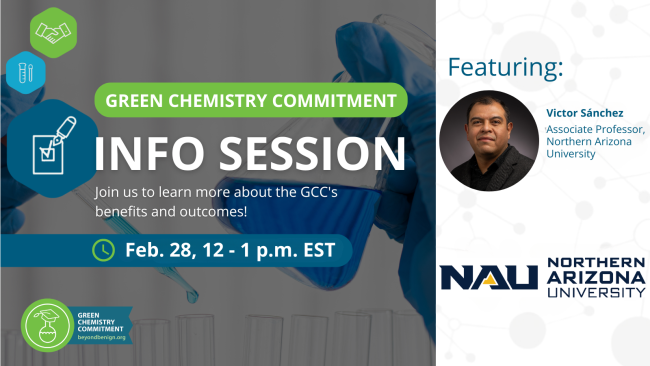
Higher education faculty, students, and staff—shape the future of chemistry education and innovation with us! Learn how the Green Chemistry Commitment (GCC) program can help integrate green chemistry at your institution during this info session from 12-1 p.m. EST. We’ll be joined by Victor Sánchez, Associate Professor at Northern Arizona University, who will share how the GCC supports Northern Arizona University’s green chemistry goals. RSVP today and spread the word!


About Victor:

Website: https://sites.google.com/view/ramossanchezlabatnau/


Prof. Ramos Sánchez joined the Northern Arizona University in 2023 and is currently an Associate Professor in the Department of Chemistry and Biochemistry before he was appointed Tenured Professor in the Faculty of Chemical Sciences (Facultad de Ciencias Químicas in Spanish) at the Autonomous University of Chihuahua (Universidad Autónoma de Chihuahua in Spanish) from 2011 to 2022. During his sabbatical, he was appointed a Visiting Professor at the University of California, San Diego, in 2019. Previously, he was a Lecturer at the Polytechnic University of Chiapas (Universidad Politécnica de Chiapas in Spanish) from 2009 to 2011. Prof. Ramos Sánchez holds a Ph.D. in Chemistry from the University of Sheffield in the United Kingdom and a bachelor’s degree in industrial chemistry from the Autonomous University of Chihuahua. His main area of research focuses on the design and implementation of sustainable materials and processes for hydrogen production and fuel cells, which has led him to accumulate extensive expertise in the development of green routes of synthesis and analysis. Additionally, he collaborates enthusiastically with other fellow researchers in exciting areas such as food technology and environmental science, offering strategies of instrumental analysis for different scientific challenges.


Prof. Ramos Sánchez has received research grants from the U.S. Department of Energy, the Mexican Council of Science and Technology, and the Ministry of Higher Education and contracts from local industrial partners (plastics, aerospace, and agroindustry). His publications have appeared in prestigious journals such as the Journal of Chemical Education, Chemical Engineering Journal, Journal of Material Chemistry A, ACS Environmental Science & Technology, ACS Sustainable Chemistry & Engineering, International Journal of Hydrogen Energy, Catalysis Today, and Carbon, among others. As a result of his research, Professor Ramos Sánchez was granted one patent in Mexico.


Prof. Ramos Sanchez has contributed to the development of human resources both as a research advisor/mentor and as an instructor, teaching courses in instrumental analysis, physical chemistry, general chemistry and sustainable chemistry. He has served as an academic advisor in the elaboration and evaluation of the Mexican Standardized National Assessment of BSc in Chemistry (EGEL-Q/CENEVAL, A.C.)


Image
A button that says register now


17th Green Chemistry Postgraduate Summer School (GCSS 2025)

17th Green Chemistry Postgraduate Summer School (GCSS 2025)
Event Date
-
Event Type
Lead Organizers
Hosting Organization(s)
Green Sciences for Sustainable Development Foundation

Event Description

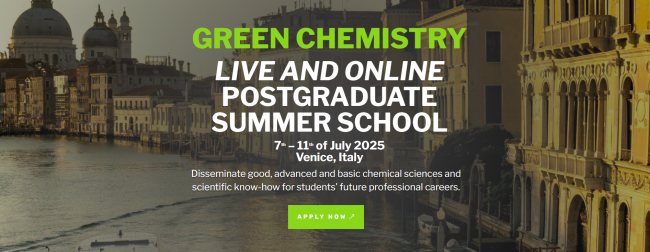
The 17th Green Chemistry Postgraduate Summer School (GCSS 2025) continues its tradition of fostering international collaboration and advancing Green Chemistry education. Building on past successes, this prestigious event will bring together leading scientists, industry experts, and top postgraduate students to explore key topics, including:

Benign synthesis routes & green catalysis
Alternative solvents & renewable materials
Sustainable polymers & clean processes
Green chemistry for energy & education

With support from sponsors, scholarships will be awarded to outstanding students from developing countries, covering both virtual and on-site participation. Participants will also have the opportunity to present their research in poster sessions, with awards for the best contributions.

Beyond learning, GCSS 2025 provides a platform for networking, knowledge exchange, and global research collaboration. The event will take place both in-person in Venice and online.

🌱 Don’t miss this opportunity to be part of the future of Green Chemistry!


Deadline for applications is April 30th, 2025.

10 Years of The GCI Symposium: Thinking Green(er) in Daily Life

GCI Symposium Banner
Event Date
-
Hosting Organization(s)
Green Chemistry Initiative - University of Toronto
Green Chemistry McGill
Queen's University ACS Student Chapter

Event Description

We at the GCI are proud to announce our 10th annual GCI Symposium, organized in partnership with Green Chemistry McGill and Queen's University (Q-ACS)!


As a result of this great milestone, this symposium, titled 10 Years of The GCI Symposium: Thinking Green(er) in Daily Life, will celebrate all that we have been able to achieve in green chemistry, while thinking about how to broaden the scope of green chemistry to outside of the lab: in career, education, and society. This symposium is designed to connect students, post-doctoral fellows and faculty members interested in Green Chemistry with current leaders in the field to discuss advances in chemical processes and the future of sustainable research practices.


This symposium is a two and a half-day event, from May 7th - 9th, 2025. All events will be held at the University of Toronto – St. George Campus.


Important Dates

December 6th, 2024 - Registration opens
April 4th, 2025 - Early bird registration closes at 11:59 pm EDT
April 25th, 2025 - Regular registration closes at 11:59 pm EDT
April 16th, 2025 - Poster abstract submission closes at 11:59 pm EDT


Poster Abstract Submission & Travel Scholarship Application

We encourage all our attendees to submit a poster abstract for our poster networking session, taking place in the evening of Thursday, May 8th. Abstracts are limited to 200 words. Please note that posters do not require the inclusion/mention of Green Chemistry elements or aspects. However, all presenters are invited to look for opportunities to talk about Green Chemistry within the context of their research. Posters from previous conferences are welcome! Please make sure to submit your abstracts early, as they will be evaluated on a first-come-first-serve basis.


Additionally, we will be providing travel scholarships to alleviate some costs. The amount awarded is on a need-basis. Applications for the travel scholarship can be found on the second page of the poster abstract submission form.

Event Format
Event Address

80 St. George Street
Lash Miller Chemical Labs
Toronto ON M5S3H6
Canada

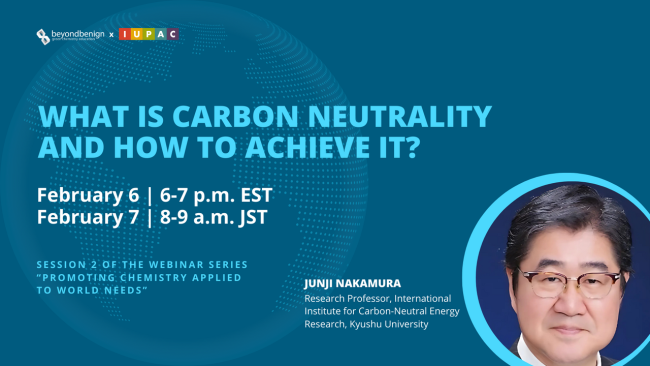
What is Carbon Neutrality, and How to Achieve It?

Decorative Image
Event Date
-
Event Type
Lead Organizers
Hosting Organization(s)
International Union of Pure and Applied Chemistry
Beyond Benign, Inc.

Event Description

Reducing total CO₂ emissions to zero is called #CarbonNeutrality. To achieve this, industrial and energy reforms must be undertaken within the next decade. However, the specific measures are not generally known…


Join us for a special webinar with Junji Nakamura, a Research Professor at the International Institute for Carbon-Neutral Energy Research, Kyushu University, to explore what the path to carbon neutrality looks like.

🗓️ When: February 6th from 6-7 p.m. EST / February 7th from 8-9 a.m. JST.


🧪 Register: This is the second installment of the webinar series, “Promoting Chemistry Applied to World Needs” presented by Beyond Benign and IUPAC CHEMRAWN. If you haven’t already registered for this free series, RSVP here! 


Promoting Chemistry Applied to World Needs

decorate image
Event Date
-
Event Type
Hosting Organization(s)
International Union of Pure and Applied Chemistry
Beyond Benign, Inc.

Event Description

Are you an aspiring chemist, a passionate climate advocate, or an interested member of the public? Do you want to change the world through science? Join the IUPAC CHEMRAWN and Beyond Benign throughout 2025 to learn from experts in the field who are leading the charge to solve existential, world needs through chemistry. Speakers will orient their presentations around the United Nations Sustainable Development Goals (UN SDGs), as well as the IUPAC Top 10 Emerging Technologies, to demonstrate the power that chemists hold in shaping, and preserving, the future. 

Each talk will be accompanied by  2-3 minute videos on the topic, for chemistry students in high school, university, and for the general public.


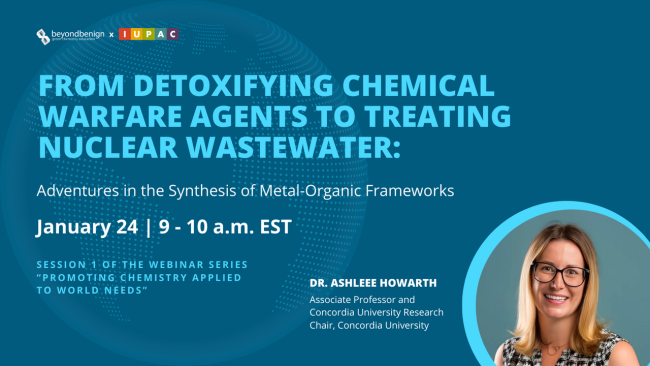
January Webinar 


“From Detoxifying Chemical Warfare Agents to Treating Nuclear Wastewater: Adventures in the Synthesis of Metal–Organic Frameworks” 

Ashlee Howarth, Concordia University

01/24/2025 | 9:00 – 10:00 AM EST


Webinar Description:

Named by IUPAC as one of the “Top 10 Emerging Technologies in Chemistry” in 2019, what can metal-organic frameworks (MOFs) really do? IUPAC CHEMRAWN Committee and Beyond Benign invite you to learn more about MOFs and join the discussion with Prof. Ashlee Howarth from Concordia University! Prof. Howarth is dedicated to using green chemistry principles and practices to design and synthesize rare-earth cluster-based MOFs which can then be applied to clean up wastewater from coal and nuclear power plants, as well as decontaminate military equipment. Other applications investigated by Ashlee also include catalysis, drug delivery, X-ray detection, and chemical sensing applications to solve our current environmental challenges. 


More About Professor Ashlee Howarth:

Ashlee J. Howarth is an Associate Professor and Concordia University Research Chair at Concordia University in Montréal. She was born and raised in London, Ontario. She obtained her undergraduate degree from the University of Western Ontario in 2009, and then went on to do her PhD in inorganic materials chemistry at the University of British Columbia under the supervision of Michael O. Wolf. Before joining the faculty at Concordia, she completed an NSERC Postdoctoral Fellowship at Northwestern University with Joseph T. Hupp and Omar K. Farha. At Concordia, the Howarth group is focused on the design and synthesis of rare-earth cluster-based metal–organic frameworks targeting applications in pollution remediation, catalysis, drug delivery, X-ray detection, and chemical sensing. Ashlee is also the contact point for the Green Chemistry Commitment at Concordia University.


ACS GCI Green & Sustainable Chemistry Summer School

ACS GCI Green & Sustainable Chemistry Summer School
Event Date
-
Lead Organizers
Hosting Organization(s)
American Chemical Society Green Chemistry Institute (ACS GCI)

Event Description

The ACS Green and Sustainable Chemistry Summer School (GSCSS) is a highly selective week-long program for graduate students and postdoctoral chemists and engineers. Each year, approximately 60 exceptional students from North, Central, and South America and the Caribbean are selected from a large pool of applicants and gather for this fully funded once-in-a-lifetime opportunity. The American Chemical Society pays for all eligible travel and program costs.


Organized and hosted by the Green Chemistry Institute since 2003, the summer school typically features more than a dozen expert instructors who share knowledge and skills from across a broad spectrum of topics directly relevant to green chemistry and sustainability. Throughout the program, students attend lectures and interactive study/project sessions, present posters about their own research, hold discussions, and spend time networking both with each other and the GSCSS faculty. Alumni of this program have gone on to become leaders in many green chemistry and sustainability-related fields and provide participants with an extensive network of professional contacts.  

Event Format
Event Address

University of Vermont
Burlington, VT 05405
United States

Keyword Tags