
Green Analytical Chemistry

Masters by Research (MPhil) for the Greening of Regulated Analytical Chemistry Methods (GRAMS) project

The GRAMS project addresses the need to implement green and sustainable laboratory practices for regulatory testing laboratories aligned with the European Union's Green Deal and Chemicals Strategy for Sustainability. Scientific laboratories are resource intensive spaces which use significantly more energy and water than office spaces and, collectively, millions of tonnes of plastic waste each year.

Post-Doctoral Research Fellow

The postdoctoral position for ‘The Greening of Regulated Analytical chemistry Methods’ (GRAMS) project using the existing regulated State Laboratory is funded by the Environmental Protection Agency (EPA). The successful candidate will join a team from TU Dublin and the State Laboratory focusing on greening regulated analytical test methods in the State Laboratory facilities in Backweston, Celbridge Co Kildare. The ideal candidate will be an analytical chemist with expertise in green chemistry, mass spectrometry and method validation.

Green Chemistry Scientist II

The New York State Pollution Prevention Institute (NYSP2I) is seeking a sustainability driven and research-oriented Green Chemist to support our Green Chemistry and Emerging Contaminants Program. This role is ideal for a chemist or environmental scientist with a strong foundation in green chemistry, environmental health and toxicology, and analytical techniques, who is passionate about applying science to sustainability challenges across New York State industries.

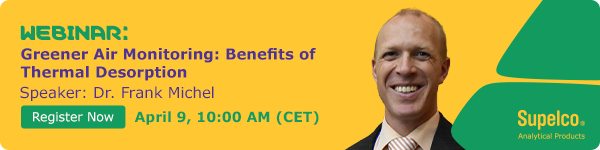
Greener Air Monitoring by Thermal Desorption (April 9)

webinar banner image with title and time as well as speaker headshot with yellow and green background
Event Date
-
Event Type
Hosting Organization(s)
Merck Life Science Srl

Event Description

This webinar will take place at 10am Central European Time (4am Eastern Time). The same webinar is also being presented on April 10th at 1pm Eastern Time (see separate event listing here).

Air Monitoring is a very important analytical field in environmental analysis and industrial hygiene. It is a discipline whose sole aim is to ensure the air we breathe is safe and free from hazardous VOCs (Volatile Organic Compounds). VOCs can be emitted from products of daily use or emitted during the manufacturing of polymers, adhesives, paints, petroleum products or pharmaceuticals.

To monitor such compounds in the air, these are trapped in collection devices such as tubes or badges with adsorbents. For analysis, the trapped compounds need to be desorbed from the adsorbents. This could be achieved using a solvent (solvent desorption) or by heat (thermal desorption).

This webinar discusses the details of thermal desorption, its benefits and limitations compared to solvent desorption. In particular, it demonstrates why thermal desorption is the much greener approach for air monitoring using different application examples and metrics based on the 12 Principles of Green Analytical Chemistry for the greenness of analytical methods.

In this webinar, you will learn:

  • Theory and background of Thermal Desorption in Air Monitoring
  • 12 Principles of Green Analytical Chemistry
  • Approaches to assess the greenness of analytical methods
  • Sustainability advantages of Thermal Desorption


Speaker:

Frank Michel, Ph.D. Technical Marketing, Scientific Education & Sustainability, Merck KGaA, Darmstadt, Germany


Frank Michel received his diploma and PhD in Analytical Chemistry at University of Muenster/Germany. At Bernina Biosystems, a biopharmaceutical company, he developed and validated analytical HPLC and other methods for Active Pharmaceutical Ingredients (APIs), including excipients and drug products. Later Frank changed to Sigma-Aldrich and had various roles in Product Development, Marketing and Customer Education in Analytical Chemistry. After an engagement at HWI Analytik, an analytical service provider for the pharmaceutical industry, he returned in 2010 to Sigma-Aldrich (since Nov. 2015 part of Merck KGaA, Darmstadt, Germany) as Scientific Advisor for Analytical Chemistry. During his career, Frank focused already on Green Analytical Chemistry, e.g. by miniaturization in HPLC for solvent savings and the solvent-free extraction technology SPME. Since 2022 he is responsible for sustainability and training in Chemistry.

Frank is a member of both the Sustainable Chemistry and the Separation Science working group in the German Chemist Society (GDCh), member of the IUPAC project team “Greenness of official standard sample preparation methods” and in the EuChemS-DAC Sample Preparation Study Group and Network.
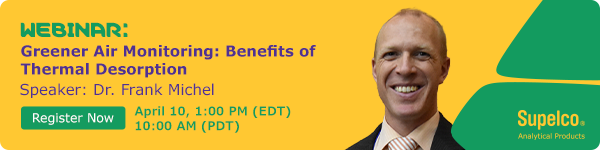
Greener Air Monitoring by Thermal Desorption (April 10)

webinar banner image with title and time as well as speaker headshot with yellow and green background
Event Date
-
Event Type
Hosting Organization(s)
Merck Life Science Srl

Event Description

This webinar will take place at 1pm Eastern Time (7pm Central European Time). The same webinar is also being presented on April 9th at 10am Central European Time (see separate event listing here).

Air Monitoring is a very important analytical field in environmental analysis and industrial hygiene. It is a discipline whose sole aim is to ensure the air we breathe is safe and free from hazardous VOCs (Volatile Organic Compounds). VOCs can be emitted from products of daily use or emitted during the manufacturing of polymers, adhesives, paints, petroleum products or pharmaceuticals.

To monitor such compounds in the air, these are trapped in collection devices such as tubes or badges with adsorbents. For analysis, the trapped compounds need to be desorbed from the adsorbents. This could be achieved using a solvent (solvent desorption) or by heat (thermal desorption).

This webinar discusses the details of thermal desorption, its benefits and limitations compared to solvent desorption. In particular, it demonstrates why thermal desorption is the much greener approach for air monitoring using different application examples and metrics based on the 12 Principles of Green Analytical Chemistry for the greenness of analytical methods.

In this webinar, you will learn:

  • Theory and background of Thermal Desorption in Air Monitoring
  • 12 Principles of Green Analytical Chemistry
  • Approaches to assess the greenness of analytical methods
  • Sustainability advantages of Thermal Desorption


Speaker:

Frank Michel, Scientific Education & Sustainability, Merck KGaA, Darmstadt, Germany

Frank Michel received his diploma and PhD in Analytical Chemistry at University of Muenster/Germany. At Bernina Biosystems, a biopharmaceutical company, he developed and validated analytical HPLC and other methods for Active Pharmaceutical Ingredients (APIs), including excipients and drug products. Later Frank changed to Sigma-Aldrich and had various roles in Product Development, Marketing and Customer Education in Analytical Chemistry. After an engagement at HWI Analytik, an analytical service provider for the pharmaceutical industry, he returned in 2010 to Sigma-Aldrich (since Nov. 2015 part of Merck KGaA, Darmstadt, Germany) as Scientific Advisor for Analytical Chemistry. During his career, Frank focused already on Green Analytical Chemistry, e.g. by miniaturization in HPLC for solvent savings and the solvent-free extraction technology SPME. Since 2022 he is responsible for sustainability and training in Chemistry.

Frank is a member of both the Sustainable Chemistry and the Separation Science working group in the German Chemist Society (GDCh), member of the IUPAC project team “Greenness of official standard sample preparation methods” and in the EuChemS-DAC Sample Preparation Study Group and Network.

SENIOR ANALYTICAL CHEMIST

🌿 JOB OPPORTUNITY: Analytical Chemist - Green Chemistry Startup 🌿

Are you passionate about revolutionizing pharmaceutical production and contributing to a sustainable future? Join our dynamic team at DUDE CHEM, a pioneering startup dedicated to bringing pharmaceutical manufacturing back to Europe and the USA through innovative, eco-friendly processes.