Webinar

GCTLC Info Session: How to Search the Library of Curriculum Resources

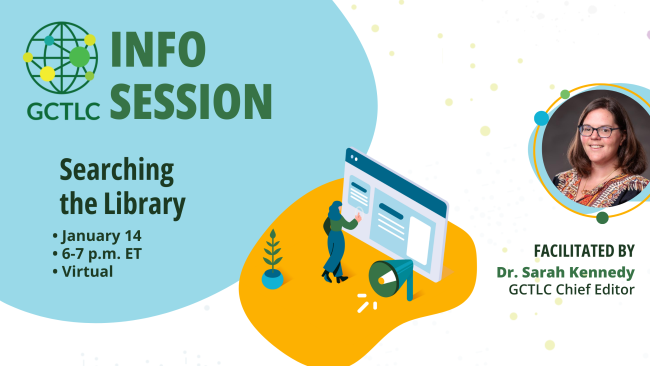
Graphic for a GCTLC Info Session titled “Searching the Library,” held January 14th (virtual, 6–7 p.m. ET), facilitated by Dr. Sarah Kennedy, GCTLC Chief Editor, with an illustration of a person using a large computer screen.
Event Date
-
Event Type
Hosting Organization(s)
Beyond Benign, Inc.

Event Description

Are you interested in incorporating green chemistry and sustainability into your classroom or lab? Do you want to excite your students about science but need some inspiration? With over 400 resources available, including open-access materials and linked journal articles, there’s something for everyone on the Green Chemistry Teaching and Learning Community (GCTLC).


Join Dr. Sarah Kennedy, Chief Editor of the GCTLC, on January 14th from 6-7 p.m. EST for a free info session to learn how to easily search and find relevant content on the GCTLC platform. This interactive session will cover how to search using common filters and topics, such as grade level, NGSS standards, activity type, keywords, and more. 


This session is free to join and open to all community members. Join us to deepen your engagement in this community and discover exciting new resources you can use in your classroom or lab! 

🔗 Zoom details: 

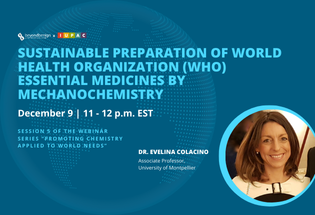
Sustainable Preparation of World Health Organization (WHO) Essential Medicines by Mechanochemistry

Graphic for the webinar, Sustainable Preparation of World Health Organization (WHO) Essential Medicines by Mechanochemistry
Event Date
-
Event Type
Hosting Organization(s)
Beyond Benign
Additional Host Organizations
IUPAC CHEMRAWN

Event Description

Although significant efforts have been made to reduce the environmental impact of active pharmaceutical ingredient (API) production, the use of organic solvents—responsible for about 75% of the total energy consumption—remains a critical step in many processes. Solvent-free synthesis through mechanochemistry aligns with several of the 12 Principles of Green Chemistry, offering a more environmentally responsible alternative for chemical synthesis. 


Join us for a free webinar on December 9th from 11 a.m. to 12 p.m. EST to hear from Dr. Evelina Colacino, Associate Professor at the University of Montpellier, who will discuss the application of mechanochemical methods to the preparation of World Health Organization essential medicines at various scales. Using green chemistry metrics, we evaluate the environmental and economic benefits of mechanochemistry, demonstrating its potential to advance greener and more sustainable pharmaceutical manufacturing. 


🌎 This webinar is part of the “Promoting Chemistry Applied to World Needs” series, hosted by Beyond Benign and the IUPAC Committee on Chemical Research Applied to World Needs (CHEMRAWN). If you haven’t yet registered for this series, sign up here

Event Format
Event Address

United States

Intended Audience

CAS Insights Webinar: Key Trends in Green Chemistry

Webinar. Key Trends in Green Chemistry. Thursday, November 20. CAS logo.
Event Date
-
Event Type
Additional Host Organizations
CAS

Event Description

From agriculture to pharmaceuticals to consumer electronics, chemistry makes modern life possible. However, resources are finite, and climate change is exacerbating environmental issues. Join the “CAS Insights Webinar: Key Trends in Green Chemistry” on November 20th at 10 a.m. EST for insights from a panel of experts, including Beyond Benign Co-Founder and Executive Director, Dr. Amy Cannon. Amy will join Dan Bailey of Takeda and Leighton Jones of CAS to discuss some of the most important trends that are helping support our economies with innovative chemistry that’s also greener.

Event Format
Event Address

United States

Keyword Tags

Green Laboratory Work 2025

ReAdvance logo with black and green text below a network globe with a green vial
Event Date
-
-
Event Type
Lead Organizers
Hosting Organization(s)
ReAdvance

Event Description

Your Event For Greener Labs

Explore how you can make your assays, instruments, and experiments more sustainable - without much time, risk, or effort—based on real case studies. Discover where we are at and what you can do to save plastics, energy and reagents - without affecting your workflows.

This event is free to register.

Green Chemistry Connections (2025-2026)

Green Chemistry Connections. Webinars for the green chemistry community.
Event Date
Monthly on the third Wednesday, 12 - 2pm until Sun, May 31 2026
Recent
  • -
  • -
Upcoming
  • -
  • -
Event Type
Lead Organizers
Hosting Organization(s)
Beyond Benign, Inc.

Event Description

From biomimicry to toxicology, green chemistry offers powerful solutions to some of the world’s most pressing crises. During the 2025-2026 Green Chemistry Connections webinar series, we will zero in on the powerfully adaptable principles of green chemistry and their role in forming connections between educators, industry, and advocates.

How? This season's speakers are a host of changemakers from diverse professions—each working to apply green chemistry in unique and inventive ways. K-12 educators, higher education faculty, students, industry professionals, advocates, and all are welcome to join these interactive monthly conversations.


Event Details:

  • Who: Anyone in the green chemistry and sustainability community. Bring your friends and colleagues!
  • What: A chance to hear from community leaders and connect with your peers.
  • When: The third Wednesday of each month from 12 to 2 p.m. ET, October 2025 through May 2026.
  • Where: Online! After you register, check your email for the webinar link.


By signing up below, you will be registered for all events and have access to recordings! 

Event Format
Intended Audience

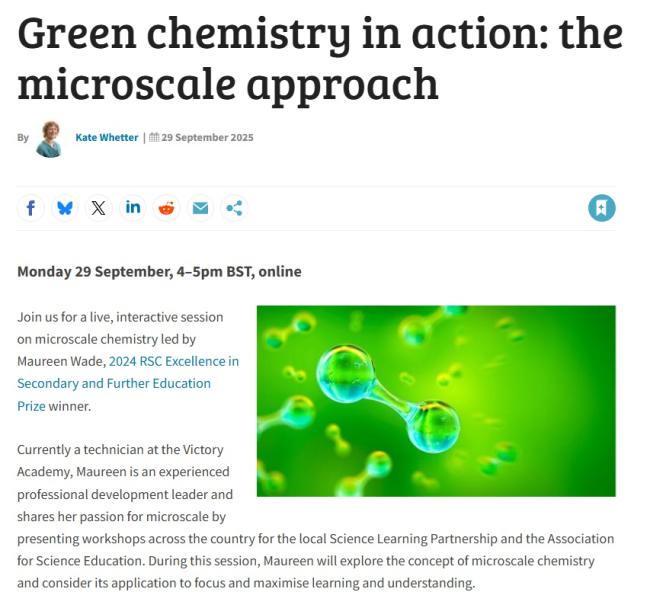
Green chemistry in action: the microscale approach

UK's Microscale RSC Chemistry Education Prize winner leads an interactive discussion.
Event Date
-
Event Type
Hosting Organization(s)
Royal Society Of Chemistry

Event Description

By the end of the session, you will have:

  • Seen a variety of demonstrations relevant to teaching students aged 11–18
  • Explored the benefits of microscale and how it can be used to enhance learning, while also promoting environmentally sustainable practices
  • Considered ways to embed microscale in your own teaching practice.

There is a question and answer session; the event is being recorded.

Sustainable Spectroscopy: Analyzing Sports Drinks with Beer's Law

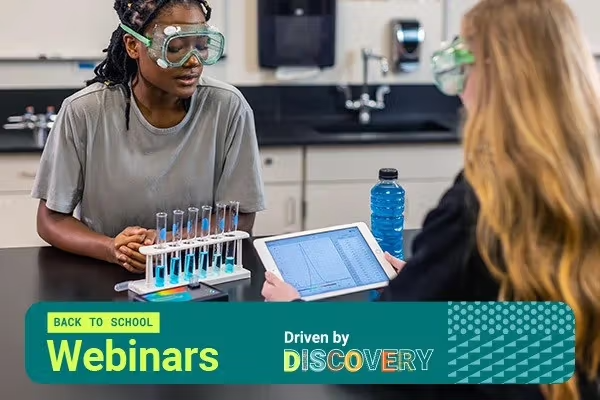
image of two people in a lab sitting at a bench looking at test tubes and spectra on an electronic tablet
Event Date
-
Event Type
Lead Organizers
Hosting Organization(s)
Vernier Science Education

Event Description

Kick off the school year with a hands-on experiment that brings real-world relevance to core chemistry concepts. Join Vernier chemistry experts Dr. Melissa Hill and Nüs Hisim as they demonstrate a green chemistry investigation that uses the Go Direct® SpectroVis® Plus to analyze food dye concentrations in popular sports drinks. This student-led experiment introduces spectroscopy as a tool for exploring molecular structure and function—and connects absorbance, transmittance, and concentration through Beer’s law in a food chemistry context.

Affordable, Equitable Clean Water Availability: A Materials-Based Approach

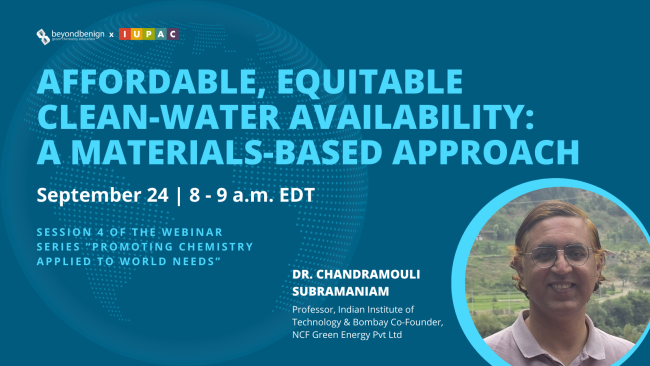
a man smiles against a turqoise background. text reads: Affordable, Equitable Clean Water Availability: A Materials-Based Approach
Event Date
-
Event Type
Hosting Organization(s)
Beyond Benign, Inc.
International Union of Pure and Applied Chemistry

Event Description

Are you an aspiring chemist, a passionate climate advocate, or an interested member of the public? Do you want to change the world through science? Join us throughout 2025 to learn from experts in the field leading the charge to solve existential, world needs through chemistry.

During this webinar series, speakers will orient their presentations around the United Nations Sustainable Development Goals (UN SDGs) and the International Union of Pure and Applied Chemistry (IUPAC) Top 10 Emerging Technologies to demonstrate the power that chemists hold in shaping and preserving the future. Each talk will be accompanied by short videos on the topic geared toward high school and university chemistry students as well as the general public.

This series is hosted by Beyond Benign and the IUPAC Committee on Chemical Research Applied to World Needs (CHEMRAWN). Register below and invite your friends and colleagues!


Department of Chemistry, Indian Institute of Technology Bombay

The total volume of water on earth is constant at 1021 liters. India has 4% of the global fresh-water resources with ~20% of the global population. Therefore, majority of Indian sub-continent is suffering from acute water stress. Equitable access to clean potable water is both a direct, important target of United National Sustainable Development Goals (SDG 6) and simultaneously carries significance to several other SDGs (SDG 3,7,13,15). Therefore, sustainable, cost-effective and affordable recovery of freshwater from contaminated water feedstock is the need of the hour to ensure it equitable access.


Solar-thermal interfacial evaporation offers immense and hitherto untapped potential for energy-efficient, sustainable freshwater production. However, fundamental challenges in materials and system-design result in low water evaporation rates (Rw < 1-2 kgm-2h-1) and even lower solar-freshwater productivity (SWP). Further, the lack of thermally and chemically stable materials that can operate in extreme salinities such as seawater without fouling or degrading is a major bottleneck that limits the wider adaptation of the technology.

This Talk would describe an ultra-thin, porosity-engineered polymeric scaffold (poly-HIPE, PH) that is anisotropically coated with nanostructured carbon florets (NCF) to deliver high solar-thermal conversion efficiency (η-STC = 84%), excellent Rw (6.5 kgm-2h-1) and exceptional SWP (3.5 Lm-2h-1) from sea-water. A few salient features of the material are
(a) Thinnest such membrane with no-signs of fouling over 30 days in sea-water, achieving
(b) Salt-rejection of ~95% with facile reusability for over 30 days,
(c) Producing freshwater of ~20 liters per m2 area per day at
(d) Lowest CO2 footprint (< 3 W/L, ~3 g /L)


Fundamental insights of materials-design to address the exothermic water-evaporation step that are synergized with systems-design approaches to achieve these key performance indices would be discussed in the talk.
Event Format
Event Address

United States

Intended Audience

Making the Case: Building a Sustainable Chemistry Minded Workforce

Event Date
-
Event Type
Hosting Organization(s)
Change Chemistry

Event Description

Fluctuations in political, economic, and R&D cycles may introduce uncertainty and necessitate the reallocation of resources, which can affect the adoption of sustainable chemistry and greener processes. Such disruptions have the potential to compromise long-term business resilience, elevate risk levels, and adversely impact both human health and the environment. Continuing to advance sustainable chemistry in a changing environment requires continued policy, investment, and market commitments.


To ensure sustainable chemistry remains a priority, demonstrating and communicating its positive impact on all business functions and through the value chain is critical. During this webinar series, subject matter experts will share tools and insights to assist champions with effectively "making the case". Structured as a series of discussions, attendees will have the unique opportunity to pre-competitively engage with the speakers and other companies facing similar challenges.


During the first 3 webinars, experts shared the benefits of sustainable chemistry for investors, on domestic manufacturing, and business health. This webinar builds on these conversations by highlighting the need for education - both in academia and for workforce development - in order to build a workforce with sustainable chemistry knowledge and skill sets. Juan Colberg from Pfizer will discuss the business benefits of a sustainability minded workforce and needs to attract this talent. Amy Cannon from Beyond Benign will share how our community can support students and educators in training the next generation for success.


*This webinar is available to Change Chemistry members only.

Event Format
Event Address

United States

Green Chemistry Connections

Decorative Image
Event Date
-
Event Type

Event Description

The ARC Training Centre for Green Chemistry in Manufacturing is transforming and revitalizing Australian Manufacturing through the adoption of green and sustainable chemical technologies.


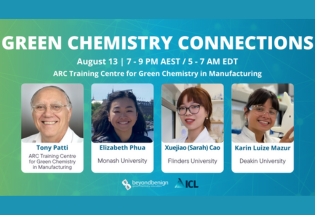
Join us on August 13th to learn more about this incredible work! During this Green Chemistry Connections session, we'll be joined by the center's director and three PhD students who are working with the center to bring Green Chemistry to industry partners:


• Tony Patti | Director, ARC Training Centre for Green Chemistry in Manufacturing
• Elizabeth Phua | PhD Student, Monash University
• Xuejiao (Sarah) Cao | PhD Student, Flinders University
• Karin Luize Mazur | PhD Student, Deakin University


August 13th from 7-9 p.m. AEST / 5-7 a.m. EDT.
This session was rescheduled from May. If you aren't already registered for the series, register here.