Welcome to the GCTLC Library. Use the search and filter options below to find green chemistry education resources and curriculum materials from community members from across the world. You can also submit a new resource to the library. For information for authors and reviewers, please consult the Guidelines for Submission and Review of Learning Objects.

Case study: Microplastics in cosmetics
This case study involves a young engineering student on an industrial placement year at a firm that manufactures cosmetics. The student has been working hard to impress the company as they are aware that this may lead to them being offered a job upon graduation. They are involved in a big project that focuses on alternative, more environmentally friendly cosmetic chemistries. When they notice a ...
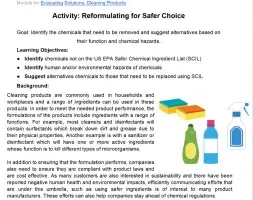
Reformulating for Safer Choice: Cleaning and Disinfecting Products
In this activity, you will evaluate a cleaning product formulation to see if it could qualify for the US EPA Safer Choice Fragrance-Free label, relate those ingredients that don’t qualify to specific health and environmental impacts, and suggest safer functional alternative chemicals using the EPA Safer Chemical Ingredient List to replace for those that need to be replaced. Both a slide deck and ...
Science Shorts! Bell Ringer Activities for K-12 Focused on Sustainability and Green Chemistry
Over 90 slides containing short, sustainability and green chemistry focused activities, videos, and books for you and your students to engage in. Their lengths are perfect for bell ringers or end of lesson connections. Some slides have related lessons in the speaker notes when you are ready to go further into a topic with your students. Elementary, middle and high school leveled shorts are all ...
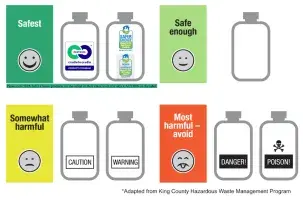
STEMify Your Classroom Supply List
In this lesson, students will develop an evidence-based argument after investigating the product safety, performance, and cost of a variety of cleaning and disinfecting products designed to remove germs. Students will be introduced to principles of sustainable design, life-cycle thinking, and how to identify safer products for certifications.
Except where otherwise noted, this work by Saskia van ...
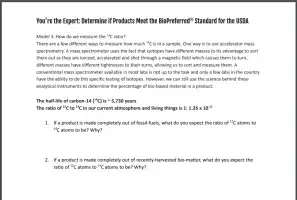
USDA BioPreferred Standards Context Lesson Plan
Students will compare the basis of the derivatives for different plastics in order to determine their expected carbon-14 content. They will then compare ratios of carbon-14 to carbon-12 in plastic samples and categorize the sample according to its percent bio-based composition.
Teacher Background Information: This lesson is more of a context design to be used with an existing nuclear chemistry ...
"Greening Up" the Suzuki Reaction
An aqueous Suzuki reaction is described which highlights the facile preparation of a non-steroidal anti-inflammatory (NSAID) drug analog under green conditions. While palladium-catalyzed cross-coupling reactions are common in most modern organic chemistry labs, they are often performed with hazardous solvents and large amounts of corrosive additives. Undertaken at the mid-undergraduate level ...
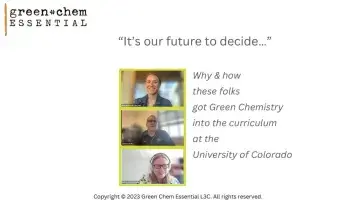
"It's Our Future to Decide" - How a Student & Two Professors Got Green Chemistry into the Curriculum at the Univ. of Colorado
In this episode of Green Chem Essential, with host James Rea: Learn how – and why — a motivated student and two professors at CU Boulder successfully worked to get green chemistry into the curriculum at their school.
Guests in this episode include; Brinn McDowell, Dr. Kathryn Ramirez Aguilar and Dr. Matthew E Wise
"New" Compounds from Old Plastics: Recycling PET Plastics via Depolymerization. An Activity for the Undergraduate Organic Lab
As landfills begin reaching their capacity and waste generation skyrockets, the world is being forced to take a harder look at recycling. Because it is currently estimated that plastics make up a quarter of landfill space, the recycling of plastics is a hot, current topic.
In this lab, a common plastic, polyethylene terephthalate (PET), will be depolymerized by a simple hydrolysis reaction ...
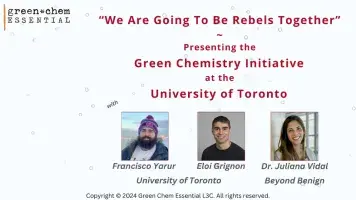
"We Are Going To Be Rebels Together" ~ A Look Inside the Univ. of Toronto's Green Chemistry Initiative
For more than 10 years now, the University of Toronto's Green Chemistry Initiative has been a wonderfully creative incubator for green chemistry learning on that campus. In this episode of Green Chem Essential, with host James Rea: Hear how -- and why -- this student-led group works to engage their peers in the science of sustainability.
The interview includes discussion about their annual spring ...
00 Soy Chemistry Curriculum Overview - Instructor Notes
This overview provides information about the student learning objectives, target audience, an overview of each module and its content and additional information instructors need for a successful implementation of the curriculum for classroom and laboratory use.
This resource was made possible with support from the United Soybean Board (USB).
Any opinions, findings, and/or interpretations of data ...
01 - History and Principles of Toxicology - (Toxicology for Chemists Curriculum - Module 1)
This module serves as a good first introduction to toxicology. In the first part of the module, students will learn and understand: the history of toxicology and its underlying principles; the progression of toxicology as a science; the development of regulatory agencies; key case studies that developed the field; and the paradox of uncertainty. In the second part of the module, students will ...
02 - Understanding Hazard and Risk (Toxicology for Chemists - Module 2)
This module is an introduction to understanding the principles of hazard and risk. The lectures are designed with a “choose your own adventure” format: you can take any slides and use them in any order to build your lecture! Using these materials, students will understand the basic concepts of hazard, exposure, and risk; be able to perform a simple chemical hazard assessment; be able to compare ...
03 - Toxicokinetics and Toxicodynamics (Toxicology for Chemists - Module 3)
This module is an introduction to toxicokinetics and toxicodynamics. The module is split into five lectures addressing: absorption, distribution, biotransformation, excretion, and toxicodynamics. Using these materials, students will be able to: explain and describe ADME; learn introductory biochemistry, chemistry, and anatomy to explain ADME; and explain and describe toxicodynamics. The lecture ...
04 - Reaction Mechanisms (Toxicology for Chemists - Module 4)
This module gives an overview of the main reaction mechanisms seen in toxicology studies. Students will learn primarily about the main electrophilic reactions that bind toxicants to proteins, in addition to a brief introduction to reactive oxygen species and radical reactions. This module pairs well with Module 11 – Structure-Activity Relationships, and these lecture slides are also included for ...
06 - Toxicity of Metals (Toxicology for Chemists - Module 6)
This module is a good introduction to metal toxicity. Students will learn about the toxicity of metals in the body, metal pollution, the difference between metals and metalloids, mechanisms of heavy metal toxicity, and factors that affect metal toxicity. These lecture slides are heavily case-study based and provide an applied outlook on the chemistry with reference to many global incidents and ...
07 - Environmental Fate, Persistence, and Biodegradation (Toxicology for Chemists - Module 7)
This module contains an introduction to the concepts of fate, persistence, and biodegradation. Students will learn about: classes of molecules that persist in the environment; different types of degradation and their critical role in the environment and society; and parameters that affect biodegradation rate. Part II of this module is a full case study entirely based on the Deepwater Horizon oil ...
08 - Environmental Toxicology (Toxicology for Chemists - Module 8)
This module serves as an introduction to the principles of environmental toxicity: air pollution, water pollution, and chemical transport and fate. Using these materials, students will learn examples of pollutants and their effects on human health and the environment through multiple case studies and in-class discussions. These lecture slides comprise mostly case studies and provide a good outlook ...
09 - Ecotoxicology (Toxicology for Chemists - Module 9)
This module provides an introduction to ecotoxicology, an overview of exposure and thresholds, an overview of the main concepts and scales of ecotoxicology, and some applications of ecotoxicology. Using these materials, students will learn: the history of ecotoxicology; why ecotoxicology is important to sustainability; effects on levels of biological organization; relations to hazard and risk ...
10 - Predictive Toxicology (Toxicology for Chemists - Module 10)
This module provides an overview of computational methods to predict the toxicity of chemicals. Students will learn an updated overview of the latest methods that have been successfully applied to predict toxic effects of chemicals, in addition to understanding the outlook towards at the nexus of computational sciences and toxicology. Particular emphasis is placed on carbon-based toxicants ...
11 - Structure-Activity Relationships (Toxicology for Chemists - Module 11)
This module connects the structure of molecules to their activity in biological systems. Students will be able to: identify physicochemical properties related to ADME; identify and rationalize relationships between physiochemical properties and biological activity in different species; apply pre-screening tools for acute and chronic human and ecological endpoints based on physicochemical ...
12 - Case Studies, ChemToxTidbits, “Grab Bag” Folder (Toxicology for Chemists - Module 12)
Don’t have much time to prepare your lectures? Don’t know where to start with incorporating toxicology into existing class lectures or assignments? Not sure if you’re ready to adopt a full module? Do you just want access to the case studies, in-class assignments, homework assignments, and ChemToxTidbits slides? This folder contains all of these materials in a format easily accessible to you so ...
12 Principles of Green Chemistry
This is a poster of the 12 Principles of Green Chemistry. The poster can be printed out in varying sizes and is designed to be used as a teaching tool in a classroom, laboratory or manufacturing setting.
Please select the file below based on your audience location. For those in North America please use the MilliporeSigma file, for those outside North America please use the international Merck ...
3D-Printable Biobased Eutectogels Based on Soybean Oil and Natural Deep Eutectic Solvents for Underwater EMG Recording
This study presents the development of 3D-printable biobased eutectogels that integrate acrylated epoxidized soybean oil (AESO) with natural deep eutectic solvents (DES) to create hydrophobic, conductive soft materials suitable for underwater electromyography (EMG) recording. The research explores the tunability of the eutectogels' mechanical, electrochemical, and water-repellent properties by ...
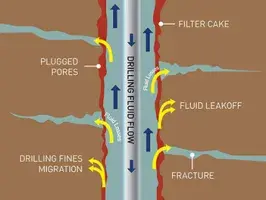
A Comparative Study of Diesel Oil and Soybean Oil as Oil-Based Drilling Mud
This study evaluates the performance of high oleic soybean oil (HOSO) as a sustainable alternative to diesel oil in oil-based drilling muds, with implications for both lubricant and biodiesel applications. The research compares the rheological, filtration, and thermal properties of drilling fluids formulated with HOSO versus conventional diesel oil.
Full citation: Agwu, O. E., Okon, A. N., & Udoh ...
A convenient guide to help select replacement solvents for dichloromethane in chromatography
This article overviews a study of the eluting properties of greener solvent systems as a replacement for dichloromethane in chromatography and chromatographic purification. A library of "drug-like" compounds was used to determine the efficacy and potential application of the greener solvent systems for purification. In particular, various mixtures of 3:1 EtOAc:EtOH in hexanes were found to have ...
A Green Alternative to Aluminum Chloride Alkylation of Xylene
The alkylation of aromatic compounds is a very important industrial process. Typically these alkylations are performed using strong Lewis acids like aluminum trichloride as catalysts. However, the use of these catalysts often requires an aqueous work-up to remove the aluminum and also leads to mixtures of products due to carbocation rearrangement.
By using graphite this greener alkylation ...
A Green and Efficient Cyclization of Citronellal into Isopulegol: A Guided-Inquiry Organic Chemistry Laboratory Experiment
Citronellal is a naturally occurring aldehyde derived from essential oils like citronella. In this laboratory activity, citronellal undergoes a cyclization reaction to form isopulegol, a chiral terpene with various applications. The reaction utilizes montmorillonite (MK10) clay as a catalyst in a buffer medium at room temperature for 2 hours. NMR Spectroscopy is used to characterize the product. ...
A Green Nucleophilic Aromatic Substitution Reaction
This laboratory activity focuses on the tie-dyeing process as a safer alternative to nucleophilic aromatic substitution (SNAr) reactions for an introductory organic chemistry laboratory. The simple and straightforward experiment provides students with an opportunity to gain practical experience in conducting a chemical reaction in a real-world context while applying concepts of design for ...
A Green Polymerization of Aspartic Acid for the Undergraduate Organic Laboratory
Because of the ubiquity of polymers, chemists are looking for ways to make polymers renewable, biodegradable, and with less waste. In this laboratory chemistry students will have the opportunity to make poly(aspartate), a polymer that fulfills all the abovementioned goals.
The synthesis of this condensation polymer starts by simply heating neat aspartic acid for two hours to form poly(succinimide ...
A Green, Guided-Inquiry Based Electrophilic Aromatic Substitution for the Organic Chemistry Laboratory
This exercise demonstrates the regioselectivity of substituted aromatic systems while reducing the amount and hazards of the waste produced by the class. Although typical iodinations involve either high amounts of derivatization (i.e., nitration, then reduction to aniline, formation of diazonium, then ionization) or use of hazardous/expensive reagents (iodine and mercury acetate, bis(pyridine ...
A Green(er) Redox Reaction
Green chemistry is an approach to practicing chemistry that strives to reduce or eliminate the use and generation of hazardous substances. This focus on safety and environmental responsibility must always refer to a baseline measure, meaning that reactions can never be “green” but instead can always be “greener”.
This lab provides a great example of a greener approach to teaching reduction ...
A Greener Approach for Measuring Colligative Properties
This experiment teaches students the concept of colligative properties using renewable, benign, and biodegradable materials. Rather than using conventional solvents with high cryoscopic constants (which are oftentimes aromatics), fatty acids are used to explore freezing-point depression. By monitoring the change in freezing points of solutions with varying solute concentrations, students will be ...
A Greener Chemiluminescence Demonstration
This demonstration shows students a long-lasting, chemiluminescent reaction in light sticks without the toxic solvents. The instructor must prepare the chemiluminescent reagent, divanillyl oxalate, in a one-step synthetic procedure or can have the students prepare the reagent as part of an organic chemistry experiment.
Solvents acceptable for the chemiluminescence reaction are ethyl acetate or ...
A greener organic chemistry experiment: reduction of citronellal to citronellol using poly(methylhydro)siloxane
An undergraduate organic chemistry experiment is described in which the aldehyde functional group of citronellal is reduced to a primary alcohol using poly(methylhydro)siloxane (PMHS) as a reducing agent, activated by a catalytic amount of fluoride. PMHS serves as a safer and greener alternative to sodium borohydride, being stable in air and water. The experiment employs standard organic chemistry ...
A greener tetraphenylporphyrin synthesis and metallation: an undergraduate teaching experiment
In this experiment, 5,10,15,20-tetraphenyl-21H,23H-porphyrin (H2TPP) is synthesized on the microscale using an optimized procedure with a research-grade microwave apparatus (CEM Discover). This experiment can also be extended to the para-substituted phenyl derivatives.
Metalloporphyrins, with an array of metals, can then be synthesized using greener routes including mechanochemical methods (with ...
A Guide To Green Chemistry Experiments for Undergraduate Organic Chemistry Labs
Beyond Benign, My Green Lab, and MilliporeSigma have teamed up to develop a comprehensive teaching guide for undergraduate labs featuring Green Chemistry alternatives to traditional organic chemistry experiments and Green Chemistry lab practices*.
The purpose of this guide is to provide examples of green chemistry experiments that may serve as substitutions for classic undergraduate organic ...
A guide to using the Greener Alternatives Evaluation Matrix (DOZN™ 2.0) in Academic Settings for Safer Labs
This learning object presents an overview of DOZN™ 2.0, the free web-based quantitative green chemistry evaluator by MilliporeSigma. It also provides specific rules for utilizing the tool in academic settings as well as a template worksheet for students, with select reactions with DOZN™ 2.0 scoring to serve as introductory examples.
A guidebook for sustainability in laboratories
This guidebook aims to improve lab users’ everyday practices to become more sustainable. Specifically, this guidebook provides practical suggestions on how to effectively use lab instruments and resources and how to acquire data. We provide advice to labs covering disciplines such as biology, chemistry, computational science, engineering, life sciences, materials sciences, medicine, pharmacy, and ...
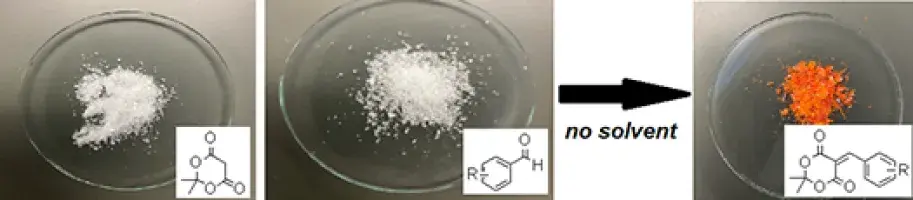
A Guided Inquiry Laboratory Activity to Explore Reactivity of Carbonyl Compounds
A laboratory activity to demonstrate reactivity of carbonyl compounds using Meldrum's acid as a nucleophile is presented. The experiment requires no solvent and can be completed in a single 3-4 hour laboratory period. Substrate information and related spectroscopic information are provided.
Tracey, M. P., Nigam, M., Pirzada, E., & Osman, T. (2024). A solventless carbonyl addition reaction as a ...
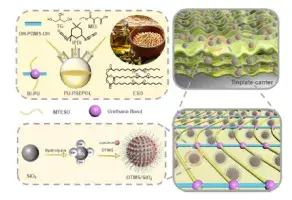
A highly reactive soybean oil-based superhydrophobic polyurethane film with longlasting antifouling and abrasion resistance
This Learning Object explores the development of a soybean oil-based superhydrophobic polyurethane film that demonstrates long-lasting antifouling and abrasion resistance. The study highlights the synthesis of bio-based polyols derived from epoxidized soybean oil and their subsequent integration into polyurethane coatings enhanced with superhydrophobically modified silica nanoparticles and OH–PDMS ...

A Microscale Heck Reaction In Water
This laboratory experiment features the palladium-catalyzed Heck synthesis of (E)-4-acetylcinnamic acid from 4-iodoacetophenone and acrylic acid by mid-level undergraduates. Traditional Heck reaction organic solvents (e.g. acetonitrile) and base (e.g. triethylamine) are replaced by water and sodium carbonate respectively. This approach introduces fundamentals of green chemistry (aqueous and ...
A Mole of Rice
The mole is a very large number used to measure the number of very small objects in chemistry. Using the mole to describe the number of a macroscopic object is not practical.
Earth’s diameter (see link below)
How much rice does China grow? (see link below)
A new formaldehyde-free wood adhesive from renewable materials
This study presents the development and evaluation of a formaldehyde-free wood adhesive composed of soy flour (SF) and a novel curing agent (CA) synthesized from epichlorohydrin (ECH) and ammonium hydroxide. The adhesive was tested on various plywood configurations (seven-ply, five-ply yellow poplar, and five-ply aspen) and assessed for water resistance using standardized soak and boil tests. The ...
A new method of making particleboard with a formaldehyde-free soy-based adhesive
This study presents a novel method for producing particleboard using a formaldehyde-free adhesive composed of soy flour (SF) and a curing agent (CA). Traditional soy-based adhesives are too viscous for direct application in particleboard manufacturing. To overcome this, the researchers developed a two-step process: first coating wood particles with a dilute soy slurry, followed by drying and ...
A Novel General Chemistry Experiment for Freshmen: Transgenic Soybean Detection Based on Microfluidic Molecular Fluorescence Spectroscopy Analysis
This educational resource introduces a microfluidic-based molecular fluorescence spectroscopy experiment designed for freshmen enrolled in General Chemistry courses. The experiment focuses on the detection of transgenic soybeans by analyzing nucleic acids using a centrifugal microfluidic platform combined with loop-mediated isothermal amplification (LAMP). It serves as an interdisciplinary ...
A promise to a sustainable future: 10 years of the Green Chemistry Commitment at Beyond Benign
Green chemistry education is a fundamental tool for the achievement of a sustainable future at the molecular level. It allows the development of a scientific workforce and knowledgeable citizenry with the skills to choose, assess, and further design more benign processes for human health and the environment. In 2007, Dr Amy Cannon and Dr John Warner co-founded a non-profit organization known as ...
A Solvent-Free Baeyer–Villiger Lactonization for the Undergraduate Organic Laboratory: Synthesis of γ-t-Butyl-ε-caprolactone
The transformation of ketones into esters using peroxy acids was first reported in 1899. Since then, the Baeyer-Villiger oxidation has found itself an integral part of the organic chemist's toolkit. This modified Baeyer-Villiger is a great example of how a classic reaction can be made significantly greener. By eliminating the solvent you can avoid the hazards associated with dichloromethane (the ...
A survey of solvent selection guides
This published article provides an overview of the many solvent selection guides that had been published up until that point as well as a compilation of the data from the guides to allow for a ranked comparison of all solvents, allowing for a general grouping into four categories: recommended, problematic, hazardous and highly hazardous. Of the 51 solvents considered, 17 could not be unequivocally ...