USDA BioPreferred Standards Context Lesson Plan
Contributors


Summary
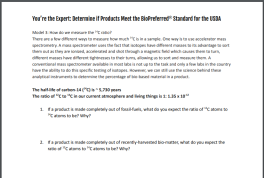
Students will compare the basis of the derivatives for different plastics in order to determine their expected carbon-14 content. They will then compare ratios of carbon-14 to carbon-12 in plastic samples and categorize the sample according to its percent bio-based composition.
Teacher Background Information: This lesson is more of a context design to be used with an existing nuclear chemistry lesson plan. The goal is for students to see the applicability of nuclear chemistry beyond carbon-dating by showing how carbon-dating can be used to determine the carbon sources of products. Students will need a basic understanding of the carbon cycle, and nuclear equations. The lesson will need students to learn about half-lives halfway through the lesson and that is left open to teach as you wish. There is room for extension to mass spectrometry if you want to incorporate it here for AP Chemistry or as an honors extension. To do that, the Flinn POGIL on Mass Spectrometry is recommended.
Authors: Johanna Brown, Carissa Haug, Saskia van Bergen
Teacher Background Information: This lesson is more of a context design to be used with an existing nuclear chemistry lesson plan. The goal is for students to see the applicability of nuclear chemistry beyond carbon-dating by showing how carbon-dating can be used to determine the carbon sources of products. Students will need a basic understanding of the carbon cycle, and nuclear equations. The lesson will need students to learn about half-lives halfway through the lesson and that is left open to teach as you wish. There is room for extension to mass spectrometry if you want to incorporate it here for AP Chemistry or as an honors extension. To do that, the Flinn POGIL on Mass Spectrometry is recommended.
Authors: Johanna Brown, Carissa Haug, Saskia van Bergen
Keyword Tags
Link to external
Creative Commons License
