NGO/non-profit

My Green Lab Europe Summit 2025

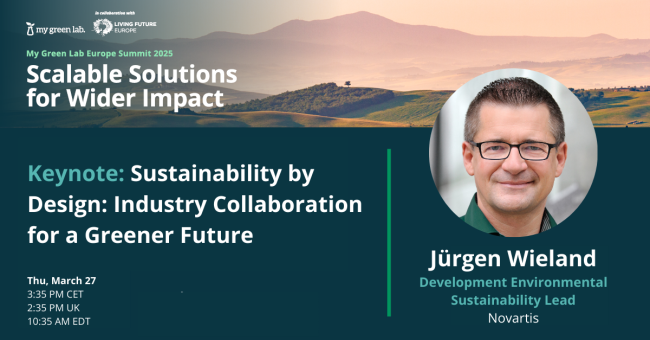
A picture of the keynote speaker, Jürgen Wieland, who is the Development Environmental Sustainability Lead at Novartis. The title of the keynote is: Sustainability by Design: Industry Collaboration for a Greener Future
Event Date
-
Hosting Organization(s)
My Green Lab
Additional Host Organizations
Living Future Europe

Event Description

The My Green Lab Europe Summit 2025 brings together scientists, sustainability leaders, and industry experts from across Europe to explore scalable solutions for greener labs and lab products.

This free virtual event will highlight how laboratories, institutions, and policymakers are advancing sustainability through product innovation, organization-wide initiatives, and sector-wide policy changes while ensuring compliance with evolving European regulations.

Whether you're a researcher, lab manager, or industry professional, you'll gain the knowledge and connections to help drive meaningful change in lab sustainability.


For more information visit: https://mygreenlab.regfox.com/my-green-lab-europe-summit-2025.


Canadian Chemistry Conference and Exhibition (CSC 2025)

decorative image
Event Date
-
Event Type

Event Description

Canadian Chemistry Conference and Exhibition is the premier conference for the Canadian Society for Chemistry. The mission of the chemistry conference is to be your forum; a venue where you can embrace learning, exchange knowledge, build innovative ideas, advance your career, and advance the chemistry profession.


Taking part in the Canadian Chemistry Conference and Exhibition is an opportunity to grow, learn, connect, and celebrate all that Canadian chemistry has to offer.

This is the first year of the inaugural Green Division and there will be tons of green chemistry-related symposia and workshops throughout the conference!! Several will be led by Beyond Benign team members! Read more about them here

--

Beyond Benign Talks

Green and Sustainable Practices in Chemistry Education (CE/GC)

Barb Morra, University of Toronto; Jonathon Moir, Beyond Benign; Nimrat Obhi, Beyond Benign; Andrew Dicks, University of Toronto; Olivia Mann-Delany, University of Toronto

--

Chemistry education plays a critical role in training the next generation of chemists and engineers to consider the holistic impact of their work and actively explore ways to use more sustainable practices. This session aims to explore how educators can integrate green and sustainable chemistry practices into their classrooms, teaching laboratories, and programs. The session will be split into two parts: oral presentations followed up a workshop.


Part 1 (what are others doing with green chemistry in education?): This component will bring together instructors, teaching assistants, technical staff, and other educational stakeholders and provide them with a platform to showcase the creative ways they incorporate green and sustainable practices into their departments and curricula. Participants are encouraged to provide their unique perspective into the development, implementation, and learning outcomes of their pedagogical work, while considering how their efforts could be adopted by other instructors, particularly those with limited resources or experience with green and sustainable practices.


Part 2 (how can I add more green chemistry to my teaching?): The second part of the session will involve a workshop that provides an opportunity for educators to learn how to further adapt and implement more green and sustainable concepts into their own classrooms and laboratory using a guided inquiry approach. Workshop participants will work in small groups with facilitators to explore simple and effective approaches to updating their existing course/laboratory content and establish action plans toward implementation.


Bringing Green Chemistry into Your Lab – A Workshop for Graduate Students and Postdoctoral Fellows (GC)

Tuesday, June 17th from 8:00-11:40am in room 203 at the Rogers Center Ottawa

Jonathon Moir, Beyond Benign; Juliana Vidal, Beyond Benign; Nimrat Obhi, Beyond Benign; Barb Morra, University of Toronto; David Laviska, ACS GCI; Galen Yang, McGill University; Shauna Schechtel, Queen’s University

--

Research laboratories are some of the most energy and resource intensive spaces on university and college campuses. They generate large amounts of both hazardous and non-hazardous waste (including solvents, reagents, solids, glassware, filter paper, drying agents, disposable gloves, and column waste) daily. However, this is often considered a necessary evil and an acceptable price to pay to make innovative discoveries for the betterment of humanity. Fortunately, this does not need to be the case; research in higher education can be done in a way that allows for discovery and innovation to take place without generating large amounts of waste and subjecting students, postdoctoral fellows and researchers to hazardous compounds and laboratory conditions. Importantly, there are many safer alternative reagents, solvents, and laboratory materials that can be used to reduce risk of exposure. This approach, known as green chemistry, utilizes a set of twelve practical principles for research and bench chemists to help reduce the use and generation of hazardous substances for humans and the environment.


This workshop introduces green chemistry and how its associated twelve principles can be applied at the graduate and postdoctoral level in research laboratories across universities and colleges in Canada. The workshop will explore examples of how green chemistry has been successfully introduced into research labs in different subdisciplines of chemistry and will provide an opportunity for participants to work in small groups through guided discussions to identify ways of improving their own laboratory practices and research to shift towards greener and more sustainable practices.


Register Here.


Leuphana University - MSc & MBA Sustainable Chemistry - Online Information Event

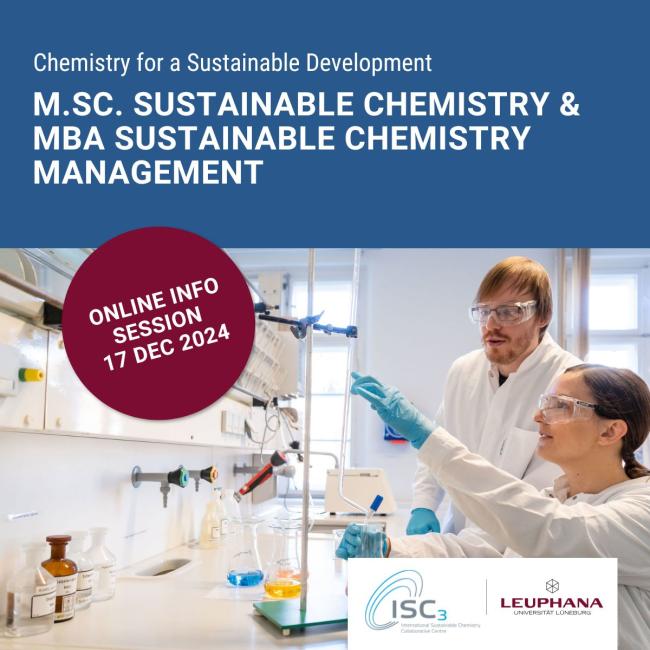
Blue banner at the top showing the event title in white font. Photograph below of two chemists in the lab with goggles, gloves, and lab coats, holding glassware attached to a rotary stand and discussing the level of solvent in the glassware. A red circle with white font at the top left shows the info session time and the ISC3 and Leuphana University logos are in the bottom right corner of the image.
Event Date
-
Hosting Organization(s)
Leuphana University

Event Description

An exclusive online event on December 17, 2024, at 5:00 p.m. Central European Time (11:00 am Eastern Time).

Designed for professionals in the chemical sector, these programs equip you to lead the transition toward sustainable practices while advancing your career. Our programs are delivered primarily online, in English, offering maximum flexibility to balance your studies with professional and personal commitments. 


At the event, you'll have the chance to learn about the unique curriculum, which integrates insights from international experts across academia, industry, and government. A special highlight of the session is a talk by Professor Klaus Kümmerer, a globally renowned scientist in sustainable chemistry. He will share his vision for sustainability's critical role in the chemical industry and explain how these programs prepare participants to be pioneers in this transformative field.


Take the first step towards making a meaningful impact in the chemical sector. Join us to learn how Leuphana University's postgraduate programs can help you stand out and shape the future of chemistry.
 

29th Annual Green Chemistry & Engineering Conference

GC&E Conference Banner
Event Date
-
Event Type
Lead Organizers
Hosting Organization(s)
American Chemical Society Green Chemistry Institute (ACS GCI)

Event Description

The GC&E Conference, hosted by the ACS Green Chemistry Institute®, is the premier global event for green chemistry and engineering. As the first and longest-running conference on this topic, GC&E attracts scientists, educators, industry professionals, and advocates to explore advancements, share best practices, inspire innovation, and build community dedicated to sustainable solutions.


Each year, the conference evolves, incorporating new ideas while maintaining its 28-year legacy. Its vision is for green and sustainable chemistry to be integral to all scientific endeavors, providing solutions that balance human well-being with planetary health. For this reason, the 2025 conference theme will be Good Health and Well-Being Through Sustainable Chemistry to align withthe United Nations Sustainable Development Goal 3.

GC&E 2025 will showcase innovative research and cross-cutting topics in green and sustainable chemistry and engineering, with an emphasis on symposia that highlight our theme “Good Health and Well-Being”, such as medical breakthroughs, new technologies, and efforts to eliminate or reduce hazardous chemical pollution promoting longer and healthier lives.


Beyond Benign Talks and Social Events


“Design and development of an on-demand introductory course to infuse green chemistry in the undergraduate curriculum”

Dr. Deborah Bromfield Lee, Professor of Chemistry, Florida Southern College


“Case study on sustainable practices in metal plating for Green Chemistry education”

Dr. Hun Bok Jung, Assistant Professor Department of Physical Sciences, Kingsborough Community College


“An online course for the chemistry education community: empowering educators to bring environmental justice discussions into the classroom”

Dr. Monica Soma Hensley, Content Manager, Beyond Benign


““Soy” What? We’ve “bean” incorporating soybean-based industrial innovations into the chemistry curriculum”

Dr. Jane Wissinger, Professor Emerita, Department of Chemistry, University of Minnesota


"Institutional Change for a Sustainable Future: Beyond Benign and the Green Chemistry Commitment"

Dr. Juliana Vidal, Dr. Amy Cannon,  Dr. Omar Villanueva, and Dr. Natalie O’Neil


"Mechanochemistry and Green Chemistry: A Connection Between Education, Research, and Innovation for a Healthier Planet"

Juliana Vidal, Beyond Benign; James Batteas, Texas A&M University; Francesca Kerton, Memorial University; Isaiah Speight, William & Mary


"Comprehensive survey on the implications of green chemistry and toxicology concepts in chemistry education: An industry and academic perspective"

Nesta Bortey-Sam, University of Pittsburgh


"Development of a green chemistry and toxicology professional development certificate course"

Douglas Raynie, South Dakota State University


"Green Chemistry Resources in the Classroom"

Thomas P. Umile, Villanova University; Jennifer A. Tripp, University of San Francisco; Monica Soma Hensley, Beyond Benign; Amy S. Cannon, Beyond Benign; David Laviska, Green Chemistry Institute, American Chemical Society


Image
Decorative image


Green Chemistry Commitment: Catalysts for Change Reception

Come mix and mingle with Beyond Benign, MilliporeSigma (the U.S. and Canada Life Science business of Merck KGaA, Darmstadt, Germany), and the American Chemical Society Green Chemistry Institute at 6 PM on Sunday, June 22nd, 2025 at Sienna Mercato's rooftop bar, il Tetto.

Embrace the unique opportunity to connect with current leaders in the field of green chemistry and find resources to help lead a sustainable future.
Current green chemistry leaders joining this event include members of industry, as well as faculty members who are signers of Beyond Benign's Green Chemistry Commitment.

Enjoy free food and drinks and unique networking opportunities-- all against the beautiful Pittsburgh skyline at a scenic, award-winning venue.

Who: Chemistry Faculty, Undergraduate and Graduate Students
What: A chance to connect with likeminded young chemistry leaders and influencers in the green chemistry space.
When: Sunday, June 22nd at 6:00 PM EST
Where: il Tetto at Sienna Mercato, 942 Penn Ave, Pittsburgh, PA 15222


Catalyzing Change in Chemistry Education Faculty Luncheon

Join Beyond Benign, MilliporeSigma (the U.S. and Canada Life Science business of Merck KGaA, Darmstadt, Germany), and the American Chemical Society Green Chemistry Institute (ACS GCI) for a free, catered luncheon on June 24th, 2025 at the ACS Green Chemistry and Engineering Conference.


Who: Chemistry faculty, administrators, and student leaders interested in generating departmental support for green chemistry implementation.

What: A lunch panel of faculty members who are leading a systemic change in education through the Green Chemistry Commitment (GCC) at their institutions.

Panel moderators: Dr. Amy Cannon (Executive Director & Co-Founder of Beyond Benign) and Jeffrey Whitford Vice President of Sustainability & Social Business Innovation at MilliporeSigma, will bring their own expertise as green chemistry leaders.

Where: Sterlings 1, 2, & 3

When: Tuesday, June 24th, 2025 at 12:30 PM EDT
The GCC program is a collaborative voice created to unite the higher education chemistry community towards green chemistry principles and practices and further its size, reach, and diversity. Join us to learn all the benefits that the students, faculty, and staff in your department can gain access to when they join the GCC.

Register on the GC&E Website


Bioenergy Research and Education Bridge Program (BRIDGES) Bioenergy 101 Virtual Workshop

Bioenergy Research and Education Bridge Program (BRIDGES) Bioenergy 101 Virtual Workshop
Event Date
-
Event Type
Hosting Organization(s)
U.S. Department of Energy
Argonne National Laboratory
Additional Host Organizations
Idaho National Laboratory

Event Description

📚 Register TODAY for the Bioenergy Research and Education Bridge Program (BRIDGES) Bioenergy 101 Virtual Workshop on Thursday, October 17, 2024, from 6:00 p.m. – 7:00 p.m.

Build knowledge and engage your high school, community & technical college, and university students with free high quality instructional materials in renewable energy based on national laboratory research!

Developed by the U.S. Department of Energy (DOE), Idaho National Laboratory, and Argonne National Laboratory, BRIDGES provides an opportunity for educators and students to learn about and prepare for the next generation of clean energy technologies. In addition, case studies represent actual DOE national laboratory research that will assist students to strengthen their research skills, improve their critical thinking, along with opening a world of new potential career opportunities.

The Relevance of Sustainable Laboratory Practices and Green Labs

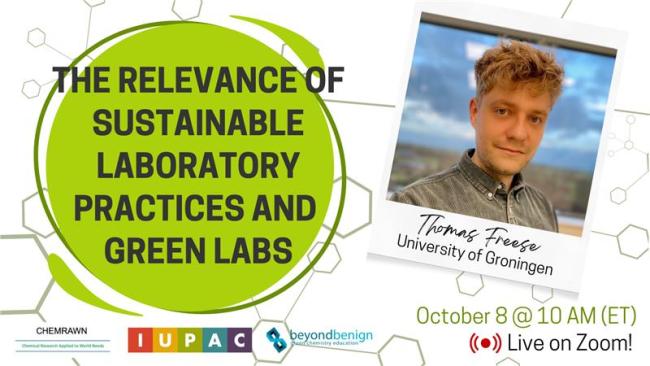
Green Molecules stand out against a white background, in a green text bubble black text reads: The Relevance of Sustainable Laboratory Practices and Green Labs. To the right of the text is a picture of a blonde-haired, young, white man smiling, his name reads Thomas Freese, University of Groningen. The logos for IUPAC, CHEMRAWN, and Beyond Benign sit in the bottom left corner.
Event Date
-
Event Type
Lead Organizers
Hosting Organization(s)
Beyond Benign, Inc.
Additional Host Organizations
International Union of Pure and Applied Chemistry, CHEMRAWN

Event Description

Join IUPAC CHEMRAWN and Beyond Benign in a webinar featuring Thomas Freese (University of Groningen, Netherlands) to discuss sustainable laboratory practices. In this event, guidelines and hands-on advice on how to make your laboratory greener at research institutions and industry will be presented, as well as examples of achieving systemic change for a sustainable future. If you have any questions in advance for Thomas, feel free to add them in below! We are looking forward to seeing you there!


Making strides in sustainable laboratories: Examples of recent initiatives

Chemistry World and RSC webinar image showing generic lab glassware and the title of the event
Event Date
-
Event Type
Hosting Organization(s)
Royal Society Of Chemistry

Event Description

Lab sustainability is increasingly at the forefront of decision making in science centres around the world, as evidenced by the Royal Society of Chemistry (RSC) Sustainable Labs report and the high level of interest in the RSC Sustainable Lab grants. 


In this hour-long, interactive webinar you will hear from recipients of the first round of the RSC Sustainable Labs grant whose projects seek to answer questions in topics areas including solvent choices and reuse of single use plastics. You will hear about the problems they’re trying to solve and how findings from their initial results can be actioned. By joining this webinar, you will learn how chemical scientists are looking to solve challenges faced when making more sustainable choices in the lab. You will also hear perspectives on the broader challenges in sustainable labs and efforts by the wider research community – including major funders – to drive more sustainable laboratory practices. 


The webinar will provide useful and actionable information as well as highlighting the opportunity to apply for the second round of RSC Sustainable Laboratories grants. 


The RSC will send a certificate of attendance to everyone who joins us live for the event. Please make sure you register using exactly the name you want on the certificate.


Note: this webinar will run from 3 - 4 pm British Standard Time (10 - 11 am Eastern Time).
 

2025 ACS Great Lakes Regional Meeting

GLRM 2025: Chemistry for a Better Planet
Event Date
-
Event Type
Hosting Organization(s)
ACS Great Lakes Regional Board

Event Description

With the theme "Chemistry for a Better Planet" this Regional Meeting will bring more than 400 chemists from industry, academia, and government sectors together for symposia on a wide range of topics including green and sustainable chemistry. The call for abstracts will appear in Chemical & Engineering News in early 2025.

Biennial Conference on Chemistry Education (BCCE)

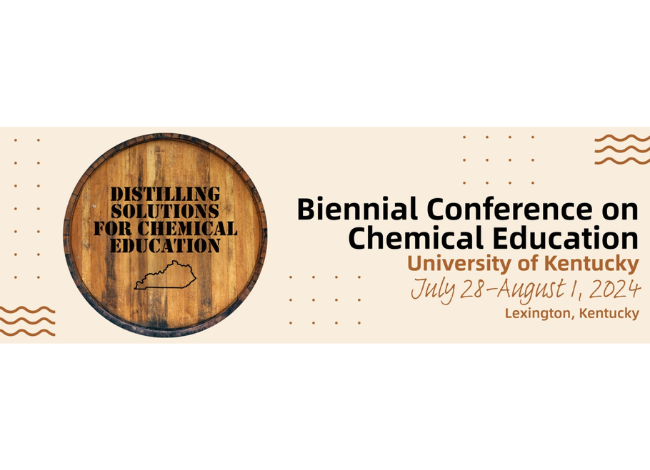
A wooden barrel is labelled in rugged font: Distilling Solutions for Chemical Education. Biennial Conference for Chemical Education, University of Kentucky, July 28- August 1st 2024. Lexington, KY.
Event Date
-
Event Type
Hosting Organization(s)
University of Kentucky

Event Description

The conference will be held on the beautiful campus of University of Kentucky in Lexington, Kentucky in the Summer of 2024. The 28th BCCE, like all of its predecessors, is designed to provide you with opportunities for interacting with chemistry instructors of all levels in formal and informal settings. There will be a mixture of symposia, workshops, poster sessions, exhibits, and tours of chemistry research areas.


Registration for BCCE 2024 is now live. Early bird pricing is available until May 31!  The registration form includes workshops, on-campus housing options, and more.  Those who have submitted abstracts will be notified in April about their submission.


The conference will be organized around four themes - Classroom Practice and Learning Environments, Curriculum and Cognition, Assessment and Research Methods, and Professional Development - within the K-12, two-year college, and university communities.

Instructions for presenters are available.


Connect with attendees and stay up to date with the conference on the GCTLC's BCCE 2024 forum thread!


Sunday

Workshop: Introduction to Integrating Green Chemistry and Sustainability in Undergraduate Teaching Laboratories
8:30am - 11:45am
Chaired by: John De Backere (University of Toronto)

Authors: Jonathon Moir, John De Backere, David Laviska, Jane Wissinger

Green Chemistry is a framework that helps “minimize or eliminate the use or generation of hazardous substances” in chemical processes and products. It is our responsibility as instructors to educate our students with respect to green chemistry, sustainability, and environmental issues to prepare them as future members of the workforce and agents of change in the world. Importantly, this has recently been recognized in the new ACS Guidelines for Bachelor's Degree Programs as a critical requirement, whereby curricula must provide students with a working knowledge of the Twelve Principles of Green Chemistry.

This interactive half-day (3h) workshop is aimed towards laboratory instructors at two- and four-year undergraduate institutions teaching curricula in all areas of specialization. We will illustrate the connection between fundamental principles of green chemistry, safety, and traditional teaching laboratory protocols (further examples provided in the accompanying symposium, see below for details). Participants will gain an understanding of not only practical aspects of greening undergraduate labs, but also ways of modifying assessments and content to improve pedagogical aspects of laboratory learning to include more topics around green chemistry and broader sustainability concepts. Participants will then divide into small sub-discipline specific groups to share experiments currently used in their courses, and discuss possible modifications to their own lab manuals to make them “greener”. After reflecting on current curricula, we will explore a number of useful resources for integrating theory into practice, such as the new online Green Chemistry Teaching and Learning Community (GCTLC). The workshop will conclude by creating personal action plans for implementing sustainable changes, both practically and pedagogically, to current experiments or potentially new experiments to be developed.

This workshop complements the symposium entitled “Frontiers in Integrating Green Chemistry and Sustainability into the Teaching Laboratory”, which will provide recent examples of "greener" teaching experiments.


Monday

Poster: Addressing the knowledge gap through professional education initiatives for educators to promote the global integration of sustainable chemistry into curricula

6:00pm - 6:55pm

Presented By: Monica Nyansa

The design for sustainable solutions to global challenges creates a critical need to develop a future workforce proficient in practicing and teaching the principles of sustainable chemistry. This entails equipping present and future scientists with the requisite skills in green chemistry and sustainability. The American Chemical Society (ACS) recently updated its Guidelines for Bachelor’s Degree Programs to incorporate green chemistry and sustainability into the learning outcomes as a normal expectation for coursework in ACS-approved degree programs.

Beyond Benign, an educational nonprofit that is a prominent advocate for green chemistry education worldwide plays a pivotal role in supporting the integration of green chemistry and sustainable practices into the chemistry curriculum. This support extends to the development and dissemination of curricular materials and resources created directly with educators and strategic partners through their Green Chemistry Commitment (GCC) and the Green Chemistry Teaching and Learning Community (GCTLC) platform. Another way Beyond Benign supports this endeavor is through the exploration of professional educational opportunities, empowering educators to integrate green chemistry and sustainability principles into the chemistry curriculum effectively, thus nurturing the next generation of scientists adept at addressing global challenges through sustainable chemistry practices.

This presentation aims to highlight the ongoing efforts of Beyond Benign, a champion of green chemistry education, to explore professional educational opportunities for educators, facilitating the integration of green and sustainable chemistry into the chemistry curriculum for a sustainable future.


Tuesday

Green Chemistry Education: Empowering the Global Community
in S60: Promoting Global Collaboration in Chemistry Education: Insights from International Initiatives |8:30am - 10:00am

Talk Presented By: Amy Cannon

The field of chemistry, providing the molecular building blocks of materials and products used throughout society, has a critical and foundational role in addressing the Sustainable Development Goals outlined by the United Nations. Green chemistry, the use and design of less hazardous chemical products, is essential in providing solutions in order to achieve these ambitious goals. As the global demand for greener, more sustainable chemicals and materials grows, the chemistry education system must shift in order to meet this demand. Green chemistry education is required to train scientists and professionals with the skills to address hazards and mitigate impacts at the earliest stages of the product lifecycle. Beyond Benign, a non-profit organization based in the USA, has been leading green educational initiatives aimed at empowering educators to change chemistry education for a sustainable future. As the organization has grown, so has the outreach and engagement with the global chemistry education community. With specific goals to scale the adoption of green chemistry within higher education systems globally, this presentation will share Beyond Benign’s approach to building community and engaging educators, empowering them to be transformative change agents. Specifically, the Green Chemistry Commitment (GCC) program, an institutional commitment towards including green chemistry in college level chemistry programs, and the Green Chemistry Teaching and Learning Community (GCTLC), an on-line platform supporting educators on their journeys, will be highlighted. Each program aims to build upon work in North America and authentically engage and empower the global community to adopt green chemistry in their teaching and practice.


Development of an open-access, community-driven, peer-reviewed library of green chemistry educational materials in Drupal 10: The Green Chemistry Teaching and Learning Community (GCTLC)

in S233: Computers in Chemical Education | 10:15am - 11:45 am

Talk Presented By: Jonathon Moir

The Green Chemistry Teaching and Learning Community (GCTLC) is a virtual space for higher education faculty and lecturers as well as K-12 teachers to find and share resources, participate in peer-to-peer learning, and connect and network with other users from around the world. The mission of the GCTLC is to help advance the integration of green chemistry across education systems worldwide to help train the next generation of scientists and workers with the knowledge and skills to address sustainability challenges across the globe. The platform allows users to connect with others through forums, group spaces, events, a job board, and more. Of particular note is the GCTLC’s open-access, peer-reviewed and community-driven library of over 190 curriculum resources. These include greener lab experiments, course modules, lecture slides, assessments and exams, journal articles, and more. Users can browse the existing collections via searching based on keyword terms, by contributor, by title, or by other filters, and can submit their own original work to the library or submit existing resources found elsewhere on the internet. Submitted resources undergo a simplified peer review process, managed by the GCTLC’s Chief Editor, and upon acceptance are published in the GCTLC’s searchable library (and, if warranted, added to new or existing curated collections on the platform). This presentation will overview the development and management of the GCTLC’s library and peer-review system using Drupal 10, including use of taxonomy terms, moderation states and workflows, and dynamic content displays. Ultimately this presentation will showcase the utility of open-source programming in creating inclusive spaces for educational communities of practice.


B19: Green Chemistry Teaching and Learning Community (GCTLC) Get-Together and Share-a-thon

1:00pm - 1:45pm
Chaired By: Jonathon Moir and Nimrat Obhi

This Birds of a Feather is a chance to come learn about the GCTLC and meet other GCTLC users (in-person!) from around the world. After some informal socializing, Beyond Benign's team members will walk through the basics of the GCTLC platform and jump into a group sharing session including an in-person resource upload (hackathon style)! We ask all attendees to bring their personal laptops to participate in the share-a-thon!

Attendees may ask for a "to go" container for their lunch from Champions Kitchen and bring it with you to the Birds of a Feather session.


Fostering a sense of belonging on the Green Chemistry Teaching and Learning Community (GCTLC) online platform

in S98: Effective Approaches to Inclusive Chemistry Education | 2:00 pm - 3:30 pm

Talk Presented by: Nimrat Obhi

Green chemistry education is essential in helping chemists and people with chemistry training to achieve global sustainability targets such as the United Nations Sustainable Development Goals. Inclusive communities of practice are needed to foster and facilitate transformative change in chemistry education for widespread knowledge and adoption of green chemistry. Beyond Benign – a non-profit organization advocating for global green chemistry education – has created the Green Chemistry Teaching and Learning Community (GCTLC), a free online platform that is the meeting place for a global green chemistry education community of practice. The GCTLC offers community-driven spaces and peer-to-peer mentoring, access to a searchable library of open-access green chemistry educational resources, an events calendar, a job board, and more.

Ensuring the GCTLC is and remains an inclusive community of practice for green chemistry educators involves interweaving diversity, equity, belonging, and respect principles throughout the entire development and sustenance of the platform. This presentation will outline our efforts to design an online space prioritizing educators’ feelings of belonging, community, and growth. We will discuss drafting a Code of Conduct for the platform, creating equitable and accessible community spaces, finding open-access resources for educators that include methods to decolonize and diversify green chemistry, running global community events, and creating an inclusive community engagement strategy for all users. Ultimately, we will discuss using open-access online platforms to strengthen a pipeline of green chemistry practitioners who are empowered to transform chemistry education.


Wednesday

B24: Green Chemistry Commitment (GCC) Program: Lunch and Learn about Professional Development and Grants
12:00pm - 12:45pm

Chaired By: Amy Cannon, Monica Nyansa

Join Beyond Benign staff and faculty from Green Chemistry Commitment (GCC) institutions for sharing green chemistry education best practices and networking over lunch. This session is open to all who are interested in incorporating green chemistry into their curriculum or interested in learning more about Beyond Benign’s Green Chemistry Commitment program and/or the Green Chemistry Teaching and Learning Community (GCTLC) online platform. Attendees will learn about the new benefits of the GCC program, including the GCTLC platform, green chemistry education challenge awards, and free on-demand professional development in green chemistry and toxicology for signing institution members to access through the GCC program only but open to all at a sustainable cost.

Attendees may ask for a "to go" container for their lunch from Champions Kitchen and bring it with you to the Birds of a Feather session.


S31: Current Research on the Undergraduate Chemistry Laboratory
Chaired by: Nikita Burrows (Monmouth University) , Monica Nyansa (Michigan Technological University, Beyond Benign) , Mary Ross (Central College)

This symposium will focus on current qualitative and quantitative research related to the undergraduate chemistry laboratory curriculum. Contributed papers should address research related to any aspect of the undergraduate laboratory. This includes, but is not limited to, general chemistry, organic chemistry, biochemistry, instructors, students, laboratory curriculum, pre-laboratory assignments, laboratory assessments, cognitive, affective or psychomotor factors, etc. Related research on laboratory design for exploring student’s engagement in chemistry laboratory may also be addressed.


Two-Day Symposium: Integrating Green Chemistry and Sustainability into Chemistry Education

Chaired By: Loyd Bastin (Widener University), and David Laviska (ACS Green Chemistry Institute)

This symposium will highlight the incorporation of green chemistry and sustainability principles throughout the chemistry curriculum as well as through co-curricular activities such as clubs, organizations and service-learning opportunities. The focus will be on green chemistry and sustainability materials and models rooted in the Twelve Principles of Green Chemistry that are designed to educate high school, community college, four year college and graduate students. These materials will include classroom teaching modules/courses, learning methods, educational research, laboratory experiments and experiences, the integration of toxicology into the chemistry curriculum, and the use of systems-thinking.
Emerald Isle Conference on Sustainable Chemistry & Engineering

EIC 2025 Belfast
Event Date
-
Event Type
Lead Organizers
Hosting Organization(s)
Queen's University Belfast

Event Description

We are delighted to announce the inaugural Emerald Isle Conference on Sustainable Chemistry and Engineering, which will be held in Belfast from 9th to 11th April 2025 in the historic Europa Hotel in the heart of Belfast city centre.


International green chemists, engineers, and educators will meet to share best practice and strengthen collaboration. A line up of global thought leaders will offer insights to help shape the future direction of green chemistry and engineering education, research, and industry.


We have an exciting list of invited green leaders speaking and participating in a panel discussion, https://www.qub.ac.uk/sites/eic2025/Programme/  

including: the authors of the 12 Principles of and Green Chemistry, the authors of the 12 principles of Green Engineering, the inventor of the E Factor, Chief Editor of ACS Sustainable Journals, Chief Editor of ACS Environmental journals, Chair of RSC Green Chemistry Editorial Board & 3 previous chairs, Director of Sustainable Development at the American Chemical Society, President of the Royal Irish Academy, and a YouTube legend. 


Abstract submissions are open over three themes:

  • Education & Training
  • Chemistry & Synthesis
  • Engineering & Process

See you in Belfast!