Webinar

Greener Air Monitoring by Thermal Desorption (April 10)
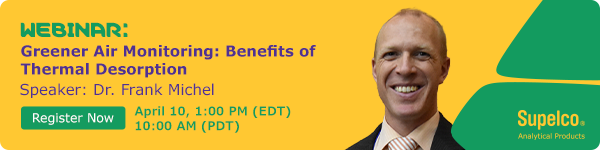
webinar banner image with title and time as well as speaker headshot with yellow and green background
Event Date
-
Event Type
Hosting Organization(s)
Merck Life Science Srl

Event Description

This webinar will take place at 1pm Eastern Time (7pm Central European Time). The same webinar is also being presented on April 9th at 10am Central European Time (see separate event listing here).

Air Monitoring is a very important analytical field in environmental analysis and industrial hygiene. It is a discipline whose sole aim is to ensure the air we breathe is safe and free from hazardous VOCs (Volatile Organic Compounds). VOCs can be emitted from products of daily use or emitted during the manufacturing of polymers, adhesives, paints, petroleum products or pharmaceuticals.

To monitor such compounds in the air, these are trapped in collection devices such as tubes or badges with adsorbents. For analysis, the trapped compounds need to be desorbed from the adsorbents. This could be achieved using a solvent (solvent desorption) or by heat (thermal desorption).

This webinar discusses the details of thermal desorption, its benefits and limitations compared to solvent desorption. In particular, it demonstrates why thermal desorption is the much greener approach for air monitoring using different application examples and metrics based on the 12 Principles of Green Analytical Chemistry for the greenness of analytical methods.

In this webinar, you will learn:

  • Theory and background of Thermal Desorption in Air Monitoring
  • 12 Principles of Green Analytical Chemistry
  • Approaches to assess the greenness of analytical methods
  • Sustainability advantages of Thermal Desorption


Speaker:

Frank Michel, Scientific Education & Sustainability, Merck KGaA, Darmstadt, Germany

Frank Michel received his diploma and PhD in Analytical Chemistry at University of Muenster/Germany. At Bernina Biosystems, a biopharmaceutical company, he developed and validated analytical HPLC and other methods for Active Pharmaceutical Ingredients (APIs), including excipients and drug products. Later Frank changed to Sigma-Aldrich and had various roles in Product Development, Marketing and Customer Education in Analytical Chemistry. After an engagement at HWI Analytik, an analytical service provider for the pharmaceutical industry, he returned in 2010 to Sigma-Aldrich (since Nov. 2015 part of Merck KGaA, Darmstadt, Germany) as Scientific Advisor for Analytical Chemistry. During his career, Frank focused already on Green Analytical Chemistry, e.g. by miniaturization in HPLC for solvent savings and the solvent-free extraction technology SPME. Since 2022 he is responsible for sustainability and training in Chemistry.

Frank is a member of both the Sustainable Chemistry and the Separation Science working group in the German Chemist Society (GDCh), member of the IUPAC project team “Greenness of official standard sample preparation methods” and in the EuChemS-DAC Sample Preparation Study Group and Network.

Green Chemistry as the Foundation of Sustainability and the Circular Economy

Green Chemistry Webinar with John Warner on 04/03/2025
Event Date
-
Event Type
Hosting Organization(s)
Merck Life Science Srl

Event Description

While there is a lot of discussion about WHY we need sustainability (Climate Change, Forever Chemicals, Human Toxicity, Ecosystem Degradation…) and WHAT we should do to measure and characterize sustainability (LCA’s, UN SDGs, Circular Economy, Safe and Sustainable by Design, Planetary Boundaries…) It is especially important to discuss HOW we should make these changes. This is the domain of Green Chemistry.

When a researcher contemplates a new experiment, when an inventor imagines a new product, he or she makes several small and large decisions that will have profound impact on the ultimate sustainability of what they do. If they do not have the skills and tools to understand the sustainability implications at the mechanistic molecular level (green chemistry), it is unlikely that they will successfully achieve sustainability objectives. This presentation will discuss how green chemistry can be integrated into the earliest stages of research and development to ensure maximum sustainability. Real world, commercialized examples will be used to illustrate key points.

In this webinar, you will learn:

  • The Why’s and the What’s of sustainability are important, but solutions come from How (green chemistry).
  • It is not enough to simply WANT to create sustainable technologies, there are certain critical skills required, as defined by the 12 principles of green chemistry.
  • Not only does green chemistry have moral and ethical implications, but it is also a pathway to accelerate R&D and lower costs. (If you truly understand green chemistry).
  • Several commercialize products illustrate the reality of green chemistry’s successful implementation in the real world.


Speaker:

John C. Warner

CEO & CTO, Technology Greenhouse, LLC


John Warner is one of the founders of the field of green chemistry. He wrote the book that provides the definition and 12 principles of green chemistry with Paul Anastas in 1998.He received his B.Sc. from UMASS Boston and his PhD from Princeton University.As an industrial chemist, he has over 350 patents and has worked with hundreds of companies worldwide and serves on the sustainability advisory boards of several multinational companies. He received the Perkin Medal in 2014 from The Society of Industrial Chemistry.As an educator, he was a tenured full professor of chemistry and a tenured full professor of plastics engineering at the University of Massachusetts where he started the world’s first PhD program in Green Chemistry. He has over 120 publications in synthetic methodologies, noncovalent derivatization, polymer photochemistry and metal oxide semiconductors. In 2004 he received the Presidential Award for excellence in science mentoring (PAESMEM) from the US National Science Foundation (NSF) and President George W Bush and in 2022 he received the August Wilhelm von Hofmann Medal from the German Chemical Society. In 2007 he cofounded Beyond Benign, a nonprofit green chemistry education organization with Dr. Amy Cannon.As an entrepreneur, John’s inventions have led to the founding of many companies in the fields of photovoltaics, neurochemistry, construction materials, water harvesting and cosmetics. In 2016 he received the Lemelson Invention Ambassadorship from the Lemelson Foundation and the American Association for the Advancement of the Sciences (AAAS).

Ecomapping® – A Practical Approach to Implement Sustainability in Your Lab

Ecomapping webinar on 04/02/2025
Event Date
-
Event Type
Hosting Organization(s)
Merck Life Science Srl

Event Description

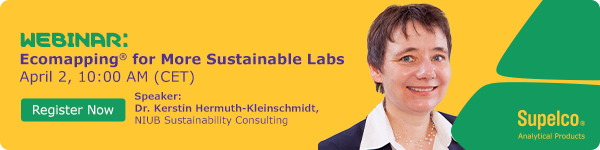
Laboratory work is resource intensive. Large equipment such as -80°C freezers use on average as much energy as a single-family home, plastic consumables are necessary but leave a huge amount of waste, and water consumption is also immense. So, the question is what to do? After all, samples have to be stored safely, experiments cannot be easily changed, and desirable measures are often simply not possible for safety reasons. Checklists and green lab guides can help and are a good starting point. However, every laboratory is different and has its own questions, hurdles and problems. A suggestion that is easy to implement for one lab may be difficult or even impossible for a neighboring group.

This is where Ecomapping® comes in. With its help, laboratories create an individual action plan. The core of the method is to focus on the environmental impacts of laboratory work, such as waste, water and energy consumption, emissions, chemicals and consumables, but safety aspects are also taken into account. This presentation explains the key features of the methodology and uses practical examples to give an insight into the improvements that laboratories can achieve using it.

After attending the webinar you can expect to:

  • Understand the concept of Ecomapping® and how it can be tailored to address the unique sustainability challenges in different laboratory environments.
  • Learn about the significant environmental impacts of laboratory operations, including energy consumption, waste generation, and water usage, and how to assess these factors effectively.
  • Discover practical strategies and actionable steps for implementing sustainability measures in your laboratory.
  • Learn about the successful application of the Ecomapping® method through best practice examples.


This webinar will be recorded and will be available on demand later, if the time doesn't fit to your time zone!


Speaker:


Dr. Kerstin Hermuth-Kleinschmidt

NIUB Sustainability Consulting


Kerstin Hermuth-Kleinschmidt graduated in chemistry and holds a PhD in microbiology from the university of Freiburg, Germany. She worked for several years in sales and technical customer service in the life science industry, before she turned her attention to the topic of sustainability. As an independent consultant, speaker and author of publications on various aspects of sustainability, her focus is now on the implementation and monitoring of sustainability processes and the practical implementation of sustainability in scientific work and research. She offers workshops and lectures on specific aspects of sustainability in laboratory and research work and the context of life sciences companies as well as individual support. In her daily work with labs, she uses the Ecomapping® method that helps labs to develop their individual action plan to make lab work more sustainable.

Since 2017, she has also been teaching as part of the “Studium Generale. Forum Wissenschaft und Gesellschaft” (FORUM) at KIT Karlsruhe as part of the Sustainable Development degree programme to pass on her knowledge to the younger generation.

Collaborative Initiatives to Reduce Chemical Hazards: A Path Forward

Event Date
-
Hosting Organization(s)
Harvard University

Event Description

Interdisciplinary discussion bringing together policy experts from Harvard’s Kennedy School, chemical industry, and the nonprofit ChemFORWARD 

How can we reduce the impacts of the most toxic chemicals in today's supply chains? 

Join the Belfer Center's Environment and Natural Resources Program for a discussion panel on the role of information access in enhancing environmental initiatives to reduce pollution and chemical toxins. Panelists - including Harvard Kennedy School experts, industry leaders, and representatives from ChemFORWARD, the 2024 winner of the Roy Award for Environmental Partnership - will explore the challenges that the private sector faces in addressing toxic pollution, the upsides and downsides of regulatory approaches, and lessons learned from a cross-sectoral approach to chemical hazard mitigation. 

Q&A to follow. Coffee and light refreshments will be served. 

Recording: A recording of the seminar will be made available on the Belfer Center's YouTube channel. 

Registration: RSVP required. A Harvard University ID is required for in-person attendance; all are welcome on Zoom 

Register here:  https://hksexeced.tfaforms.net/f/registration?e=a4oPp000001PwRdIAK

Event Format
Event Address

United States

Intended Audience
Keyword Tags

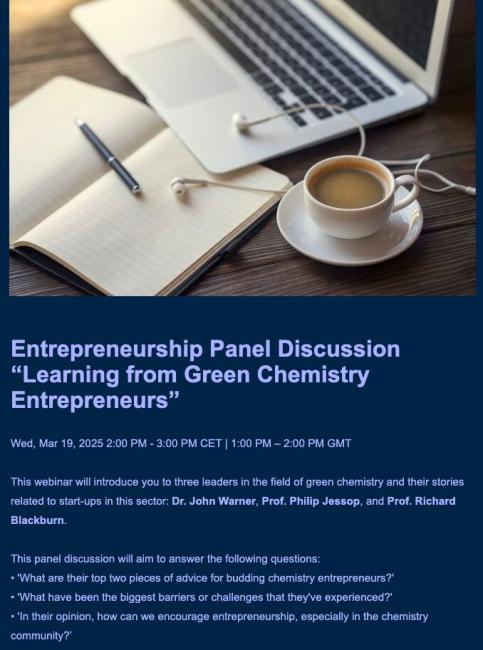
Entrepreneurship Panel Discussion “Learning from Green Chemistry Entrepreneurs”

description of event with image of a laptop and notebook and coffee
Event Date
-
Event Type
Hosting Organization(s)
International Union of Pure and Applied Chemistry

Event Description

This webinar will introduce you to three leaders in the field of green chemistry and their stories related to start-ups in this sector: Dr. John Warner, Prof. Philip Jessop, and Prof. Richard Blackburn.

This panel discussion will aim to answer the following questions: 
•    'What are their top two pieces of advice for budding chemistry entrepreneurs?'
•    'What have been the biggest barriers or challenges that they've experienced?'
•    'In their opinion, how can we encourage entrepreneurship, especially in the chemistry community?’

Event Format
Intended Audience

Navigating Sustainability in Higher Education in 2025

AASHE logo with blue purple and green ribbon over dark text
Event Date
Weekly on Tuesday, 1 - 2pm until Tue, Mar 25 2025
Recent
  • -
  • -
Event Type

Event Description

As the landscape of sustainability in higher education continues to evolve, we understand that the changing policies under the new federal administration are impacting campuses across the country. To help our members navigate these changes, and to offer support amidst so much change, AASHE will be hosting a discussion series every Tuesday throughout March. This series will be facilitated by AASHE staff and board leadership, and will offer a space for members to come together, discuss challenges, share insights, and explore how AASHE can best support campuses in these challenging times. While we may not have clear solutions, being in community with sustainability change agents will hopefully create an opportunity for collective processing and exploration of productive responses. 


  • When: Tuesdays in March (March 4, 11, 18, 25)
  • Time: 1:00 – 2:00 PM (EST)
  • Format: Informal, member-driven discussions facilitated by AASHE staff & board 
  • Location: Virtual via Zoom (link provided upon registration)


This is an opportunity for all AASHE members to connect, share experiences, and gain valuable insights from your peers as we collectively work toward advancing sustainability and climate action in higher education.

Event Format
Event Address

United States

Intended Audience

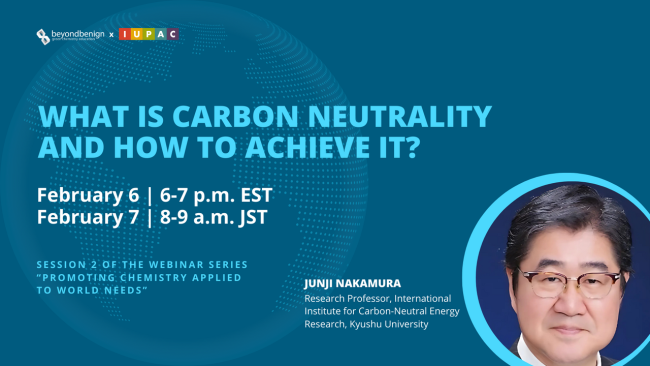
What is Carbon Neutrality, and How to Achieve It?

Decorative Image
Event Date
-
Event Type
Lead Organizers
Hosting Organization(s)
International Union of Pure and Applied Chemistry
Beyond Benign, Inc.

Event Description

Reducing total CO₂ emissions to zero is called #CarbonNeutrality. To achieve this, industrial and energy reforms must be undertaken within the next decade. However, the specific measures are not generally known…


Join us for a special webinar with Junji Nakamura, a Research Professor at the International Institute for Carbon-Neutral Energy Research, Kyushu University, to explore what the path to carbon neutrality looks like.

🗓️ When: February 6th from 6-7 p.m. EST / February 7th from 8-9 a.m. JST.


🧪 Register: This is the second installment of the webinar series, “Promoting Chemistry Applied to World Needs” presented by Beyond Benign and IUPAC CHEMRAWN. If you haven’t already registered for this free series, RSVP here! 


Weston Roundtable with Amy Cannon, University of WI, Madison

Decorative image of the UWM Center for Sustainability and the Global Environment Logo
Event Date
-
Event Type
Hosting Organization(s)
University of Wisconsin, Madison

Event Description

Weston Roundtable


The Weston Roundtable is made possible by a generous donation from Roy F. Weston, a highly accomplished UW-Madison alumnus. Designed to promote a robust understanding of sustainability science, engineering, and policy, these interactive lectures are co-sponsored by the Center for Sustainability and the Global Environment (SAGE), the Department of Civil and Environmental Engineering, and the Office of Sustainability.

Lectures are held 4:15–5:15 p.m. Thursdays in 1163 Mechanical Engineering. Some lectures will be presented online, which will require registration.

_____________________


Dr. Amy Cannon 


Amy received the world’s first Ph.D. in Green Chemistry. Holding an undergraduate degree in chemistry from Saint Anselm College (1997), Amy sought to use her chemistry degree within the field of sustainability. At the University of Massachusetts Boston, she met Dr. John Warner, who introduced her to green chemistry, a blossoming movement in the late 1990’s. It was there where they created a Ph.D. concentration in Green Chemistry, addressing the education gap in chemistry education – chemists were not being properly prepared with skills to design and create solutions to support the development and implementation of sustainable chemical products. After working in industry (Rohm and Haas, and Gillette Company) and academia (University of Massachusetts Lowell), Amy remained passionate about Green Chemistry education, recognizing the growing need for education systems to change to prepare scientists with Green Chemistry skills to address sustainability through chemistry. In 2007, Amy co-founded, Beyond Benign, a non-profit solely dedicated to advancing Green Chemistry education. Since inception, this organization has been leading Green Chemistry education initiatives in K-12 through higher education, focusing on empowering educators to make transformative change in their teaching and practice.  

Amy has been recognized for her work in research (Kenneth G. Hancock Memorial Award in Green Chemistry in 2004, for titanium dioxide semiconductors and their application in dye-sensitized solar cells) and also for her leadership in driving green chemistry education (2012 EPA New England Environmental Merit award). Beyond Benign’s work has also been recognized through the ACS NERM Partners for Progress and Prosperity (P3) Region Award (2016), and as a semi-finalist in the Buckminster Fuller Challenge (2013).  


Hear directly from Amy: 


Key publications: 


Event Format
Event Address

United States

Intended Audience

GCC Consortium: Insights and Opportunities

GCC Consortium: Insights and Opportunities
Event Date
-
Event Type
Lead Organizers
Hosting Organization(s)
Visayas State University Tolosa

Event Description

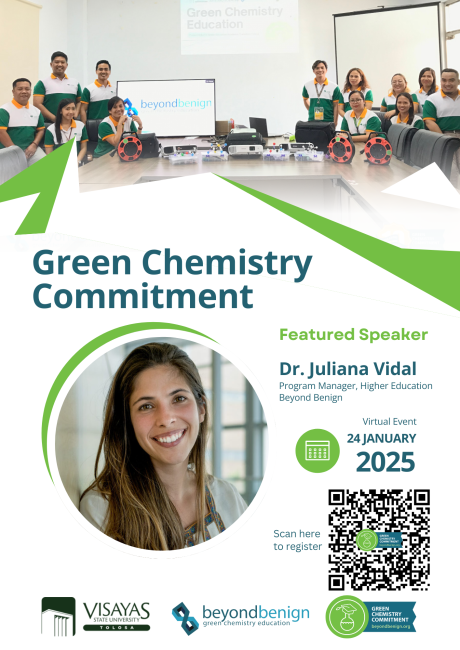
The Chemistry Faculty of Visayas State University - Tolosa is thrilled to reach out to Dr. Juliana Vidal, Program Manager for Higher Education at Beyond Benign, with an invitation to share her invaluable expertise on the Green Chemistry Commitment (GCC).

As proud members of the GCC consortium, we are organizing a series of virtual workshops focused on integrating green chemistry principles into academic curricula, and we believe Dr. Vidal’s insights will set the perfect tone for this initiative.

Nanoscale and nanotechnology for green and sustainable chemistry + Biomimicry

Decorative Image
Event Date
-
Event Type
Lead Organizers
Hosting Organization(s)
Beyond Benign, Inc.

Event Description

We’re kicking off 2025 with an exciting Green Chemistry Connections session! 🌱

Join us on January 15th from 8–10 a.m. UTC / 7–9 p.m. AEDT to explore nanoscale and nanotechnology for green and sustainable chemistry, alongside the brilliance of biomimicry. These topics showcase how Green Chemistry principles can be applied in innovative ways to solve global challenges. 

Our featured speakers include: 
– Sally Fierenzi, Royal Botanic Gardens Victoria
– Terry Turney, PhD, Sonic Essentials Pty Ltd & Monash University
(and others!)

↪️ This monthly webinar series is designed for educators, industry professionals, advocates, and anyone passionate about building a sustainable future through green chemistry. Register now to secure your spot and gain access to all events in the series, plus recordings: https://mailchi.mp/beyondbenign/connections?mc_cid=409bfe4d28&mc_eid=da8a16d315

Event Format
Event Address

United States

Intended Audience