- "Students are given the opportunity to assess chemical products and processes and design greener alternatives when appropriate."
- "Students understand and can evaluate the environmental, social, and health impacts of a chemical product over the life cycle of the product, from synthesis to disposal."
At the highest level of the ACS guidelines, students are expected to have a deeper understanding of and critical thinking skills around developing and designing greener chemical products and processes. This can include the various environmental, social and health aspects of a chemical product, in particular as it pertains to life cycle analysis.
GCTLC Library
Below are resources from the GCTLC library that are tagged with any of the following Green Chemistry Principles:
- #3 (Less Hazardous Chemical Syntheses)
- #4 (Design Safer Chemicals)
- #5 (Safer Solvents and Auxiliaries)
OR have been tagged with keyword "Life Cycle Assessment".
The variety of resources below should provide educators with numerous options to help tailor their lectures and courses with more green and sustainable chemistry content. However, if you have additional suggestions for resources, you can always submit them for inclusion in the GCTLC library, or you can post them in the forum "Green Chemistry Resources for Addressing the ACS Guidelines" on the GCTLC.

Infographic and Discussion on Application to Organic Chemistry I Lecture
In Organic Chemistry I, many connections can be made to the new reactions and content students learn. As such, in the lecture, students see weekly a connection to Green Chemistry Principles modeled in preparation for an infographic activity on one green principle. In this activity, students work in small groups of 2-3 students to create an infographic on one slide (ppt) and present it to their ...
Inorganic Chemistry
This module is part of a collection of nine green chemistry teaching modules developed in the early 2000s by a team of faculty (Donna Narsavage-Heald, Trudy Dickneider, David Marx, Timothy Foley, Joan Wasilewski) led by Michael Cann at the University of Scranton and has been migrated to the GCTLC. The subjects of the modules are based on winners of the Green Chemistry Challenge Awards. The modules ...
Integrating Artificial Intelligence (AI) Chatbots and Green Chemistry Principles in the Synthesis of Cyclohexene
This transformative undergraduate organic chemistry lab reimagines traditional instruction by embedding green chemistry principles and generative AI tools to elevate student engagement and learning outcomes. Piloted at a two-year college, the activity tasked students with synthesizing cyclohexene from cyclohexanol using safer, more sustainable catalysts—challenging them to rethink conventional ...
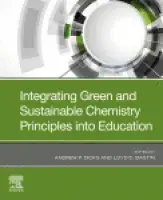
Integrating Green and Sustainable Chemistry Principles into Education
Integrating Green and Sustainable Chemistry Principles into Education draws on the knowledge and experience of scientists and educators already working on how to encourage green chemistry integration in their teaching, both within and outside of academia. It highlights current developments in the field and outlines real examples of green chemistry education in practice, reviewing initiatives and ...
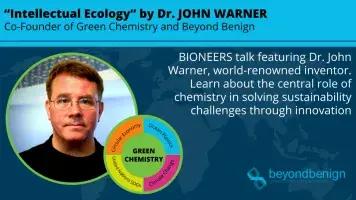
Intellectual Ecology by Dr. John Warner
Dr. John Warner speaks at a Bioneers conference in 2014 on "Intellectual Ecology". This is a great inspirational introductory video for understanding Green Chemistry.
Introduction to Systems Thinking in Chemistry
This module serves as a foundation and introduction to systems thinking in chemistry classes, introducing key terminology and concepts in systems thinking with specific ties to green and sustainable chemistry concepts and the United Nations Sustainable Development Goals (UN SDGs). The authors created this module to be useful for both instructors and students who may be new to systems thinking in ...
Involving Students in the Greening of the Organic Laboratory Curriculum
Additional Author: Kaitlyn Gerhart
When greening an organic chemistry laboratory, redesigning the course to educate students about green chemistry rather than simply greening the individual experiments is crucial. This chapter describes a process of redesigning the organic chemistry I laboratory from a microscale course into a green chemistry lab. An organic chemistry I laboratory course where ...
Iron (Fe) in Vitamins
This is an improvement over a similar lab published in Harris’ Analytical Chemistry text. Instead of using organics to form reddish solutions, the catechins or polyphenolic compounds in green tea form colored complexes with iron. UV-Vis spectroscopy in conjunction with Beer’s law can then be used to determine the concentration of Fe in vitamin tablets.
Other authors: Davis Winn (Georgia Gwinnett ...
Mannich Reactions in Room Temperature Ionic Liquids (RTILs): An Advanced Undergraduate Project of Green Chemistry and Structural Elucidation
Many people would argue that one of the ultimate goals of green chemistry should be to solely use water as a solvent if a solvent is needed at all. For reactions where water is not an option, a choice must be made from a wide variety of organic solvents. Recently room temperature ionic liquids (RTIL) have been receiving a lot of attention because of their chemical and thermal stability, low vapor ...
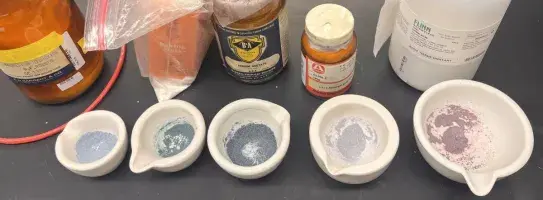
Mechanochemistry with Anthocyanin Indicators Using Solid Acids and Bases
In this activity, dried anthocyanin-containing flowers are combined with acidic, basic, and neutral powders using mortars and pestles in a demonstration of mechanochemistry. Students first research which solids they would like to use for this activity on the basis of maximum efficacy and minimum hazard. The data that they collect are used to inform the instructor as to which chemicals are to be ...