Conference

This is a description of a conference.

BioQUEST's BIOME 2025

BIOME 2025 Logo
Event Date
-
Hosting Organization(s)
Bioquest Curriculum Consortium

Event Description

BioQUEST is excited to announce applications for the virtual BIOME 2025 (July 21-23), an event to challenge the status quo and drive meaningful transformation in STEMM education, are now open! This year’s theme of Catalysts for Change: Empowering Faculty to Move Forward Together, for educators, researchers, and innovators to come together, share experiences, and gain the support they need to navigate today’s challenges in STEMM education. BioQUEST is excited to welcome participants to engage in open conversations about teaching through adversity, exchanging new ideas, and working together to find creative solutions. Don’t miss this opportunity to be part of the movement shaping the future of STEMM education. The general application deadline is May 16, and more information can be found in the BIOME 2025 page. 

2025 Innovators Roundtable

The Change Chemistry 2025 Innovators Roundtable is September 9-11 in Columbus, Ohio.
Event Date
-
Hosting Organization(s)
Change Chemistry

Event Description

The 2025 Innovators Roundtable will be an opportunity for Change Chemistry members and non-members to engage with leading innovators, investors, and government officials in the green and sustainable chemistry space.


Structured as a series of dialogues exploring topics, the gathering will provide attendees with opportunities to meet and engage with key players from across the globe. 


The 2025 Innovators Roundtable will be hosted by Battelle in Columbus, Ohio and will consist of participants from companies across sectors and the value chain as well as consultants, academics, government, and non-profits. 

ACS Great Lakes Regional Meeting (GLRM)

Decorative Image
Event Date
-
Event Type
Hosting Organization(s)
ACS Great Lakes Regional Board

Event Description

Chemistry for a Better Planet


This year’s theme is Chemistry for a Better Planet. Chemistry has led to hundreds of innovative solutions over the last several centuries and it will continue to do so. Chemistry helps us gain a better understanding of the world around us, in all facets of life: health care, environmental science, and more. Chemistry and the planet are closely intertwined with one another and there are connections at all different levels and scales. With this theme, we hope to encourage curiosity and ingenuity to explore and discover all the possibilities that exist between the two.


Thursday, June 5th, 2025

Workshop: Empowering Educators in Green Chemistry Education for a Better Planet

Veronica Mengqi Zhang, Ph.D. (Michigan State University), Monica Soma Hensley, Ph.D. (Beyond Benign) 


Workshop Description

Green chemistry education is essential for preparing students to address global environmental challenges and contribute to a sustainable and better planet. This interactive workshop aims to equip educators with the tools, knowledge, and resources required to integrate green chemistry principles into their teaching, advancing both sustainability and environmental responsibility.


Participants will gain a comprehensive understanding of the 12 Principles of Green Chemistry and explore various examples of green curricula resources, including lesson plans, lab activities, and case studies.


This workshop provides practical approaches and resources to "green" existing lectures and lab experiments across the chemistry curriculum, as well as guidance for designing standalone green chemistry courses. Additionally, attendees will be introduced to an on-demand online course that helps educators incorporate green chemistry into their teaching, fostering deeper student engagement in sustainable practices.


Through collaborative discussions and hands-on activities, educators will leave with actionable strategies to enhance their curricula and promote environmental responsibility in their classrooms and laboratories.

By the end of the workshop, participants will be able to:

  • Understand and apply the 12 Principles of Green Chemistry in educational settings to promote sustainable practices.
  • Explore and access green chemistry curricula resources, including lesson plans, lab activities, and case studies, to enhance sustainability-focused education.
  • Design and adapt green chemistry experiments and activities that engage students while reducing environmental impact.
  • Utilize an on-demand online course designed to teach educators how to integrate green chemistry into their own courses, supporting their professional development in expanding sustainability education across curricula.
Event Format
Event Address

United States

Intended Audience

39th Philippine Chemistry Congress

39th Philippine Chemistry Congress
Event Date
-
Lead Organizers
Hosting Organization(s)
Philippine Association of Chemistry Teachers Inc. (PACT)
Philippine Federation of Chemistry Societies (PFCS)

Event Description

The Philippine Association of Chemistry Teachers Inc. (PACT), in partnership with the Philippine Federation of Chemistry Societies (PFCS), is delighted to invite you to the 39th Philippine Chemistry Congress from July 2 to 4, 2025, at the Iloilo Convention Center (ICON), Mandurriao, Iloilo City. The theme, “Beyond the Orbitals: Exploring the Multi-Realms in Chemistry, promises an inspiring journey into the intersections of quantum science and chemistry. The Congress will bring together esteemed chemistry practitioners, scientists, and researchers from the industry, academe, and government agencies to discuss and highlight the scientific contributions of quantum science and technology to chemistry. We will focus on how these advancements drive research, foster innovation, and promote sustainable development.

AASHE 2025: A Strategic Forum for Higher Education Sustainability

AASHE 2025 Conference and Expo logo
Event Date
-
Lead Organizers
Hosting Organization(s)
Association for the Advancement of Sustainability in Higher Education (AASHE)

Event Description

The AASHE 2025 Conference & Expo, October 22-24 in Minneapolis, MN, is your strategic opportunity to lead the charge in higher education sustainability.


In a world demanding decisive action, this conference serves as a pivotal forum for:

  • Strategic Vision: Engage in high-level discourse on the evolving landscape of sustainability, and gain insights to inform your institution's long-term strategy.
  • Leadership Development: Connect with a network of influential peers, cultivate strategic partnerships, and enhance your capacity to drive meaningful change.
  • Knowledge Exchange: Participate in curated sessions designed to foster deep learning and facilitate the exchange of best practices among leading sustainability professionals.

This is more than a conference; it’s a catalyst for change! Secure your place and empower your institution's sustainability journey by registering before July 18 for early bird rates.

International Symposium on Green Chemistry

International Symposium on Green Chemistry Logo
Event Date
-
Event Type
Hosting Organization(s)
Centre national de la recherche scientifique (CNRS)
Additional Host Organizations
International Symposium on Green Chemistry

Event Description

Join the global movement in sustainable chemistry innovation!
 

The International Symposium on Green Chemistry (ISGC 2025), scheduled for May 12-16, 2025 in La Rochelle, France, is one of the world’s leading events in sustainable chemistry research and innovation. This global event is a cornerstone for advancing sustainable chemistry, bringing together academia, industry leaders, startups, and innovators from around the world.

Featuring over 320 speakers, cutting-edge plenary sessions, and innovative startups, it offers an unparalleled opportunity to connect and collaborate on advancements in green chemistry. Topics to be covered are:

  • Biomass conversion
  • Waste and side streams valorization
  • Homogenous, Heterogeneous and Biocatalysis
  • Polymers or composites
  • Alternative solvents
  • Alternative technologies such as microwaves, plasma, ultrasound, mechanochemistry, photochemistry, electrochemistry, etc.
  • Clean reactions such as tandem and cascade reactions, one-pot reactions, multicomponent reactions, etc.
  • Chemical engineering
  • Industrial chemistry
  • Energy such as hydrogen, energy storage, batteries, biofuels, solar cells, etc.
  • Mechanism investigations
  • Artificial intelligence
  • Life cycle and environmental assessment
  • Networking and education

The event also includes a 3,500 m² exhibition area, showcasing technologies and solutions that pave the way for a sustainable future. Don't miss your chance to be part of this milestone in chemistry innovation.


To learn more, visit ISGC Symposium Website (https://www.isgc-symposium.com/). Don't miss your chance to be part of this milestone in Greener Chemistry innovation!

Canadian Chemistry Conference and Exhibition (CSC 2025)

decorative image
Event Date
-
Event Type

Event Description

Canadian Chemistry Conference and Exhibition is the premier conference for the Canadian Society for Chemistry. The mission of the chemistry conference is to be your forum; a venue where you can embrace learning, exchange knowledge, build innovative ideas, advance your career, and advance the chemistry profession.


Taking part in the Canadian Chemistry Conference and Exhibition is an opportunity to grow, learn, connect, and celebrate all that Canadian chemistry has to offer.

This is the first year of the inaugural Green Division and there will be tons of green chemistry-related symposia and workshops throughout the conference!! Several will be led by Beyond Benign team members! Read more about them here

--

Beyond Benign Talks

Green and Sustainable Practices in Chemistry Education (CE/GC)

Barb Morra, University of Toronto; Jonathon Moir, Beyond Benign; Nimrat Obhi, Beyond Benign; Andrew Dicks, University of Toronto; Olivia Mann-Delany, University of Toronto

--

Chemistry education plays a critical role in training the next generation of chemists and engineers to consider the holistic impact of their work and actively explore ways to use more sustainable practices. This session aims to explore how educators can integrate green and sustainable chemistry practices into their classrooms, teaching laboratories, and programs. The session will be split into two parts: oral presentations followed up a workshop.


Part 1 (what are others doing with green chemistry in education?): This component will bring together instructors, teaching assistants, technical staff, and other educational stakeholders and provide them with a platform to showcase the creative ways they incorporate green and sustainable practices into their departments and curricula. Participants are encouraged to provide their unique perspective into the development, implementation, and learning outcomes of their pedagogical work, while considering how their efforts could be adopted by other instructors, particularly those with limited resources or experience with green and sustainable practices.


Part 2 (how can I add more green chemistry to my teaching?): The second part of the session will involve a workshop that provides an opportunity for educators to learn how to further adapt and implement more green and sustainable concepts into their own classrooms and laboratory using a guided inquiry approach. Workshop participants will work in small groups with facilitators to explore simple and effective approaches to updating their existing course/laboratory content and establish action plans toward implementation.


Bringing Green Chemistry into Your Lab – A Workshop for Graduate Students and Postdoctoral Fellows (GC)

Tuesday, June 17th from 8:00-11:40am in room 203 at the Rogers Center Ottawa

Jonathon Moir, Beyond Benign; Juliana Vidal, Beyond Benign; Nimrat Obhi, Beyond Benign; Barb Morra, University of Toronto; David Laviska, ACS GCI; Galen Yang, McGill University; Shauna Schechtel, Queen’s University

--

Research laboratories are some of the most energy and resource intensive spaces on university and college campuses. They generate large amounts of both hazardous and non-hazardous waste (including solvents, reagents, solids, glassware, filter paper, drying agents, disposable gloves, and column waste) daily. However, this is often considered a necessary evil and an acceptable price to pay to make innovative discoveries for the betterment of humanity. Fortunately, this does not need to be the case; research in higher education can be done in a way that allows for discovery and innovation to take place without generating large amounts of waste and subjecting students, postdoctoral fellows and researchers to hazardous compounds and laboratory conditions. Importantly, there are many safer alternative reagents, solvents, and laboratory materials that can be used to reduce risk of exposure. This approach, known as green chemistry, utilizes a set of twelve practical principles for research and bench chemists to help reduce the use and generation of hazardous substances for humans and the environment.


This workshop introduces green chemistry and how its associated twelve principles can be applied at the graduate and postdoctoral level in research laboratories across universities and colleges in Canada. The workshop will explore examples of how green chemistry has been successfully introduced into research labs in different subdisciplines of chemistry and will provide an opportunity for participants to work in small groups through guided discussions to identify ways of improving their own laboratory practices and research to shift towards greener and more sustainable practices.


Register Here.


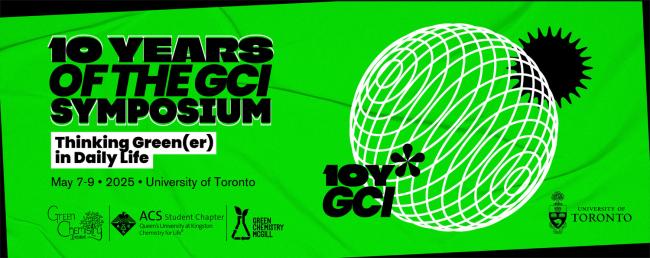
10 Years of The GCI Symposium: Thinking Green(er) in Daily Life

GCI Symposium Banner
Event Date
-
Hosting Organization(s)
Green Chemistry Initiative - University of Toronto
Green Chemistry McGill
Queen's University ACS Student Chapter

Event Description

We at the GCI are proud to announce our 10th annual GCI Symposium, organized in partnership with Green Chemistry McGill and Queen's University (Q-ACS)!


As a result of this great milestone, this symposium, titled 10 Years of The GCI Symposium: Thinking Green(er) in Daily Life, will celebrate all that we have been able to achieve in green chemistry, while thinking about how to broaden the scope of green chemistry to outside of the lab: in career, education, and society. This symposium is designed to connect students, post-doctoral fellows and faculty members interested in Green Chemistry with current leaders in the field to discuss advances in chemical processes and the future of sustainable research practices.


This symposium is a two and a half-day event, from May 7th - 9th, 2025. All events will be held at the University of Toronto – St. George Campus.


Important Dates

December 6th, 2024 - Registration opens
April 4th, 2025 - Early bird registration closes at 11:59 pm EDT
April 25th, 2025 - Regular registration closes at 11:59 pm EDT
April 16th, 2025 - Poster abstract submission closes at 11:59 pm EDT


Poster Abstract Submission & Travel Scholarship Application

We encourage all our attendees to submit a poster abstract for our poster networking session, taking place in the evening of Thursday, May 8th. Abstracts are limited to 200 words. Please note that posters do not require the inclusion/mention of Green Chemistry elements or aspects. However, all presenters are invited to look for opportunities to talk about Green Chemistry within the context of their research. Posters from previous conferences are welcome! Please make sure to submit your abstracts early, as they will be evaluated on a first-come-first-serve basis.


Additionally, we will be providing travel scholarships to alleviate some costs. The amount awarded is on a need-basis. Applications for the travel scholarship can be found on the second page of the poster abstract submission form.

Event Format
Event Address

80 St. George Street
Lash Miller Chemical Labs
Toronto ON M5S3H6
Canada

ACS Spring Meeting 2025

Decorative Image
Event Date
-
Event Type
Hosting Organization(s)
American Chemical Society (ACS)

Event Description

ACS Meetings & Expositions are where chemistry professionals meet to share ideas and advance scientific and technical knowledge. By attracting thousands of chemical professionals, the meetings provide excellent opportunities for sharing your passion for chemistry, connecting with one of the world's largest scientific societies, and advancing your career in this ever-changing global economy.


Mechanisms to Move the Oil and Gas Business to Green Chemistry

Presented by Dr. John Warner, Co-Founder of Beyond Benign; Co-Author of Green Chemistry: Theory and Practice; CEO of the Technology Greenhouse

Sunday, March 23rd from 8:00 - 11:00 AM PST | Marriot Grand Ballroom Section 11


To many people the oil and gas business represents one of the most unsustainable aspects of the chemical enterprises. In many ways this perception is deserved. But in some ways this perspective misses some important social implications. Because our global economy is currently dependent on this industry, we can’t simply decide to just stop overnight. It is going to take a very long time to create alternative technologies that meet the current global demands that the oil and gas business. In parallel to creating alternatives, we have a moral and ethical responsibility to take as many steps as possible to improve the sustainability performance of the myriad integrated processes to this business.. This presentation will discuss the challenges and opportunities that must be addressed as soon as possible.


Green Chemistry and Circular Economy Opportunities for Soft Materials

Presented by Dr. John Warner, Co-Founder of Beyond Benign; Co-Author of Green Chemistry: Theory and Practice; CEO of the Technology Greenhouse

Sunday, March 23rd from 4:20 - 4:25 PM PST | Ballroom 6D


Soft materials provide molecular mechanisms that allow the design of products capable of achieving sustainability goals (green chemistry and circular economy). Unique reversible and irreversible interactions that create flexible molecular architectures provide structural resilience and adaptation in various environments. These systems under dynamic equilibria offer customized product performance and enable circular economic models of reuse. This presentation will discuss examples of noncovalent derivatization and photo crosslinked polymer matrices as bioinspired illustrations of commercially relevant technologies that are consistent with the 12 principles of green chemistry.


Advancing Green Chemistry Education: The Process, Research and New Developments in Curricular Activities

Organized by: Dr. Deborah Bromfield-Lee, Dr. Monica Soma Hensley, & Dr. Jane Wissinger

Wednesday, March 26th from 8:00– 11:00 AM PST | Room 5B


There is an increase in educational activities aimed at enhancing knowledge and use of Green Chemistry principles and applications. However, with demands in academia, this sometimes presents a barrier to wider adoption across the curriculum. This symposium explores the process of developing Green Chemistry activities, courses, and curricular changes, sharing how educators got started and progressed through development. The discussion will cover research, theory-based methodology, and pedagogical strategies used to revamp or develop activities, as well as chemical education research on this process. The session will also discuss the pivotal role of change agents—educators and researchers who drive the adoption of innovative practices and sustainable principles in education. By sharing the developmental journey and the theoretical underpinnings of our assessment strategies, the session aims to contribute to the broader discourse on advancing Green Chemistry education and to inspire ongoing research and implementation of effective teaching methodologies. Speakers from all sectors of the CHED community are invited to share how they are integrating green and sustainable chemistry, systems-thinking, toxicology, and social/environmental justice into their classrooms, laboratory curriculum, undergraduate research and outreach activities. Interdisciplinary and international perspectives are welcome, as are student speakers at the undergraduate, graduate and post-doctoral levels, including those from minority-serving institutions.


Fostering Green Chemistry Education: Enhancing Curricula and Faculty Development through Industry Collaboration and Open-Access Curriculum Development

Presented by Dr. Monica Soma Hensley

Wednesday, March 26th from 10:25 – 10:45 AM PST | Room 5B


The incorporation of green chemistry principles as a decision-making framework into academic curricula is essential for preparing students for sustainable careers in chemistry and related fields. This process requires the development of curricular materials that are both relevant and accessible, as well as a professional development infrastructure to support educators in this endeavor. Beyond Benign, a nonprofit organization focused on green chemistry education, has created a comprehensive framework that fosters faculty development through open-access resource creation and collaborative opportunities with industry experts. One key initiative is the faculty-led, faculty-developed approach to curriculum design, which incorporates industrial expertise to ensure real-world relevance. This partnership exemplifies how industrial collaboration can enhance curricular content, making it more applicable to current industry standards while supporting faculty in their professional growth.

In this presentation, notable case studies will be highlighted to showcase how Beyond Benign promotes collaboration for developing open-access curricular activities, and the impact of these initiatives on faculty development, resource creation, and the broader adoption of green chemistry education across academic institutions. Additionally, findings from a faculty survey highlighting the professional development needs of educators in green chemistry will be shared.


Environmental Justice: Community Engagement, Education and Action Through Green and Sustainable Chemistry and Chemical Engineering

Organized by: Dr. Loyd Bastin, Dr. Edward Brush, Dr. Tsvetanka Filipova, Dr. Nimrat Obhi, Dr. Laurel Royer, and Dr. Jane Wissinger

Thursday, March 27th from 8:00 AM– 12:00 PM PST | Marriott Grand Ballroom: Section 5


This symposium will explore the growing need for the chemistry and chemical engineering enterprises to adopt green chemistry and green engineering principles and practices through the lens of environmental justice. The United States Environmental Protection Agency defines Environmental Justice as the fair treatment and meaningful involvement of all people regardless of race, color, national origin, or income, with respect to the development, implementation, and enforcement of environmental laws, regulations, and policies . . .achieved when everyone enjoys: (1) The same degree of protection from environmental and health hazards, and (2) Equal access to the decision-making process to have a healthy environment in which to live, learn, and work. This symposium will engage a multi-stakeholder, multi-disciplinary discourse of speakers and participants focused on a re-evaluation of our business-as-usual practices through the lens of environmental justice: community groups and organizations, education (especially project-based and/or civic learning with environmental justice communities); careers at the intersection of green chemistry and environmental justice; sustainable chemistry technologies; sustainable engineering; connections to the UN Sustainable Development Goals; climate justice; policy statements; and industrial practices. The symposium will include an open discussion on Strengths, Opportunities, Aspirations and Results for the critical role that environmental justice will play in the chemistry and chemical engineering enterprises because it provides a framework to address global environmental and human health impacts that continue to disproportionately burden communities of color, vulnerable and low-income populations.


Event Format
Event Address

San Diego, CA
United States

Intended Audience

29th Annual Green Chemistry & Engineering Conference

GC&E Conference Banner
Event Date
-
Event Type
Lead Organizers
Hosting Organization(s)
American Chemical Society Green Chemistry Institute (ACS GCI)

Event Description

The GC&E Conference, hosted by the ACS Green Chemistry Institute®, is the premier global event for green chemistry and engineering. As the first and longest-running conference on this topic, GC&E attracts scientists, educators, industry professionals, and advocates to explore advancements, share best practices, inspire innovation, and build community dedicated to sustainable solutions.


Each year, the conference evolves, incorporating new ideas while maintaining its 28-year legacy. Its vision is for green and sustainable chemistry to be integral to all scientific endeavors, providing solutions that balance human well-being with planetary health. For this reason, the 2025 conference theme will be Good Health and Well-Being Through Sustainable Chemistry to align withthe United Nations Sustainable Development Goal 3.

GC&E 2025 will showcase innovative research and cross-cutting topics in green and sustainable chemistry and engineering, with an emphasis on symposia that highlight our theme “Good Health and Well-Being”, such as medical breakthroughs, new technologies, and efforts to eliminate or reduce hazardous chemical pollution promoting longer and healthier lives.


Beyond Benign Talks and Social Events


“Design and development of an on-demand introductory course to infuse green chemistry in the undergraduate curriculum”

Dr. Deborah Bromfield Lee, Professor of Chemistry, Florida Southern College


“Case study on sustainable practices in metal plating for Green Chemistry education”

Dr. Hun Bok Jung, Assistant Professor Department of Physical Sciences, Kingsborough Community College


“An online course for the chemistry education community: empowering educators to bring environmental justice discussions into the classroom”

Dr. Monica Soma Hensley, Content Manager, Beyond Benign


““Soy” What? We’ve “bean” incorporating soybean-based industrial innovations into the chemistry curriculum”

Dr. Jane Wissinger, Professor Emerita, Department of Chemistry, University of Minnesota


"Institutional Change for a Sustainable Future: Beyond Benign and the Green Chemistry Commitment"

Dr. Juliana Vidal, Dr. Amy Cannon,  Dr. Omar Villanueva, and Dr. Natalie O’Neil


"Mechanochemistry and Green Chemistry: A Connection Between Education, Research, and Innovation for a Healthier Planet"

Juliana Vidal, Beyond Benign; James Batteas, Texas A&M University; Francesca Kerton, Memorial University; Isaiah Speight, William & Mary


"Comprehensive survey on the implications of green chemistry and toxicology concepts in chemistry education: An industry and academic perspective"

Nesta Bortey-Sam, University of Pittsburgh


"Development of a green chemistry and toxicology professional development certificate course"

Douglas Raynie, South Dakota State University


"Green Chemistry Resources in the Classroom"

Thomas P. Umile, Villanova University; Jennifer A. Tripp, University of San Francisco; Monica Soma Hensley, Beyond Benign; Amy S. Cannon, Beyond Benign; David Laviska, Green Chemistry Institute, American Chemical Society


Image
Decorative image


Green Chemistry Commitment: Catalysts for Change Reception

Come mix and mingle with Beyond Benign, MilliporeSigma (the U.S. and Canada Life Science business of Merck KGaA, Darmstadt, Germany), and the American Chemical Society Green Chemistry Institute at 6 PM on Sunday, June 22nd, 2025 at Sienna Mercato's rooftop bar, il Tetto.

Embrace the unique opportunity to connect with current leaders in the field of green chemistry and find resources to help lead a sustainable future.
Current green chemistry leaders joining this event include members of industry, as well as faculty members who are signers of Beyond Benign's Green Chemistry Commitment.

Enjoy free food and drinks and unique networking opportunities-- all against the beautiful Pittsburgh skyline at a scenic, award-winning venue.

Who: Chemistry Faculty, Undergraduate and Graduate Students
What: A chance to connect with likeminded young chemistry leaders and influencers in the green chemistry space.
When: Sunday, June 22nd at 6:00 PM EST
Where: il Tetto at Sienna Mercato, 942 Penn Ave, Pittsburgh, PA 15222


Catalyzing Change in Chemistry Education Faculty Luncheon

Join Beyond Benign, MilliporeSigma (the U.S. and Canada Life Science business of Merck KGaA, Darmstadt, Germany), and the American Chemical Society Green Chemistry Institute (ACS GCI) for a free, catered luncheon on June 24th, 2025 at the ACS Green Chemistry and Engineering Conference.


Who: Chemistry faculty, administrators, and student leaders interested in generating departmental support for green chemistry implementation.

What: A lunch panel of faculty members who are leading a systemic change in education through the Green Chemistry Commitment (GCC) at their institutions.

Panel moderators: Dr. Amy Cannon (Executive Director & Co-Founder of Beyond Benign) and Jeffrey Whitford Vice President of Sustainability & Social Business Innovation at MilliporeSigma, will bring their own expertise as green chemistry leaders.

Where: Sterlings 1, 2, & 3

When: Tuesday, June 24th, 2025 at 12:30 PM EDT
The GCC program is a collaborative voice created to unite the higher education chemistry community towards green chemistry principles and practices and further its size, reach, and diversity. Join us to learn all the benefits that the students, faculty, and staff in your department can gain access to when they join the GCC.

Register on the GC&E Website