Sustainable Chemistry
Webinar on "Metrics & Mandates: Driving Chemistry Toward a Greener Future"

Event Date
-
Event Type
Hosting Organization(s)
American Chemical Society (ACS)
Event Description
As sustainability continues to guide both corporate and academic decision-making in the lab, chemists are increasingly tasked with evaluating the environmental impact of their work early in process development.
Understanding what makes a chemical reaction sustainable and having the tools to assess and improve it is a crucial skill in modern chemistry. Join Jonathan Tripp of Gilead Sciences as he explores practical methods and tools chemists can use to enhance reaction sustainability, as well as how to quantify the benefits of different process options using well-established metrics.
In addition to internally led initiatives to improve the sustainability of chemical processes, the U.S. Federal Government continues to implement new regulations that impact the work of industrial and academic chemists. With the EPA’s ruling on methylene chloride (also known as dichloromethane) taking effect under Section 6(a) of the Toxic Substances Control Act as of July 8, 2024, academic institutions must now plan for compliance with industrial and commercial uses to follow in 2026. Join Amanda Chung of UNC Chapel Hill as she shares how her institution has addressed this regulatory shift through collaboration, communication, and program development to ensure safe, compliant use of methylene chloride in research and teaching labs.
This ACS Webinar is moderated by Edmond Lam of the ACS Green Chemistry Institute and is coproduced by ACS Government Affairs.
What You Will Learn
- What factors contribute to the sustainability of a chemical reaction
- What tools are available to assess and improve the sustainability of chemical processes
- What are the key sustainability metrics and how they’re calculated and applied
- How the new methylene chloride rule impacts academic institutions
- What steps has UNC Chapel Hill taken to develop and implement a compliant program
- What are the takeaways from exposure monitoring at UNC-CH and implications for lab safety
Event Details
- Thursday, August 14, 2025 @ 2-3:30pm ET
- Free to attend
- Slides will be available to download on the day of the webinar
More Information About Event
Event Registration
Research Assistant Postdoc
The University is looking for the Institute of Sustainable Chemistry, Professorship of Sustainable Chemistry of Renewable Organic Resources, for a responsible, motivated and committed and aware of the importance of chemistry person to start as soon as possible.
2025 Innovators Roundtable
Event Date
-
Event Type
Hosting Organization(s)
Change Chemistry
Event Description
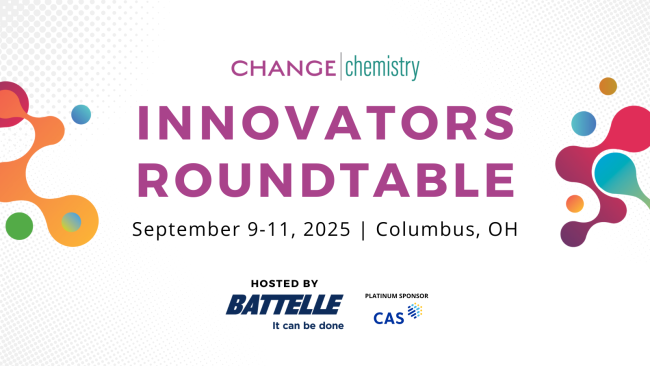
The 2025 Innovators Roundtable will be an opportunity for Change Chemistry members and non-members to engage with leading innovators, investors, and government officials in the green and sustainable chemistry space.
Structured as a series of dialogues exploring topics, the gathering will provide attendees with opportunities to meet and engage with key players from across the globe.
The 2025 Innovators Roundtable will be hosted by Battelle in Columbus, Ohio and will consist of participants from companies across sectors and the value chain as well as consultants, academics, government, and non-profits.
More Information About Event
Event Registration
Event Format
Event Address
United States
International Symposium on Green Chemistry

Event Date
-
Event Type
Hosting Organization(s)
Centre national de la recherche scientifique (CNRS)
Additional Host Organizations
International Symposium on Green Chemistry
Event Description
Join the global movement in sustainable chemistry innovation!
The International Symposium on Green Chemistry (ISGC 2025), scheduled for May 12-16, 2025 in La Rochelle, France, is one of the world’s leading events in sustainable chemistry research and innovation. This global event is a cornerstone for advancing sustainable chemistry, bringing together academia, industry leaders, startups, and innovators from around the world.
Featuring over 320 speakers, cutting-edge plenary sessions, and innovative startups, it offers an unparalleled opportunity to connect and collaborate on advancements in green chemistry. Topics to be covered are:
- Biomass conversion
- Waste and side streams valorization
- Homogenous, Heterogeneous and Biocatalysis
- Polymers or composites
- Alternative solvents
- Alternative technologies such as microwaves, plasma, ultrasound, mechanochemistry, photochemistry, electrochemistry, etc.
- Clean reactions such as tandem and cascade reactions, one-pot reactions, multicomponent reactions, etc.
- Chemical engineering
- Industrial chemistry
- Energy such as hydrogen, energy storage, batteries, biofuels, solar cells, etc.
- Mechanism investigations
- Artificial intelligence
- Life cycle and environmental assessment
- Networking and education
The event also includes a 3,500 m² exhibition area, showcasing technologies and solutions that pave the way for a sustainable future. Don't miss your chance to be part of this milestone in chemistry innovation.
To learn more, visit ISGC Symposium Website (https://www.isgc-symposium.com/). Don't miss your chance to be part of this milestone in Greener Chemistry innovation!
More Information About Event
Event Registration
Event Format
Event Address
Espace Encan
Quai Louis Prunier
17033 La Rochelle
France
Intended Audience
Greener Air Monitoring by Thermal Desorption (April 9)
Event Date
-
Event Type
Hosting Organization(s)
Merck Life Science Srl
Event Description
This webinar will take place at 10am Central European Time (4am Eastern Time). The same webinar is also being presented on April 10th at 1pm Eastern Time (see separate event listing here).
Air Monitoring is a very important analytical field in environmental analysis and industrial hygiene. It is a discipline whose sole aim is to ensure the air we breathe is safe and free from hazardous VOCs (Volatile Organic Compounds). VOCs can be emitted from products of daily use or emitted during the manufacturing of polymers, adhesives, paints, petroleum products or pharmaceuticals.
To monitor such compounds in the air, these are trapped in collection devices such as tubes or badges with adsorbents. For analysis, the trapped compounds need to be desorbed from the adsorbents. This could be achieved using a solvent (solvent desorption) or by heat (thermal desorption).
This webinar discusses the details of thermal desorption, its benefits and limitations compared to solvent desorption. In particular, it demonstrates why thermal desorption is the much greener approach for air monitoring using different application examples and metrics based on the 12 Principles of Green Analytical Chemistry for the greenness of analytical methods.
In this webinar, you will learn:
- Theory and background of Thermal Desorption in Air Monitoring
- 12 Principles of Green Analytical Chemistry
- Approaches to assess the greenness of analytical methods
- Sustainability advantages of Thermal Desorption
Speaker:
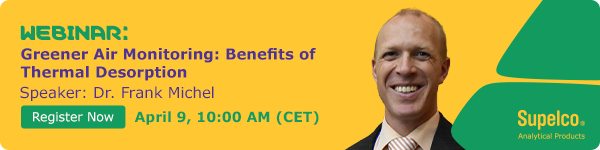
Frank Michel, Ph.D. Technical Marketing, Scientific Education & Sustainability, Merck KGaA, Darmstadt, Germany
Frank Michel received his diploma and PhD in Analytical Chemistry at University of Muenster/Germany. At Bernina Biosystems, a biopharmaceutical company, he developed and validated analytical HPLC and other methods for Active Pharmaceutical Ingredients (APIs), including excipients and drug products. Later Frank changed to Sigma-Aldrich and had various roles in Product Development, Marketing and Customer Education in Analytical Chemistry. After an engagement at HWI Analytik, an analytical service provider for the pharmaceutical industry, he returned in 2010 to Sigma-Aldrich (since Nov. 2015 part of Merck KGaA, Darmstadt, Germany) as Scientific Advisor for Analytical Chemistry. During his career, Frank focused already on Green Analytical Chemistry, e.g. by miniaturization in HPLC for solvent savings and the solvent-free extraction technology SPME. Since 2022 he is responsible for sustainability and training in Chemistry.
Frank is a member of both the Sustainable Chemistry and the Separation Science working group in the German Chemist Society (GDCh), member of the IUPAC project team “Greenness of official standard sample preparation methods” and in the EuChemS-DAC Sample Preparation Study Group and Network.
More Information About Event
Event Registration
Event Format
Intended Audience
Ecomapping® – A Practical Approach to Implement Sustainability in Your Lab
Event Date
-
Event Type
Hosting Organization(s)
Merck Life Science Srl
Event Description
Laboratory work is resource intensive. Large equipment such as -80°C freezers use on average as much energy as a single-family home, plastic consumables are necessary but leave a huge amount of waste, and water consumption is also immense. So, the question is what to do? After all, samples have to be stored safely, experiments cannot be easily changed, and desirable measures are often simply not possible for safety reasons. Checklists and green lab guides can help and are a good starting point. However, every laboratory is different and has its own questions, hurdles and problems. A suggestion that is easy to implement for one lab may be difficult or even impossible for a neighboring group.
This is where Ecomapping® comes in. With its help, laboratories create an individual action plan. The core of the method is to focus on the environmental impacts of laboratory work, such as waste, water and energy consumption, emissions, chemicals and consumables, but safety aspects are also taken into account. This presentation explains the key features of the methodology and uses practical examples to give an insight into the improvements that laboratories can achieve using it.
After attending the webinar you can expect to:
- Understand the concept of Ecomapping® and how it can be tailored to address the unique sustainability challenges in different laboratory environments.
- Learn about the significant environmental impacts of laboratory operations, including energy consumption, waste generation, and water usage, and how to assess these factors effectively.
- Discover practical strategies and actionable steps for implementing sustainability measures in your laboratory.
- Learn about the successful application of the Ecomapping® method through best practice examples.
This webinar will be recorded and will be available on demand later, if the time doesn't fit to your time zone!
Speaker:
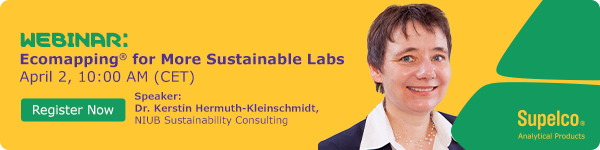
Dr. Kerstin Hermuth-Kleinschmidt
NIUB Sustainability Consulting
Kerstin Hermuth-Kleinschmidt graduated in chemistry and holds a PhD in microbiology from the university of Freiburg, Germany. She worked for several years in sales and technical customer service in the life science industry, before she turned her attention to the topic of sustainability. As an independent consultant, speaker and author of publications on various aspects of sustainability, her focus is now on the implementation and monitoring of sustainability processes and the practical implementation of sustainability in scientific work and research. She offers workshops and lectures on specific aspects of sustainability in laboratory and research work and the context of life sciences companies as well as individual support. In her daily work with labs, she uses the Ecomapping® method that helps labs to develop their individual action plan to make lab work more sustainable.
Since 2017, she has also been teaching as part of the “Studium Generale. Forum Wissenschaft und Gesellschaft” (FORUM) at KIT Karlsruhe as part of the Sustainable Development degree programme to pass on her knowledge to the younger generation.
More Information About Event
Event Registration
Event Format
Intended Audience
Modern Approaches to High School Chemistry Instruction Through Today’s Sustainability Challenges
Event Date
-
Event Type
Lead Organizers
Hosting Organization(s)
University of Minnesota
NSF Center for Sustainable Polymers
Additional Host Organizations
UMN MRSCEC Research Experience for Teachers
Event Description
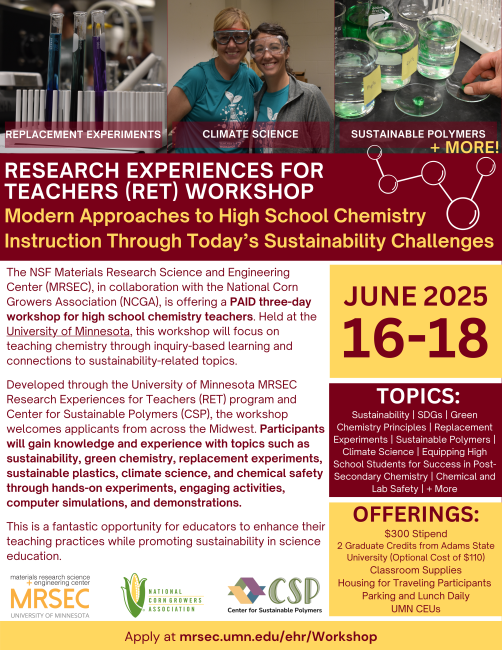
The NSF Materials Research Science and Engineering Center (MRSEC), in collaboration with the National Corn Growers Association (NCGA), is offering a PAID three-day workshop for high school chemistry teachers. Held at the University of Minnesota, this workshop will focus on teaching chemistry through inquiry-based learning and connections to sustainability-related topics.
Developed through the University of Minnesota MRSEC Research Experiences for Teachers (RET) program and Center for Sustainable Polymers (CSP), the workshop welcomes applicants from across the Midwest. The workshop is in-person only.
Participants will gain knowledge and experience with topics such as sustainability, green chemistry, replacement experiments, sustainable plastics, climate science, and chemical safety through hands-on experiments, engaging activities, computer simulations, and demonstrations.
This is a fantastic opportunity for educators to enhance their teaching practices while promoting sustainability in science education.
More Information About Event
Event Format
Event Address
207 Pleasant St SE
Minneapolis, MN 55455
United States
Intended Audience