- "Students are given the opportunity to assess chemical products and processes and design greener alternatives when appropriate."
- "Students understand and can evaluate the environmental, social, and health impacts of a chemical product over the life cycle of the product, from synthesis to disposal."
At the highest level of the ACS guidelines, students are expected to have a deeper understanding of and critical thinking skills around developing and designing greener chemical products and processes. This can include the various environmental, social and health aspects of a chemical product, in particular as it pertains to life cycle analysis.
GCTLC Library
Below are resources from the GCTLC library that are tagged with any of the following Green Chemistry Principles:
- #3 (Less Hazardous Chemical Syntheses)
- #4 (Design Safer Chemicals)
- #5 (Safer Solvents and Auxiliaries)
OR have been tagged with keyword "Life Cycle Assessment".
The variety of resources below should provide educators with numerous options to help tailor their lectures and courses with more green and sustainable chemistry content. However, if you have additional suggestions for resources, you can always submit them for inclusion in the GCTLC library, or you can post them in the forum "Green Chemistry Resources for Addressing the ACS Guidelines" on the GCTLC.
An Asymptotic Approach to the Development of a Green Organic Chemistry Laboratory
This article provides a rationale and stepwise process for evaluating and improving the "greenness" of an undergraduate organic chemistry laboratory curriculum. After emphasizing the educational value of sharing this process with students, effective risk assessment is discussed as an important tool for both evaluating and redesigning laboratory exercises. The greening process is illustrated by ...
An Innovation Studio Leans into the Power of Green Chemistry
Schoolab is an innovation studio that pairs student teams with corporate partners to solve real-world business & design challenges. In the US, they run a program at the University of California Berkeley called "Deplastify the Planet."
Recently it became clear that the sustainable design solutions they were trying to create would benefit tremendously from taking their design thinking all the ...
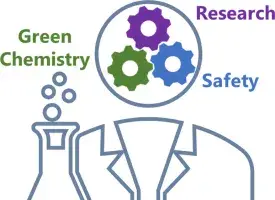
Approaches to Incorporating Green Chemistry and Safety into Laboratory Culture
This is an open access article linked from the Journal of Chemical Education article. It highlights a systems thinking approach to incorporating green chemistry and safety into laboratory culture. This article, emphasizes how framing green chemistry through the lens of systems thinking can build a culture of safety in the laboratory.
Aqueous-Phase Palladium-Catalyzed Coupling. A Green Chemistry Laboratory Experiment
This experiment highlights both the importance of palladium-catalyzed coupling reactions and the need for finding greener solvents. The aqueous-phase coupling of iodobenzene and diethylphosphite is a great example of how a reaction can be made greener with a relatively straightforward modification. By simply sulfonating triphenylphosphine, students will be synthesizing a water-solubilizing ligand ...
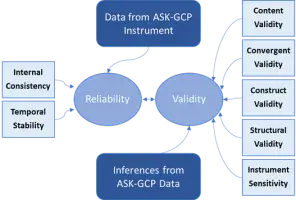
Assessment of Student Knowledge of Green Chemistry Principles
The following abstract is excerpted from the linked external resource.
"As implementation of green chemistry into university-level courses increases, it is vital that educators have a tool to rapidly measure student knowledge of green chemistry principles. We report the development of the Assessment of Student Knowledge of Green Chemistry Principles (ASK-GCP) and evaluation of its sensitivity ...
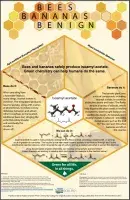
Bees, Bananas, Benign - Green Chemistry Poster
Poster promoting green chemistry.
Isoamyl acetate is used in many products, adding banana flavor to food, providing a sweet smell, or serving as an ingredient in varnishes. The trouble is that isoamyl acetate is synthesized through the Fischer esterification reaction, which requires the use of sulfuric acid as a catalyst and ether to extract the chemical. Using the principles of green chemistry ...

Beyond Benign Greener Solvent Guide
The greener solvent guide by Beyond Benign was created based on existing solvent selection guides available in the literature (referenced in the attached PDF). It was meant to help synthesize the information in existing guides into a simple graphic that can be quickly referenced and placed in the workplace for ease-of-use and access. The guide is often printed as a magnet and placed in ...
Biochemistry
This module is part of a collection of nine green chemistry teaching modules developed in the early 2000s by a team of faculty (Donna Narsavage-Heald, Trudy Dickneider, David Marx, Timothy Foley, Joan Wasilewski) led by Michael Cann at the University of Scranton and has been migrated to the GCTLC. The subjects of the modules are based on winners of the Green Chemistry Challenge Awards. The modules ...

Bioleaching of Rare Earth Fluorescent Lamp Phosphors Using Kombucha
Rare earth elements (REEs) are critical for modern technologies but are rarely recycled, with less than 1% recovered from waste products. Yttrium, a key component in fluorescent lamps and light emitting diodes, poses particular recycling challenges despite its high concentration in such materials. Here, we present an innovative bioleaching approach for yttrium recovery using the fermented tea ...
Bringing State-of-the-Art, Applied, Novel, Green Chemistry to the Classroom by Employing the Presidential Green Chemistry Challenge Awards
In 1995 President Clinton introduced the Presidential Green Chemistry Challenge (PGCC) Awards Program. The program was created to acknowledge companies and individuals who research and develop technologies "that promote pollution prevention and industrial ecology through a new EPA Design for the Environment partnership with the chemical industry." In this article, Dr. Michael Cann discusses two ...