
Bioleaching of Rare Earth Fluorescent Lamp Phosphors Using Kombucha
Bioleaching of Rare Earth Fluorescent Lamp Phosphors Using Kombucha
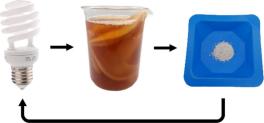
fluorescent lightbulb with an arrow to a glass of kombucha with an arrow to a weighboat with white powder with an arrow back to the fluorescent bulb
Summary
Rare earth elements (REEs) are critical for modern technologies but are rarely recycled, with less than 1% recovered from waste products. Yttrium, a key component in fluorescent lamps and light emitting diodes, poses particular recycling challenges despite its high concentration in such materials. Here, we present an innovative bioleaching approach for yttrium recovery using the fermented tea beverage Kombucha in the context of science communication and outreach. Kombucha contains organic acid producing microorganisms, which can mobilize yttrium from a model phosphor mixture. In this experiment, high school students prepare Kombucha, mix it with phosphor powder, and allow bioleaching to occur over 7 to 14 days. The dissolved yttrium is then precipitated as yttrium oxalate using oxalic acid and thermally converted back to yttrium oxide. Yields of yttrium oxide ranged from 7% to 13%, depending on the maturity of the Kombucha culture and the experimental conditions. This model experiment enables students to understand bioleaching as a sustainable alternative to conventional chemical extraction, illustrating its advantages such as reduced environmental impact and energy use. Furthermore, it highlights the potential of bioleaching to improve the recycling of critical materials such as yttrium, aligning with circular economy goals.

Full citation: Fritz, A.P.; Daumann, L.J.; Schwarzer, S. J. Chem. Educ. 2025, DOI: https://doi.org/10.1021/acs.jchemed.4c01532
Learning Goals/Student Objectives
-Provide an introduction to the fundamental principles of bioleaching for high school students.
-Link to contemporary chemical research, demonstrating how innovative scientific approaches address real-world challenges.
-Compare and explain the advantages and disadvantages of bioleaching in comparison to chemical extraction methods as well as evaluate the sustainability benefits inherent to bioleaching.
-Critically assess the potential of integrating bioleaching into larger recycling systems as part of a circular economy framework.
-Develop a deeper understanding of the role of chemistry in addressing environmental challenges and fostering sustainable technologies
-Recognize the increasing relevance of interdisciplinary solutions that merge chemistry and biology.
Object Type
Laboratory experiment
Journal articles
Audience
High School (Secondary School)
Introductory Undergraduate
Common pedagogies covered
Hands-on learning
Green Chemistry Principles
Waste Prevention
Safer Solvents and Auxiliaries
Use of Renewable Feedstocks
U.N. Sustainable Development Goals (SDGs)
Sustainable Cities and Communities
Responsible Consumption and Production
Safety Precautions, Hazards, and Risk Assessment
See linked article for full details. For safety reasons, protective goggles and lab coats should always be worn. Oxalic acid poses health risks, such as skin and eye irritation on contact, and can be harmful if swallowed. When the Bunsen burner is used, there is a risk of burn injuries due to the open flame. The prepared Kombucha was in contact with laboratory equipment and therefore should not be consumed.

Share This

Submitted by

Published on
Moderation state
Published
Creative Commons License