- "Students are given the opportunity to assess chemical products and processes and design greener alternatives when appropriate."
- "Students understand and can evaluate the environmental, social, and health impacts of a chemical product over the life cycle of the product, from synthesis to disposal."
At the highest level of the ACS guidelines, students are expected to have a deeper understanding of and critical thinking skills around developing and designing greener chemical products and processes. This can include the various environmental, social and health aspects of a chemical product, in particular as it pertains to life cycle analysis.
GCTLC Library
Below are resources from the GCTLC library that are tagged with any of the following Green Chemistry Principles:
- #3 (Less Hazardous Chemical Syntheses)
- #4 (Design Safer Chemicals)
- #5 (Safer Solvents and Auxiliaries)
OR have been tagged with keyword "Life Cycle Assessment".
The variety of resources below should provide educators with numerous options to help tailor their lectures and courses with more green and sustainable chemistry content. However, if you have additional suggestions for resources, you can always submit them for inclusion in the GCTLC library, or you can post them in the forum "Green Chemistry Resources for Addressing the ACS Guidelines" on the GCTLC.

Calorimetry
Three “coffee-cup” calorimetry experiments:
1) Use of the Law of Dulong and Petit to identify an unknown metal
2) Measurement of the enthalpy of sublimation of dry ice
3) Exploration of the relationship between surface area and the rate of heat transfer and the amount of heat transferred
Featuring contributions from Tamara Fitzjarrald
Carbonyls Redox: Aldehydes and Ketones
This module covers aldehydes and ketones as the substrates and products of redox reactions. Structure is explained with both Lewis structures and molecular orbitals to discuss mechanisms in the context of green chemistry. Students need to be familiar with organic functional groups, reactions, and proposing a mechanism.
The goal of this module is to understand the structure, reactions, and uses of ...
Careers Highlighting Green Chemistry and Sustainable Design in Chemical or Product Manufacturing Companies
This resource provides a list of videos and written stories that can be used in career exploration with students in secondary and higher education. Resources highlight careers that make use of green chemistry and sustainable design principles.
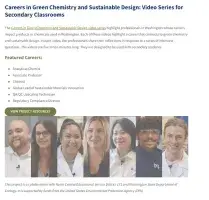
Careers in Green Chemistry and Sustainable Design: Video Series for Secondary Classrooms and Activity Guide
The Careers in Green Chemistry and Sustainable Design video series highlights professionals in Washington whose careers impact products or chemicals used in Washington. Each of these videos highlights a career that connects to green chemistry and sustainable design. In each video, the professionals share their reflections in response to a series of interview questions. The videos are five to ten ...
Catalyzing the Development of Self-Efficacy and Science Identity: A Green Organic Chemistry CURE
To remain globally competitive, education in the United States must focus on retaining students in science, technology, engineering, and mathematics (STEM). As laboratory courses have the potential to be powerful attractors or deterrents to a field, developing effective laboratory pedagogies is important to retain students in STEM. A course-based undergraduate research experience (CURE) is one ...
CHE 1110 Chemistry, Biochemistry, and Society Outreach Project
Students sometimes struggle to see the direct connection between these concepts and real-life applications. The objective of a Chemistry learning community course (first year seminar style course) is to have student groups explore a topic from General Chemistry 1 through an accompanying learning community course (which could also be integrated directly into the General Chemistry course).In this ...
CHEM21 selection guide of classical- and less classical-solvents
This article provides a ranking of and selection guide for both classical and less classical solvents, based on existing solvent selection guides as well as a set of proposed criteria on Health, Safety and Environment aligned with the Global Harmonized System (GHS) and European regulations. More details are available in the linked article.
Full citation: Prat, D.; Wells, A.; Hayler, J.; Sneddon ...
ChemFORWARD Module Overview
The ChemFORWARD module aims to help instructors teach students how to use the ChemFORWARD platform to obtain hazard information for specific chemicals, and to identify safer chemicals to replace chemicals of concern in research and in product formulations.
The module is organized into two units. Each unit contains a unit overview, specific learning outcomes, course alignment, prerequisites ...
ChemFORWARD Module Unit 1: Introduction to ChemFORWARD, and Use of ChemFORWARD to Find Safer Chemical Alternatives
This unit provides details on the organization and use of the ChemFORWARD platform, the information that can be obtained using the platform, and how to use the platform to find safer chemical alternatives for chemicals of concern. Details are provided in the ChemFORWARD How-To Guide. Pertinent slides with screenshots are provided. Students can be directed to the diethyl phthalate example ...
ChemFORWARD Module Unit 2: Avoiding Regrettable Substitutions, Natural Is Not Always Safer
This unit reiterates the importance of avoiding regrettable substitutions, emphasizes the importance of data gaps, and also cautions that naturally-occurring chemicals are not always safer, regardless of the many claims made in some consumer products.
This module unit was reviewed by Julian Silverman (Ph.D.) and Sarah Prescott (Ph.D.).
The inspiration of this work began with a Forsythia ...