- "Students are given the opportunity to assess chemical products and processes and design greener alternatives when appropriate."
- "Students understand and can evaluate the environmental, social, and health impacts of a chemical product over the life cycle of the product, from synthesis to disposal."
At the highest level of the ACS guidelines, students are expected to have a deeper understanding of and critical thinking skills around developing and designing greener chemical products and processes. This can include the various environmental, social and health aspects of a chemical product, in particular as it pertains to life cycle analysis.
GCTLC Library
Below are resources from the GCTLC library that are tagged with any of the following Green Chemistry Principles:
- #3 (Less Hazardous Chemical Syntheses)
- #4 (Design Safer Chemicals)
- #5 (Safer Solvents and Auxiliaries)
OR have been tagged with keyword "Life Cycle Assessment".
The variety of resources below should provide educators with numerous options to help tailor their lectures and courses with more green and sustainable chemistry content. However, if you have additional suggestions for resources, you can always submit them for inclusion in the GCTLC library, or you can post them in the forum "Green Chemistry Resources for Addressing the ACS Guidelines" on the GCTLC.

Putting the squeeze on imine synthesis: citrus juice as a reaction medium in the introductory organic laboratory
This article highlights a less hazardous and energy-efficient organic synthesis utilizing freshly squeezed citrus juice as a solvent that was developed for a sophomore-level laboratory course. The experiment enables students to engage with key green chemistry principles, including waste prevention, atom economy, the use of safer chemicals, and energy efficiency. In the experiment, 4 ...
Qualitative & Quantitative Gas Stoichiometry and Determination of an Unknown Alkali Carbonate
This experiment looks at two types of chemical reactions that produce hydrogen and carbon dioxide gases. It explores both qualitative observations (no measurements or numbers involved) about the reactions, as well as quantitative measurements of the volume of gas produced to explore concepts of stoichiometry and the ideal gas law. These concepts will be used to relate the stoichiometry of gas ...
Re-casting traditional organic experiments into green guided-inquiry based experiments: student perceptions
This article uses Green Chemistry principles to recast traditional Organic chemistry experiments into more guided inquiry-based experiments. It provides an overview of how traditional labs have been revamped to allow Green Chemistry principles to be taught through the labs. Lee, D. B. (2019). Recasting traditional organic experiments into green guided inquiry-based experiments: student perceptions ...
Reductive Amination: A Remarkable Experiment for the Organic Laboratory
There are many tools that a synthetic organic chemist can use to synthesize amines; one of which is reductive amination. This common method of introducing the amine functionality is especially crucial for the synthesis of pharmaceuticals and biomolecules.
A typical reductive amination is a one-pot reaction involving a solvent, an aldehyde or ketone, an amine, and a weakened reducing agent. This ...
Reprocessable Networks from Vegetable Oils, Salts, and Food Acids: A Green Polymer Outreach Demonstration
This educational resource presents a hands-on outreach demonstration to explore the concepts of green polymer chemistry and sustainability. The lesson focuses on reprocessable polymer networks—a key innovation in sustainable material development—using common household ingredients such as vegetable oils, citric acid, and baking soda. Students learn about the environmental challenges posed by ...
Rudolph Diesel Meets the Soybean: “Greasing” the Wheels of Chemical Education
This article explores the role of biodiesel as a sustainable alternative to petroleum-based fuels, highlighting its historical context, chemical principles, and practical applications. It discusses the contributions of Rudolph Diesel, who originally designed his engine to run on vegetable oil, and examines the modern shift toward biodiesel as an environmentally friendly solution to energy ...
Safer Stuff: Green Chemistry Gets Down to Business
This resource is an introduction to green chemistry and is episode 1 of a 7 episode documentary series, Safer Stuff: Green Chemistry Gets Down to Business, which is an upbeat exploration of solutions to the problem of toxic chemicals in everyday products and the part green chemistry plays.
The inspiring story of green chemistry is told through interviews with the originators of the field (Paul ...
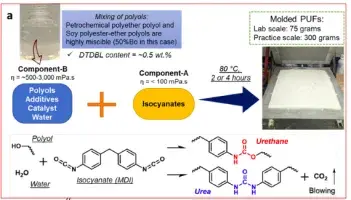
Scalable manufacturing and reprocessing of vitrimerized flexible polyurethane foam (PUF) based on commercial soy polyols
This Learning Object introduces students to Green Chemistry principles through a case study on recyclable flexible polyurethane foams (PUFs) using renewable soy-based polyols. Based on “Scalable manufacturing and reprocessing of vitrimerized flexible polyurethane foam (PUF) based on commercial soy polyols” the study demonstrates how commercial soy polyols can partially replace petrochemical ...
Solvent Selection for SN1 and SN2 Reactions in Green and Sustainable Chemistry
This module explores nucleophilic substitution reactions and how solvent selection correlates to reaction mechanisms for SN1 and SN2 reactions (i.e., reaction product, selectivity, and stereochemistry). Solvents are discussed with respect to environmental, health, safety, and life-cycle considerations. This module can be used when nucleophilic substitution reactions are introduced and is designed ...
Solvent-Free Synthesis of Chalcones
Chalcones represent a group of compounds with interesting biological activities that are formed from an aldol condensation between a benzaldehyde and an acetophenone in the presence of NaOH as a catalyst. Although typically synthesized using organic solvents, in this exercise students prepare 20 different chalcones using a solventless procedure. The scale of these reactions can be easily modified ...