Faculty or University Instructors

Canadian Chemistry Conference and Exhibition (CSC 2025)
decorative image
Event Date
-
Event Type

Event Description

Canadian Chemistry Conference and Exhibition is the premier conference for the Canadian Society for Chemistry. The mission of the chemistry conference is to be your forum; a venue where you can embrace learning, exchange knowledge, build innovative ideas, advance your career, and advance the chemistry profession.


Taking part in the Canadian Chemistry Conference and Exhibition is an opportunity to grow, learn, connect, and celebrate all that Canadian chemistry has to offer.

This is the first year of the inaugural Green Division and there will be tons of green chemistry-related symposia and workshops throughout the conference!! Several will be led by Beyond Benign team members! Read more about them here

--

Beyond Benign Talks

Green and Sustainable Practices in Chemistry Education (CE/GC)

Barb Morra, University of Toronto; Jonathon Moir, Beyond Benign; Nimrat Obhi, Beyond Benign; Andrew Dicks, University of Toronto; Olivia Mann-Delany, University of Toronto

--

Chemistry education plays a critical role in training the next generation of chemists and engineers to consider the holistic impact of their work and actively explore ways to use more sustainable practices. This session aims to explore how educators can integrate green and sustainable chemistry practices into their classrooms, teaching laboratories, and programs. The session will be split into two parts: oral presentations followed up a workshop.


Part 1 (what are others doing with green chemistry in education?): This component will bring together instructors, teaching assistants, technical staff, and other educational stakeholders and provide them with a platform to showcase the creative ways they incorporate green and sustainable practices into their departments and curricula. Participants are encouraged to provide their unique perspective into the development, implementation, and learning outcomes of their pedagogical work, while considering how their efforts could be adopted by other instructors, particularly those with limited resources or experience with green and sustainable practices.


Part 2 (how can I add more green chemistry to my teaching?): The second part of the session will involve a workshop that provides an opportunity for educators to learn how to further adapt and implement more green and sustainable concepts into their own classrooms and laboratory using a guided inquiry approach. Workshop participants will work in small groups with facilitators to explore simple and effective approaches to updating their existing course/laboratory content and establish action plans toward implementation.


Bringing Green Chemistry into Your Lab – A Workshop for Graduate Students and Postdoctoral Fellows (GC)

Tuesday, June 17th from 8:00-11:40am in room 203 at the Rogers Center Ottawa

Jonathon Moir, Beyond Benign; Juliana Vidal, Beyond Benign; Nimrat Obhi, Beyond Benign; Barb Morra, University of Toronto; David Laviska, ACS GCI; Galen Yang, McGill University; Shauna Schechtel, Queen’s University

--

Research laboratories are some of the most energy and resource intensive spaces on university and college campuses. They generate large amounts of both hazardous and non-hazardous waste (including solvents, reagents, solids, glassware, filter paper, drying agents, disposable gloves, and column waste) daily. However, this is often considered a necessary evil and an acceptable price to pay to make innovative discoveries for the betterment of humanity. Fortunately, this does not need to be the case; research in higher education can be done in a way that allows for discovery and innovation to take place without generating large amounts of waste and subjecting students, postdoctoral fellows and researchers to hazardous compounds and laboratory conditions. Importantly, there are many safer alternative reagents, solvents, and laboratory materials that can be used to reduce risk of exposure. This approach, known as green chemistry, utilizes a set of twelve practical principles for research and bench chemists to help reduce the use and generation of hazardous substances for humans and the environment.


This workshop introduces green chemistry and how its associated twelve principles can be applied at the graduate and postdoctoral level in research laboratories across universities and colleges in Canada. The workshop will explore examples of how green chemistry has been successfully introduced into research labs in different subdisciplines of chemistry and will provide an opportunity for participants to work in small groups through guided discussions to identify ways of improving their own laboratory practices and research to shift towards greener and more sustainable practices.


Register Here.


Green Chemistry Commitment Info Session

A decorative image
Event Date
-
Hosting Organization(s)
Beyond Benign, Inc.

Event Description

Image
A button that says register now


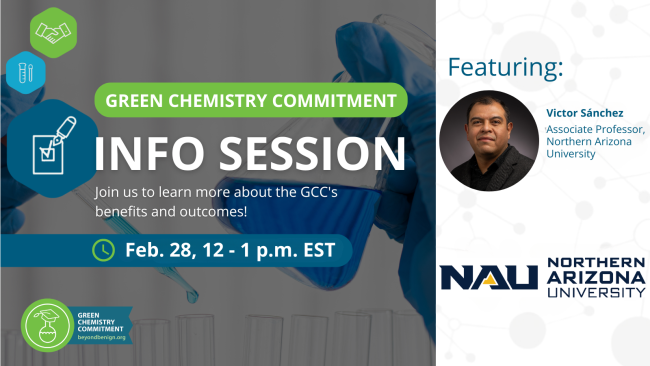
Higher education faculty, students, and staff—shape the future of chemistry education and innovation with us! Learn how the Green Chemistry Commitment (GCC) program can help integrate green chemistry at your institution during this info session from 12-1 p.m. EST. We’ll be joined by Victor Sánchez, Associate Professor at Northern Arizona University, who will share how the GCC supports Northern Arizona University’s green chemistry goals. RSVP today and spread the word!


About Victor:

Website: https://sites.google.com/view/ramossanchezlabatnau/


Prof. Ramos Sánchez joined the Northern Arizona University in 2023 and is currently an Associate Professor in the Department of Chemistry and Biochemistry before he was appointed Tenured Professor in the Faculty of Chemical Sciences (Facultad de Ciencias Químicas in Spanish) at the Autonomous University of Chihuahua (Universidad Autónoma de Chihuahua in Spanish) from 2011 to 2022. During his sabbatical, he was appointed a Visiting Professor at the University of California, San Diego, in 2019. Previously, he was a Lecturer at the Polytechnic University of Chiapas (Universidad Politécnica de Chiapas in Spanish) from 2009 to 2011. Prof. Ramos Sánchez holds a Ph.D. in Chemistry from the University of Sheffield in the United Kingdom and a bachelor’s degree in industrial chemistry from the Autonomous University of Chihuahua. His main area of research focuses on the design and implementation of sustainable materials and processes for hydrogen production and fuel cells, which has led him to accumulate extensive expertise in the development of green routes of synthesis and analysis. Additionally, he collaborates enthusiastically with other fellow researchers in exciting areas such as food technology and environmental science, offering strategies of instrumental analysis for different scientific challenges.


Prof. Ramos Sánchez has received research grants from the U.S. Department of Energy, the Mexican Council of Science and Technology, and the Ministry of Higher Education and contracts from local industrial partners (plastics, aerospace, and agroindustry). His publications have appeared in prestigious journals such as the Journal of Chemical Education, Chemical Engineering Journal, Journal of Material Chemistry A, ACS Environmental Science & Technology, ACS Sustainable Chemistry & Engineering, International Journal of Hydrogen Energy, Catalysis Today, and Carbon, among others. As a result of his research, Professor Ramos Sánchez was granted one patent in Mexico.


Prof. Ramos Sanchez has contributed to the development of human resources both as a research advisor/mentor and as an instructor, teaching courses in instrumental analysis, physical chemistry, general chemistry and sustainable chemistry. He has served as an academic advisor in the elaboration and evaluation of the Mexican Standardized National Assessment of BSc in Chemistry (EGEL-Q/CENEVAL, A.C.)


Image
A button that says register now


17th Green Chemistry Postgraduate Summer School (GCSS 2025)

17th Green Chemistry Postgraduate Summer School (GCSS 2025)
Event Date
-
Event Type
Lead Organizers
Hosting Organization(s)
Green Sciences for Sustainable Development Foundation

Event Description

The 17th Green Chemistry Postgraduate Summer School (GCSS 2025) continues its tradition of fostering international collaboration and advancing Green Chemistry education. Building on past successes, this prestigious event will bring together leading scientists, industry experts, and top postgraduate students to explore key topics, including:

Benign synthesis routes & green catalysis
Alternative solvents & renewable materials
Sustainable polymers & clean processes
Green chemistry for energy & education

With support from sponsors, scholarships will be awarded to outstanding students from developing countries, covering both virtual and on-site participation. Participants will also have the opportunity to present their research in poster sessions, with awards for the best contributions.

Beyond learning, GCSS 2025 provides a platform for networking, knowledge exchange, and global research collaboration. The event will take place both in-person in Venice and online.

🌱 Don’t miss this opportunity to be part of the future of Green Chemistry!


Deadline for applications is April 30th, 2025.

10 Years of The GCI Symposium: Thinking Green(er) in Daily Life

GCI Symposium Banner
Event Date
-
Hosting Organization(s)
Green Chemistry Initiative - University of Toronto
Green Chemistry McGill
Queen's University ACS Student Chapter

Event Description

We at the GCI are proud to announce our 10th annual GCI Symposium, organized in partnership with Green Chemistry McGill and Queen's University (Q-ACS)!


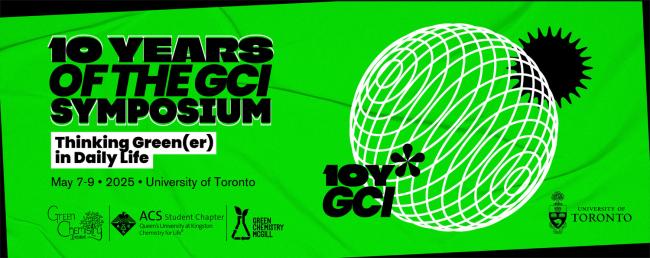
As a result of this great milestone, this symposium, titled 10 Years of The GCI Symposium: Thinking Green(er) in Daily Life, will celebrate all that we have been able to achieve in green chemistry, while thinking about how to broaden the scope of green chemistry to outside of the lab: in career, education, and society. This symposium is designed to connect students, post-doctoral fellows and faculty members interested in Green Chemistry with current leaders in the field to discuss advances in chemical processes and the future of sustainable research practices.


This symposium is a two and a half-day event, from May 7th - 9th, 2025. All events will be held at the University of Toronto – St. George Campus.


Important Dates

December 6th, 2024 - Registration opens
April 4th, 2025 - Early bird registration closes at 11:59 pm EDT
April 25th, 2025 - Regular registration closes at 11:59 pm EDT
April 16th, 2025 - Poster abstract submission closes at 11:59 pm EDT


Poster Abstract Submission & Travel Scholarship Application

We encourage all our attendees to submit a poster abstract for our poster networking session, taking place in the evening of Thursday, May 8th. Abstracts are limited to 200 words. Please note that posters do not require the inclusion/mention of Green Chemistry elements or aspects. However, all presenters are invited to look for opportunities to talk about Green Chemistry within the context of their research. Posters from previous conferences are welcome! Please make sure to submit your abstracts early, as they will be evaluated on a first-come-first-serve basis.


Additionally, we will be providing travel scholarships to alleviate some costs. The amount awarded is on a need-basis. Applications for the travel scholarship can be found on the second page of the poster abstract submission form.

Event Format
Event Address

80 St. George Street
Lash Miller Chemical Labs
Toronto ON M5S3H6
Canada

Creating and Growing Green Labs Programs

Event Date
-
Event Type
Hosting Organization(s)
Association for the Advancement of Sustainability in Higher Education (AASHE)

Event Description

This workshop will bring together representatives from various green labs programs to share strategies for establishing and expanding green labs on university campuses. With the significant environmental impact of scientific research, it is essential for R1 institutions to implement green labs initiatives to help meet sustainability and climate goals. Green labs programs not only enhance lab safety but also equip scientists with essential skills in efficiency and sustainability, which are increasingly valued in the research field. These programs have proven to save institutions money and positively impact energy and water conservation, waste reduction, community building, and educational opportunities for researchers, students, and faculty. The workshop will cover a range of topics, including program setup, funding sources, stakeholder engagement, incentive strategies, and the structural elements that drive program success. Participants will have ample opportunities to ask questions, engage in discussions, and participate in smaller group sessions for deeper exploration and problem-solving on specific topics.


Learning Outcomes

  1. Gain insights into effective strategies for starting and scaling green labs programs on university campuses.
  2. Understand the environmental, financial, and educational benefits of green labs initiatives.
  3. Learn about various funding sources, engagement tactics, and incentive strategies to support green labs programs.
  4. Explore best practices for building a strong network of campus stakeholders to drive green labs initiatives.
  5. Engage in collaborative discussions and problem-solving with peers to address challenges and share successful approaches.

Facilitators

  • Kathryn Ramirez-Aguilar, Green Labs Program Manager, University of Colorado Boulder
  • Ryan Weeks, Sr. Sustainability Specialist, Green Labs & Zero Waste, Johns Hopkins University
  • Emily Colpack, Green Labs Coordinator, University of Alabama at Birmingham
  • Leoncio Lagarde, Green Labs Program Assistant & Outreach Coordinator, University of Colorado Boulder
     

Registration Fees


Individual (non-student) associated with an AASHE member organization* -- $95

Individual (non-student) not associated with an AASHE member organization -- $125

Student -- $50

Groups -- Full price for first registrant and 20% off for each subsequent registrant

* To check if your organization is a current AASHE member, please search the AASHE Membership Directory.


A limited number of scholarships are available to individuals who need financial assistance to participate. Please apply two weeks before the program begins (e.g., 2/20/2025) to be considered for a scholarship for this workshop.

GCC Consortium: Insights and Opportunities

GCC Consortium: Insights and Opportunities
Event Date
-
Event Type
Lead Organizers
Hosting Organization(s)
Visayas State University Tolosa

Event Description

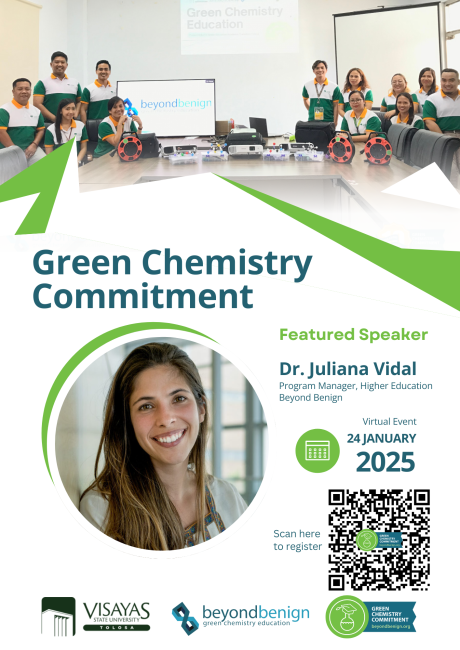
The Chemistry Faculty of Visayas State University - Tolosa is thrilled to reach out to Dr. Juliana Vidal, Program Manager for Higher Education at Beyond Benign, with an invitation to share her invaluable expertise on the Green Chemistry Commitment (GCC).

As proud members of the GCC consortium, we are organizing a series of virtual workshops focused on integrating green chemistry principles into academic curricula, and we believe Dr. Vidal’s insights will set the perfect tone for this initiative.

Promoting Chemistry Applied to World Needs

decorate image
Event Date
-
Event Type
Hosting Organization(s)
International Union of Pure and Applied Chemistry
Beyond Benign, Inc.

Event Description

Are you an aspiring chemist, a passionate climate advocate, or an interested member of the public? Do you want to change the world through science? Join the IUPAC CHEMRAWN and Beyond Benign throughout 2025 to learn from experts in the field who are leading the charge to solve existential, world needs through chemistry. Speakers will orient their presentations around the United Nations Sustainable Development Goals (UN SDGs), as well as the IUPAC Top 10 Emerging Technologies, to demonstrate the power that chemists hold in shaping, and preserving, the future. 

Each talk will be accompanied by  2-3 minute videos on the topic, for chemistry students in high school, university, and for the general public.


January Webinar 


“From Detoxifying Chemical Warfare Agents to Treating Nuclear Wastewater: Adventures in the Synthesis of Metal–Organic Frameworks” 

Ashlee Howarth, Concordia University

01/24/2025 | 9:00 – 10:00 AM EST


Webinar Description:

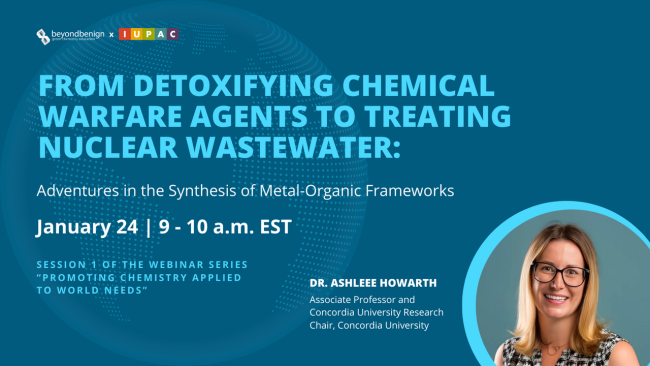
Named by IUPAC as one of the “Top 10 Emerging Technologies in Chemistry” in 2019, what can metal-organic frameworks (MOFs) really do? IUPAC CHEMRAWN Committee and Beyond Benign invite you to learn more about MOFs and join the discussion with Prof. Ashlee Howarth from Concordia University! Prof. Howarth is dedicated to using green chemistry principles and practices to design and synthesize rare-earth cluster-based MOFs which can then be applied to clean up wastewater from coal and nuclear power plants, as well as decontaminate military equipment. Other applications investigated by Ashlee also include catalysis, drug delivery, X-ray detection, and chemical sensing applications to solve our current environmental challenges. 


More About Professor Ashlee Howarth:

Ashlee J. Howarth is an Associate Professor and Concordia University Research Chair at Concordia University in Montréal. She was born and raised in London, Ontario. She obtained her undergraduate degree from the University of Western Ontario in 2009, and then went on to do her PhD in inorganic materials chemistry at the University of British Columbia under the supervision of Michael O. Wolf. Before joining the faculty at Concordia, she completed an NSERC Postdoctoral Fellowship at Northwestern University with Joseph T. Hupp and Omar K. Farha. At Concordia, the Howarth group is focused on the design and synthesis of rare-earth cluster-based metal–organic frameworks targeting applications in pollution remediation, catalysis, drug delivery, X-ray detection, and chemical sensing. Ashlee is also the contact point for the Green Chemistry Commitment at Concordia University.


Leuphana University - MSc & MBA Sustainable Chemistry - Online Information Event

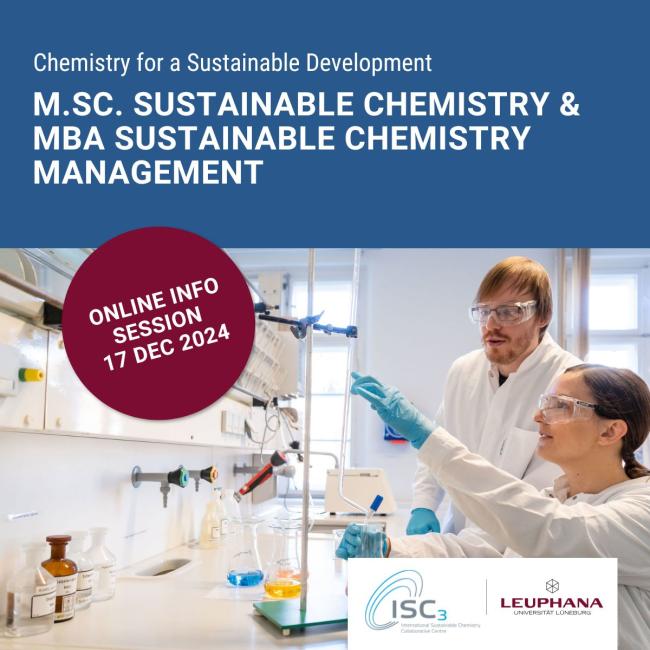
Blue banner at the top showing the event title in white font. Photograph below of two chemists in the lab with goggles, gloves, and lab coats, holding glassware attached to a rotary stand and discussing the level of solvent in the glassware. A red circle with white font at the top left shows the info session time and the ISC3 and Leuphana University logos are in the bottom right corner of the image.
Event Date
-
Hosting Organization(s)
Leuphana University

Event Description

An exclusive online event on December 17, 2024, at 5:00 p.m. Central European Time (11:00 am Eastern Time).

Designed for professionals in the chemical sector, these programs equip you to lead the transition toward sustainable practices while advancing your career. Our programs are delivered primarily online, in English, offering maximum flexibility to balance your studies with professional and personal commitments. 


At the event, you'll have the chance to learn about the unique curriculum, which integrates insights from international experts across academia, industry, and government. A special highlight of the session is a talk by Professor Klaus Kümmerer, a globally renowned scientist in sustainable chemistry. He will share his vision for sustainability's critical role in the chemical industry and explain how these programs prepare participants to be pioneers in this transformative field.


Take the first step towards making a meaningful impact in the chemical sector. Join us to learn how Leuphana University's postgraduate programs can help you stand out and shape the future of chemistry.
 

Greener Curriculum Showcase Series: Exploring Sustainable Practices and the Drive for Greener Innovations - A case study in Metal Plating

Decorative Image
Event Date
-
Hosting Organization(s)
Beyond Benign, Inc.

Event Description

This free, virtual workshop is designed to help educators effectively adapt and implement a new case study that examines the various considerations and factors driving greener innovations in the metal plating industry. One of the primary chemicals used in this sector is PFAS, which acts as a fume suppressant to control chromic acid mist during the chrome plating process. While PFAS reduces exposure to the known health hazard of hexavalent chromium, its health and environmental impacts raise significant concerns, underscoring the need for greener alternatives.


The case study focuses on the design of a new non-PFAS, non-PFOS fume suppressant, applying the 12 principles of green chemistry. It explores the implementation of this greener product in real-world applications within the metal plating industry.


This resource is ideal for educators seeking to enhance their curriculum with real-world applications that align with the academic and professional guidelines for undergraduate programs, such as those set by the American Chemical Society. Participants will learn effective strategies for using the case study to illustrate to their students the critical interplay of chemical, environmental health, regulatory, and business considerations in the design of chemical products and processes, fostering a deeper understanding of the factors influencing greener innovations.


During the 1.5-hour session, facilitators will guide participants through the resources, offer practical strategies for adaptation and implementation, and create opportunities for educators to share insights. The workshop will feature group-based learning, discussions, networking opportunities, and a Q&A session. Don't miss this opportunity to expand your teaching toolkit, engage with peers, and inspire the next generation of green chemists.


Workshop Goals:

  • Educate participants on the interplay of the different factors influencing greener innovations including chemical, environmental health, business and regulatory considerations
  • Guide participants on practical approaches to effectively incorporate the case study materials into their curriculum.
  • Empower participants to adapt and implement the case study resources and expand their professional network.


Chat with us before, during, and after this workshop series in our Greener Curriculum Showcase Series forum! Hint: this forum is part of the January Scavenger Hunt Week activity!

Event Format
Event Address

United States

29th Annual Green Chemistry & Engineering Conference

GC&E Conference Banner
Event Date
-
Event Type
Lead Organizers
Hosting Organization(s)
American Chemical Society Green Chemistry Institute (ACS GCI)

Event Description

The GC&E Conference, hosted by the ACS Green Chemistry Institute®, is the premier global event for green chemistry and engineering. As the first and longest-running conference on this topic, GC&E attracts scientists, educators, industry professionals, and advocates to explore advancements, share best practices, inspire innovation, and build community dedicated to sustainable solutions.


Each year, the conference evolves, incorporating new ideas while maintaining its 28-year legacy. Its vision is for green and sustainable chemistry to be integral to all scientific endeavors, providing solutions that balance human well-being with planetary health. For this reason, the 2025 conference theme will be Good Health and Well-Being Through Sustainable Chemistry to align withthe United Nations Sustainable Development Goal 3.

GC&E 2025 will showcase innovative research and cross-cutting topics in green and sustainable chemistry and engineering, with an emphasis on symposia that highlight our theme “Good Health and Well-Being”, such as medical breakthroughs, new technologies, and efforts to eliminate or reduce hazardous chemical pollution promoting longer and healthier lives.


Beyond Benign Talks and Social Events


“Design and development of an on-demand introductory course to infuse green chemistry in the undergraduate curriculum”

Dr. Deborah Bromfield Lee, Professor of Chemistry, Florida Southern College


“Case study on sustainable practices in metal plating for Green Chemistry education”

Dr. Hun Bok Jung, Assistant Professor Department of Physical Sciences, Kingsborough Community College


“An online course for the chemistry education community: empowering educators to bring environmental justice discussions into the classroom”

Dr. Monica Soma Hensley, Content Manager, Beyond Benign


““Soy” What? We’ve “bean” incorporating soybean-based industrial innovations into the chemistry curriculum”

Dr. Jane Wissinger, Professor Emerita, Department of Chemistry, University of Minnesota


"Institutional Change for a Sustainable Future: Beyond Benign and the Green Chemistry Commitment"

Dr. Juliana Vidal, Dr. Amy Cannon,  Dr. Omar Villanueva, and Dr. Natalie O’Neil


"Mechanochemistry and Green Chemistry: A Connection Between Education, Research, and Innovation for a Healthier Planet"

Juliana Vidal, Beyond Benign; James Batteas, Texas A&M University; Francesca Kerton, Memorial University; Isaiah Speight, William & Mary


"Comprehensive survey on the implications of green chemistry and toxicology concepts in chemistry education: An industry and academic perspective"

Nesta Bortey-Sam, University of Pittsburgh


"Development of a green chemistry and toxicology professional development certificate course"

Douglas Raynie, South Dakota State University


"Green Chemistry Resources in the Classroom"

Thomas P. Umile, Villanova University; Jennifer A. Tripp, University of San Francisco; Monica Soma Hensley, Beyond Benign; Amy S. Cannon, Beyond Benign; David Laviska, Green Chemistry Institute, American Chemical Society


Image
Decorative image


Green Chemistry Commitment: Catalysts for Change Reception

Come mix and mingle with Beyond Benign, MilliporeSigma (the U.S. and Canada Life Science business of Merck KGaA, Darmstadt, Germany), and the American Chemical Society Green Chemistry Institute at 6 PM on Sunday, June 22nd, 2025 at Sienna Mercato's rooftop bar, il Tetto.

Embrace the unique opportunity to connect with current leaders in the field of green chemistry and find resources to help lead a sustainable future.
Current green chemistry leaders joining this event include members of industry, as well as faculty members who are signers of Beyond Benign's Green Chemistry Commitment.

Enjoy free food and drinks and unique networking opportunities-- all against the beautiful Pittsburgh skyline at a scenic, award-winning venue.

Who: Chemistry Faculty, Undergraduate and Graduate Students
What: A chance to connect with likeminded young chemistry leaders and influencers in the green chemistry space.
When: Sunday, June 22nd at 6:00 PM EST
Where: il Tetto at Sienna Mercato, 942 Penn Ave, Pittsburgh, PA 15222


Catalyzing Change in Chemistry Education Faculty Luncheon

Join Beyond Benign, MilliporeSigma (the U.S. and Canada Life Science business of Merck KGaA, Darmstadt, Germany), and the American Chemical Society Green Chemistry Institute (ACS GCI) for a free, catered luncheon on June 24th, 2025 at the ACS Green Chemistry and Engineering Conference.


Who: Chemistry faculty, administrators, and student leaders interested in generating departmental support for green chemistry implementation.

What: A lunch panel of faculty members who are leading a systemic change in education through the Green Chemistry Commitment (GCC) at their institutions.

Panel moderators: Dr. Amy Cannon (Executive Director & Co-Founder of Beyond Benign) and Jeffrey Whitford Vice President of Sustainability & Social Business Innovation at MilliporeSigma, will bring their own expertise as green chemistry leaders.

Where: Sterlings 1, 2, & 3

When: Tuesday, June 24th, 2025 at 12:30 PM EDT
The GCC program is a collaborative voice created to unite the higher education chemistry community towards green chemistry principles and practices and further its size, reach, and diversity. Join us to learn all the benefits that the students, faculty, and staff in your department can gain access to when they join the GCC.

Register on the GC&E Website