Virtual

Green chemistry in action: the microscale approach

UK's Microscale RSC Chemistry Education Prize winner leads an interactive discussion.
Event Date
-
Event Type
Hosting Organization(s)
Royal Society Of Chemistry

Event Description

By the end of the session, you will have:

  • Seen a variety of demonstrations relevant to teaching students aged 11–18
  • Explored the benefits of microscale and how it can be used to enhance learning, while also promoting environmentally sustainable practices
  • Considered ways to embed microscale in your own teaching practice.

There is a question and answer session; the event is being recorded.

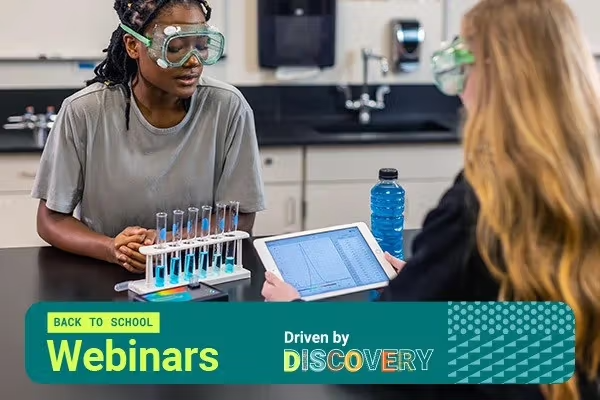
Sustainable Spectroscopy: Analyzing Sports Drinks with Beer's Law

image of two people in a lab sitting at a bench looking at test tubes and spectra on an electronic tablet
Event Date
-
Event Type
Lead Organizers
Hosting Organization(s)
Vernier Science Education

Event Description

Kick off the school year with a hands-on experiment that brings real-world relevance to core chemistry concepts. Join Vernier chemistry experts Dr. Melissa Hill and Nüs Hisim as they demonstrate a green chemistry investigation that uses the Go Direct® SpectroVis® Plus to analyze food dye concentrations in popular sports drinks. This student-led experiment introduces spectroscopy as a tool for exploring molecular structure and function—and connects absorbance, transmittance, and concentration through Beer’s law in a food chemistry context.

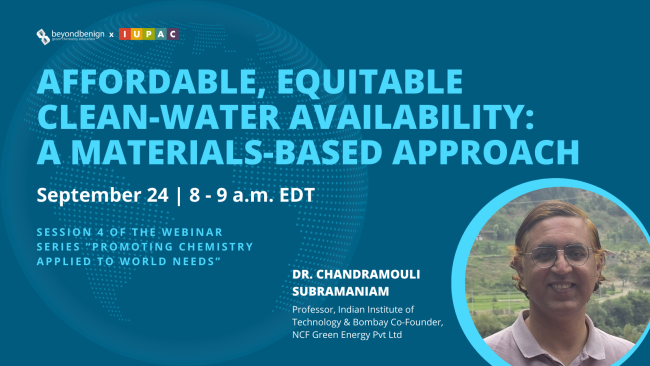
Affordable, Equitable Clean Water Availability: A Materials-Based Approach

a man smiles against a turqoise background. text reads: Affordable, Equitable Clean Water Availability: A Materials-Based Approach
Event Date
-
Event Type
Hosting Organization(s)
Beyond Benign, Inc.
International Union of Pure and Applied Chemistry

Event Description

Are you an aspiring chemist, a passionate climate advocate, or an interested member of the public? Do you want to change the world through science? Join us throughout 2025 to learn from experts in the field leading the charge to solve existential, world needs through chemistry.

During this webinar series, speakers will orient their presentations around the United Nations Sustainable Development Goals (UN SDGs) and the International Union of Pure and Applied Chemistry (IUPAC) Top 10 Emerging Technologies to demonstrate the power that chemists hold in shaping and preserving the future. Each talk will be accompanied by short videos on the topic geared toward high school and university chemistry students as well as the general public.

This series is hosted by Beyond Benign and the IUPAC Committee on Chemical Research Applied to World Needs (CHEMRAWN). Register below and invite your friends and colleagues!


Department of Chemistry, Indian Institute of Technology Bombay

The total volume of water on earth is constant at 1021 liters. India has 4% of the global fresh-water resources with ~20% of the global population. Therefore, majority of Indian sub-continent is suffering from acute water stress. Equitable access to clean potable water is both a direct, important target of United National Sustainable Development Goals (SDG 6) and simultaneously carries significance to several other SDGs (SDG 3,7,13,15). Therefore, sustainable, cost-effective and affordable recovery of freshwater from contaminated water feedstock is the need of the hour to ensure it equitable access.


Solar-thermal interfacial evaporation offers immense and hitherto untapped potential for energy-efficient, sustainable freshwater production. However, fundamental challenges in materials and system-design result in low water evaporation rates (Rw < 1-2 kgm-2h-1) and even lower solar-freshwater productivity (SWP). Further, the lack of thermally and chemically stable materials that can operate in extreme salinities such as seawater without fouling or degrading is a major bottleneck that limits the wider adaptation of the technology.

This Talk would describe an ultra-thin, porosity-engineered polymeric scaffold (poly-HIPE, PH) that is anisotropically coated with nanostructured carbon florets (NCF) to deliver high solar-thermal conversion efficiency (η-STC = 84%), excellent Rw (6.5 kgm-2h-1) and exceptional SWP (3.5 Lm-2h-1) from sea-water. A few salient features of the material are
(a) Thinnest such membrane with no-signs of fouling over 30 days in sea-water, achieving
(b) Salt-rejection of ~95% with facile reusability for over 30 days,
(c) Producing freshwater of ~20 liters per m2 area per day at
(d) Lowest CO2 footprint (< 3 W/L, ~3 g /L)


Fundamental insights of materials-design to address the exothermic water-evaporation step that are synergized with systems-design approaches to achieve these key performance indices would be discussed in the talk.
Event Format
Event Address

United States

Intended Audience

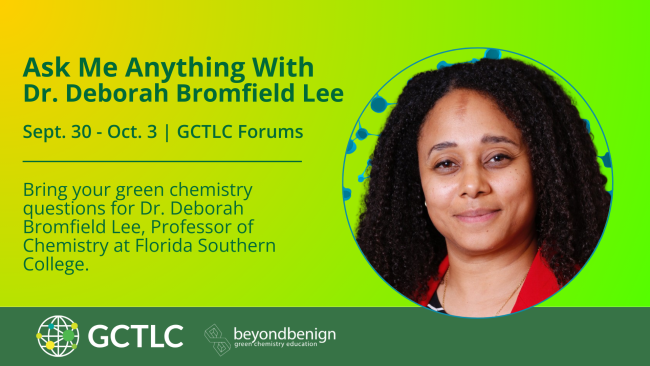
Ask Me Anything with Dr. Deborah Bromfield Lee

Decorative Image showing a woman smiling against a green background. Text reads: Bring your questions for Dr. Deborah Bromfield Lee, Professor of Chemistry at Florida Southern College
Event Date
-

Event Description

From September 30th to October 3rd, Dr. Bromfield Lee, Associate Professor of Chemistry at Florida Southern College, will share her insights and expertise with the community. Deborah’s research focuses on green chemistry education in the organic chemistry lecture and laboratory, as well as synthesis projects using green chemistry principles and metrics. Get your questions ready and meet us in the forums!

Event Format
Event Address

United States

Intended Audience

My Green Lab Global Summit 2025

Decorative Image
Event Date
-
Event Type
Hosting Organization(s)
My Green Lab

Event Description

The My Green Lab Global Summit 2025

This event will unite the global scientific community to confront the most urgent sustainability challenges of our time. This year’s theme, Rising to the Challenge, addresses both the urgency and the opportunity facing science, from adapting to a shifting regulatory and funding landscape to strengthening trust through transparency and third party verification.


During the summit, we will spotlight the newly enhanced My Green Lab® Certification and ACT® Ecolabel programs, sharing early successes and real-world impact from organizations leading the way. You’ll also hear progress updates from our three-year strategic plan and learn how our tools are uniquely positioned to help organizations navigate evolving global regulations around lab sustainability, especially those targeting greenwashing.


Speakers from around the world will share bold ideas and practical strategies to help science remain a powerful force for progress, even as it faces political and economic headwinds.


This global gathering will foster resilience, action, and collaboration. Whether you’re just beginning your sustainability journey or driving it forward, the 2025 Summit will challenge and inspire you to go further. Let’s rise to the challenge together.

Event Format
Event Address

United States

Intended Audience

Making the Case: Building a Sustainable Chemistry Minded Workforce

Event Date
-
Event Type
Hosting Organization(s)
Change Chemistry

Event Description

Fluctuations in political, economic, and R&D cycles may introduce uncertainty and necessitate the reallocation of resources, which can affect the adoption of sustainable chemistry and greener processes. Such disruptions have the potential to compromise long-term business resilience, elevate risk levels, and adversely impact both human health and the environment. Continuing to advance sustainable chemistry in a changing environment requires continued policy, investment, and market commitments.


To ensure sustainable chemistry remains a priority, demonstrating and communicating its positive impact on all business functions and through the value chain is critical. During this webinar series, subject matter experts will share tools and insights to assist champions with effectively "making the case". Structured as a series of discussions, attendees will have the unique opportunity to pre-competitively engage with the speakers and other companies facing similar challenges.


During the first 3 webinars, experts shared the benefits of sustainable chemistry for investors, on domestic manufacturing, and business health. This webinar builds on these conversations by highlighting the need for education - both in academia and for workforce development - in order to build a workforce with sustainable chemistry knowledge and skill sets. Juan Colberg from Pfizer will discuss the business benefits of a sustainability minded workforce and needs to attract this talent. Amy Cannon from Beyond Benign will share how our community can support students and educators in training the next generation for success.


*This webinar is available to Change Chemistry members only.

Event Format
Event Address

United States

Green Chemistry Connections

Decorative Image
Event Date
-
Event Type

Event Description

The ARC Training Centre for Green Chemistry in Manufacturing is transforming and revitalizing Australian Manufacturing through the adoption of green and sustainable chemical technologies.


Join us on August 13th to learn more about this incredible work! During this Green Chemistry Connections session, we'll be joined by the center's director and three PhD students who are working with the center to bring Green Chemistry to industry partners:


• Tony Patti | Director, ARC Training Centre for Green Chemistry in Manufacturing
• Elizabeth Phua | PhD Student, Monash University
• Xuejiao (Sarah) Cao | PhD Student, Flinders University
• Karin Luize Mazur | PhD Student, Deakin University


August 13th from 7-9 p.m. AEST / 5-7 a.m. EDT.
This session was rescheduled from May. If you aren't already registered for the series, register here.


Webinar on "Green is the New Standard: How to Integrate Sustainability and Systems Thinking into the Curriculum"

webinar cover image with half a globe and network mesh around parts of it
Event Date
-
Event Type
Lead Organizers
Hosting Organization(s)
American Chemical Society (ACS)
American Chemical Society Green Chemistry Institute (ACS GCI)

Event Description

The need to equip students with the tools to connect core chemistry concepts to real-world sustainability challenges has never been more urgent. That’s why green chemistry and systems thinking are now required components of ACS-approved bachelor’s degree programs.

To support this transformative shift, the ACS Green Chemistry Institute is collaborating with a national network of educators to develop powerful new teaching resources. Join David A. Laviska of the ACS Green Chemistry Institute, Michelle Brooks of the American Chemical Society, and Loyd Bastin of Widener University as they provide you an extensive library of resources ACS offers to modernize your curricula and show you how to bring green chemistry to life in your classrooms.

This ACS Webinar is co-produced with the ACS Green Chemistry Institute.


What You Will Learn

  • How chemistry curricula are evolving to empower students to tackle global challenges
  • Brand-new ACS green chemistry resources created specifically for educators
  • Practical, first-hand strategies to implement curriculum changes that truly resonate with students


Event Details

  • Thursday, August 7, 2025 @ 2-3pm ET
  • Free to attend
  • Slides will be available to download on the day of the webinar

Webinar on "Metrics & Mandates: Driving Chemistry Toward a Greener Future"

webinar cover image with half of a green globe on a light green background
Event Date
-
Event Type
Hosting Organization(s)
American Chemical Society (ACS)

Event Description

As sustainability continues to guide both corporate and academic decision-making in the lab, chemists are increasingly tasked with evaluating the environmental impact of their work early in process development. 

Understanding what makes a chemical reaction sustainable and having the tools to assess and improve it is a crucial skill in modern chemistry. Join Jonathan Tripp of Gilead Sciences as he explores practical methods and tools chemists can use to enhance reaction sustainability, as well as how to quantify the benefits of different process options using well-established metrics.

In addition to internally led initiatives to improve the sustainability of chemical processes, the U.S. Federal Government continues to implement new regulations that impact the work of industrial and academic chemists. With the EPA’s ruling on methylene chloride (also known as dichloromethane) taking effect under Section 6(a) of the Toxic Substances Control Act as of July 8, 2024, academic institutions must now plan for compliance with industrial and commercial uses to follow in 2026. Join Amanda Chung of UNC Chapel Hill as she shares how her institution has addressed this regulatory shift through collaboration, communication, and program development to ensure safe, compliant use of methylene chloride in research and teaching labs.

This ACS Webinar is moderated by Edmond Lam of the ACS Green Chemistry Institute and is coproduced by ACS Government Affairs.


What You Will Learn

  • What factors contribute to the sustainability of a chemical reaction
  • What tools are available to assess and improve the sustainability of chemical processes
  • What are the key sustainability metrics and how they’re calculated and applied
  • How the new methylene chloride rule impacts academic institutions
  • What steps has UNC Chapel Hill taken to develop and implement a compliant program
  • What are the takeaways from exposure monitoring at UNC-CH and implications for lab safety


Event Details

  • Thursday, August 14, 2025 @ 2-3:30pm ET
  • Free to attend
  • Slides will be available to download on the day of the webinar

2YC CHAS Chat: Green Chemistry Resources and Solvent Alternatives

A decorative image
Event Date
-
Event Type
Additional Host Organizations
ACS Division of Chemical Health and Safety

Event Description

This free, interactive discussion will begin with a demonstration of two GCI resources: Reagent Guides and an Acid-Base Selection Tool.

Please join the Division of Chemical Health and Safety (CHAS) from 4:00 – 5:00 PM EDT on Thursday, August 21st for our next virtual CHAS Chat: Green Chemistry Resources and Solvent Alternatives. This free, interactive discussion will begin with a demonstration by the Assistant Director of the ACS Green Chemistry Institute (GCI), Edmond Lam, of two GCI resources: Reagent Guides and an Acid-Base Selection Tool. Xavier University Teaching Professor Kendra Denlinger will then discuss how to apply green chemistry and sustainability to teaching laboratories. Higher Education Content Manager at Beyond Benign, Monica Soma Hensley, will close the presentation portion of the CHAS Chat with an introduction to this nonprofit organization and their teaching and learning platform.


The CHAS Two-Year College (2YC) Community of Practice welcomes individuals who are interested in chemical health and safety in two-year colleges and similar institutions. To support faculty, staff, and students at such institutions, the Community hosts CHAS Chats on a quarterly basis. You do not need to officially join the 2YC Community or be affiliated with a two-year college to join the CHAS Chat. Contact Dwayne Henry at [email protected] with any questions.

Event Format
Event Address

United States

Intended Audience