- "Students are given the opportunity to assess chemical products and processes and design greener alternatives when appropriate."
- "Students understand and can evaluate the environmental, social, and health impacts of a chemical product over the life cycle of the product, from synthesis to disposal."
At the highest level of the ACS guidelines, students are expected to have a deeper understanding of and critical thinking skills around developing and designing greener chemical products and processes. This can include the various environmental, social and health aspects of a chemical product, in particular as it pertains to life cycle analysis.
GCTLC Library
Below are resources from the GCTLC library that are tagged with any of the following Green Chemistry Principles:
- #3 (Less Hazardous Chemical Syntheses)
- #4 (Design Safer Chemicals)
- #5 (Safer Solvents and Auxiliaries)
OR have been tagged with keyword "Life Cycle Assessment".
The variety of resources below should provide educators with numerous options to help tailor their lectures and courses with more green and sustainable chemistry content. However, if you have additional suggestions for resources, you can always submit them for inclusion in the GCTLC library, or you can post them in the forum "Green Chemistry Resources for Addressing the ACS Guidelines" on the GCTLC.
Developing and Disseminating NOP: An Online, Open-Access, Organic Chemistry Teaching Resource To Integrate Sustainability Concepts in the Laboratory
In order to instill an increased awareness of sustainability issues in future generations of scientists, the concepts and content of science courses must be changed. While important chemical concepts must be preserved, outdated, dangerous, and wasteful chemistry should be replaced by current, more sustainable alternatives. With these beliefs in mind, six German universities combined forces and ...

Dissolved Substances in Tap Water and Seawater
The experiment "Dissolved Substances in Tap Water and Seawater" involves students evaporating tap water, distilled water, and seawater to observe solid residues. They also witness an instructor-led demonstration where gases are released from boiling these waters, collected, and tested. This practical activity helps illustrate the different dissolved substances in various water types, showcasing ...
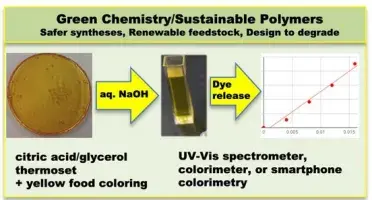
Dyeing to Degrade: A Bioplastics Experiment for the College and High School Classroom
The experiment was published in the Journal of Chemical Education @ https://pubs.acs.org/doi/abs/10.1021/acs.jchemed.9b00461 by co-authors Knutson, C. M.; Hilker, A.; Tolstyka, Z. P.; Wilbon, P. A.; Mathers, R. T.; Anderson, C. B.; Perkins, A. L.; Wissinger, J. E.
Effects of a CURE Laboratory Module on General Chemistry Students’ Perceptions of Scientific Research, Green Chemistry, and Self-Efficacy
This study describes the effects of implementing a Course-Based Research Experience (CURE) module involving materials science research with a green chemistry synthetic method on student's scientific research, green chemistry, and research skills self-efficacy. The CURE was implemented in a second-semester general chemistry laboratory course.
Effects of a CURE Laboratory Module on General ...
Encyclopedia of Green Chemistry
This comprehensive encyclopedia of green chemistry covers a wide range of topics in 146 review chapters. It is meant to be a large reference work for academic, industrial, and government scientists. Each chapter is authored by an expert in the specific topic, who brings together current research while highlighting challenges and discoveries that are most important. Volume 1 covers fundamentals ...
Environmental Chemistry
This module is part of a collection of nine green chemistry teaching modules developed in the early 2000s by a team of faculty (Donna Narsavage-Heald, Trudy Dickneider, David Marx, Timothy Foley, Joan Wasilewski) led by Michael Cann at the University of Scranton and has been migrated to the GCTLC. The subjects of the modules are based on winners of the Green Chemistry Challenge Awards. The modules ...
Environmentally Responsible Redox Chemistry: An Example of Convenient Oxidation Methodology without Chromium Waste
Oxidations and reductions are among the most commonly performed reactions in organic chemistry. Consequently, it is vital that redox chemistry is taught in our undergraduate chemistry courses. Unfortunately, many oxidations are classically and currently performed with toxic, carcinogenic chromium (VI) metals and require time-consuming and wasteful aqueous work-up.
All of these abovementioned ...
Ethers and sulfides
This learning module covers synthesis and reactivity of ethers and epoxides. Students will connect these to the larger sustainability goals of UNSDG 3: Good Health and Well-being, 9: Industry, Innovation, and Infrastructure, 12: Responsible Consumption and Production, and 13: Climate Action. This module is designed to be taught in consecutive class periods of one week in the later part of Organic ...
Evaluating Solutions: Cleaning and Disinfecting Products
In this lesson students will develop an evidence-based argument after investigating the product safety, performance, and cost of a variety of cleaning and disinfecting products designed to remove germs. Students will be introduced to principles of sustainable design, life-cycle thinking, and how to identify safer products through signal words and third-party certifications. The final project is ...
Evaluating Sustainability: Soap versus Biodiesel Production from Plant Oils
This study, conducted by Nicola L. B. Pohl, Jennifer M. Streff, and Steve Brokman at Iowa State University, presents a comparative laboratory experiment designed for undergraduate organic chemistry students. The experiment explores the saponification and transesterification of plant oils (soybean, rapeseed, and olive) to produce soap and biodiesel, respectively.
Key Learning Objectives & ...