- "Students are given the opportunity to assess chemical products and processes and design greener alternatives when appropriate."
- "Students understand and can evaluate the environmental, social, and health impacts of a chemical product over the life cycle of the product, from synthesis to disposal."
At the highest level of the ACS guidelines, students are expected to have a deeper understanding of and critical thinking skills around developing and designing greener chemical products and processes. This can include the various environmental, social and health aspects of a chemical product, in particular as it pertains to life cycle analysis.
GCTLC Library
Below are resources from the GCTLC library that are tagged with any of the following Green Chemistry Principles:
- #3 (Less Hazardous Chemical Syntheses)
- #4 (Design Safer Chemicals)
- #5 (Safer Solvents and Auxiliaries)
OR have been tagged with keyword "Life Cycle Assessment".
The variety of resources below should provide educators with numerous options to help tailor their lectures and courses with more green and sustainable chemistry content. However, if you have additional suggestions for resources, you can always submit them for inclusion in the GCTLC library, or you can post them in the forum "Green Chemistry Resources for Addressing the ACS Guidelines" on the GCTLC.
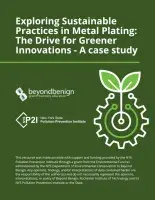
Exploring Sustainable Practices in Metal Plating: The Drive for Greener Innovations - A case study
The Drive for Greener Innovations case study module, consisting of six lesson units, is designed to highlight for students the interplay of chemical, environmental health, regulatory, and business considerations that dictate chemical processes and product design. Using the metal plating industry as a case study, the module also explores the chemistry and toxicology of hazardous chemicals ...

Extraction of dyes contained in glow sticks using liquid CO2
The authors report this easy-to-follow procedure for separating glow stick dyes from a cotton swab using liquid CO2 to illustrates several key chemical concepts, such as polarity, reaction rates, chemiluminescence, and the benefits of CO2 as a green solvent. This procedure is suitable for a diverse range of students. Due to the varying polarities of the dyes, some are preferentially dissolved in ...
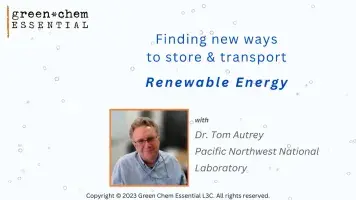
Finding New Ways to Store & Transport Hydrogen in Support of Renewable Energy
Hydrogen holds tremendous promise as a medium for storing energy generated by renewable sources such as wind and solar. However, storing hydrogen has traditionally involved very high pressures or very cold temperatures, methods that lead to cost and safety challenges.
In this episode of Green Chem Essential, with host James Rea, Dr. Tom Autrey and his fellow researchers at Pacific Northwest ...
Finding the Molar Mass Difference Between Carbon Dioxide and Air
The molar mass of an ideal gas is directly proportional to its density. This property has long been used in laboratory experiments in which a flask is filled with the vapor of a volatile liquid, and the mass, volume, temperature, and pressure of the vapor are used to find the molar mass of that vapor. In a related approach, the difference in the mass between a sample of carbon dioxide and a sample ...
General Chemistry
This module is part of a collection of nine green chemistry teaching modules developed in the early 2000s by a team of faculty (Donna Narsavage-Heald, Trudy Dickneider, David Marx, Timothy Foley, Joan Wasilewski) led by Michael Cann at the University of Scranton and has been migrated to the GCTLC. The subjects of the modules are based on winners of the Green Chemistry Challenge Awards. The modules ...
Green Chemistry 101 - Introduction
Learn the twelve principles of green chemistry taught during The Green Chemistry & Engineering Student Workshop on June 17, 2013 in Washington D.C. The course content was provided by ACS-GCI. These videos were produced by the Western States Pollution Prevention Network. Other sponsors included NPPR and Washington State Department of Ecology.
Green Chemistry and the Ten Commandments of Sustainability
Green Chemistry and the Ten Commandments of Sustainability is a chemistry LibreText that was authored, remixed and/or curated by Stanley E. Manahan. LibreTexts is a multi-institutional collaborative to provide open access educational resource in the form of online free textbooks.
Green Chemistry and the Ten Commandments of Sustainability, discusses chemistry as a whole particularly as it ...
Green Chemistry and Toxicology Moments - slide set part A
The Green Chemistry and Toxicology Moment slides (slide set part A) are standalone slides that can be easily and seamlessly inserted into general chemistry and/or organic chemistry lectures. Most of the topics just have one slide but a few have two slides. There is a wide range of topics; from Vaping and Lung Injury to Safer Epoxidations. These slides are meant to engage the students ...

Green Chemistry for Sustainability (GCS) Publications and Reports
Gain insight exploring journal articles related to green chemistry and sustainability, community-uploaded manuscripts and reports, and peer-reviewed research categorized by U.N. Sustainable Development Goal (SDG).
Green Chemistry Laboratory: Benign Synthesis of 4,6-Diphenyl[2,2']bipyridine via Sequential Solventless Aldol and Michael Addition Reactions
This laboratory exercise teaches students some of the principles of green chemistry while simultaneously introducing them to several traditional organic reactions. All the reagents used in the experiment are relatively safe and the avoidance of volatile organic solvents reduces cost, waste, and hazards. The ultimate pyridine product is reached in three steps. The first step is the solventless ...