Exploring Wavelength: A Quantitative and Qualitative Analysis of LEDs

Exploring Wavelength: A Quantitative and Qualitative Analysis of LEDs
Contributors
Associate Professor | Belmont University
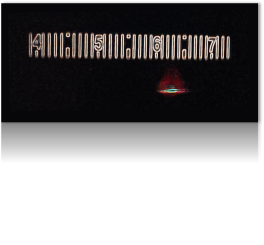
LED spectroscope image
Summary
In this lab, students will explore the relationship among wavelength, frequency and energy, as they observe white light and LED light sources, using a spectroscope. Students will also observe the effect of color filters on white light and LED light sources, using a spectroscope. Students will qualitatively explore the effectiveness of several filters, through analysis of their predictions versus their observations of the visible light bands observed before and after adding color filters. In the pre-lab, students will graphically discover the mathematical relationships among these three variables. Students will also have the opportunity to analyze these mathematical relationships through calculations.

"Exploring Wavelength: A Quantitative and Qualitative Analysis of LEDs” aligns with the Green Chemistry Principle “Safer Chemistry for Accident Prevention.” Specifically, by eliminating the use of the flame test, students are not exposed to 1) higher hazard salts, 2) potentially hazardous methods used to increase the intensity of the flames – such as the use of methanol, or 3) gas or ignition sources.
Digital Object Identifier (DOI)
https://doi.org/10.59877/PBPR2808
Learning Goals/Student Objectives
Students will:
• Explore the relationship among wavelength, frequency and energy, as white light and LED light sources are observed, using a spectroscope
• Graphically discover the mathematical relationships among wavelength, frequency and energy
• Analyze the mathematical relationships among wavelength, frequency and energy through calculations
• Observe the effect of color filters on white light and LED light sources of various colors, using a spectroscope
• Qualitatively explore the effectiveness of several color filters, through analysis of their predictions versus their observations of the visible light bands observed before and after adding color filters
Object Type
Laboratory experiment
Audience
Middle School
High School (Secondary School)
Other Faculty Educators/Teachers
Common pedagogies covered
Hands-on learning
Green Chemistry Principles
Safer Chemistry for Accident Prevention
U.N. Sustainable Development Goals (SDGs)
Affordable and Clean Energy
Safety Precautions, Hazards, and Risk Assessment
Hazards: As this activity had no chemical hazards and no glass break hazards, students are not explicitly instructed to wear safety goggles/glasses. However, students are still instructed to check with their teacher about any specific safety precautions/requirements.

Note: As with any spectroscope, this should not be used to view sunlight, as that could cause serious damage to the eyes.

Storage: For storage, the 9-Volt battery needs to be disconnected and removed from the LED test box. To avoid a possible short circuit (potential for generating significant heat, fire, or explosion), be sure batteries are stored so the terminals do not touch.

When using LED test box:
-To avoid a short circuit (potential fire hazard), be sure the two leads on the alligator clips do not touch each other when connected to the 9-Volt battery.
-Do not stare directly at the LED for extended periods of time.
Teacher Recommendations or Piloting Data (if available)
Variations of this lab have been performed by teachers attending my “It’s Easy Being Green: Budget-Friendly Safety-Conscious Chemistry Labs for the Secondary Science Classroom of Today” professional development workshop series:

• Summer 2018 (three sessions - 43 attendees): “Catch a Wave: Wavelength Analysis of LED using Handheld Spectroscopes”
• Spring 2025 (one session - 8 attendees): “Wavelength: A Quantitative and Qualitative Analysis of LEDs”
• The iteration of this lab currently being submitted as a learning object, will also be used at three sessions during the MNPS (Metro Nashville Public Schools) STEAM and Science Content Day (July 2025) for teachers.

NGSS Standards, if applicable
MS. Waves and Electromagnetic Radiation
Develop and use a model to describe that waves are reflected, absorbed, or transmitted through various materials. MS-PS4-2

HS. Waves and Electromagnetic Radiation
Use mathematical representations to support a claim regarding relationships among the frequency, wavelength, and speed of waves traveling in various media. HS-PS4-1

Share This

Submitted by

Reviewed by
Published on
Moderation state
Published

Comments

Creative Commons License