Water Electrolysis with Biobased/Low Hazard Indicators – Red Cabbage Juice or Pea Flower Tea
Contributors



Summary
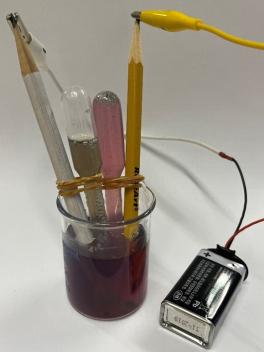
Electrolysis of water is carried out using biobased/low hazard indicators to help illustrate the reaction.
Key Chemistry References for this activity:
1) Skinner, J. F. “Red Cabbage and the Electrolysis of Water.” J Chem. Educ., 1981, 58, 1017. https://pubs.acs.org/doi/pdf/10.1021/ed058p1017.1
2) Hugerat, M.; Abu-Much, R.; Basheer, A.; Basheer, S. “Using Inexpensive to Free Materials to do Electrolysis Experiments with All School Ages.” Chem. Educ. J., 2009, 13. http://www.edu.utsunomiya-u.ac.jp/chem/v13n2/13M_Hugerat/M_Hugerat.html
Additional Credit to Kathy Hall from Hilltop Heritage Middle School (retired) who shared her experience teaching the resource developed by the University of Washington Clean Energy Insitute (https://www.cei.washington.edu/lesson-plans/electrochemical-chameleon/)
Key Chemistry References for this activity:
1) Skinner, J. F. “Red Cabbage and the Electrolysis of Water.” J Chem. Educ., 1981, 58, 1017. https://pubs.acs.org/doi/pdf/10.1021/ed058p1017.1
2) Hugerat, M.; Abu-Much, R.; Basheer, A.; Basheer, S. “Using Inexpensive to Free Materials to do Electrolysis Experiments with All School Ages.” Chem. Educ. J., 2009, 13. http://www.edu.utsunomiya-u.ac.jp/chem/v13n2/13M_Hugerat/M_Hugerat.html
Additional Credit to Kathy Hall from Hilltop Heritage Middle School (retired) who shared her experience teaching the resource developed by the University of Washington Clean Energy Insitute (https://www.cei.washington.edu/lesson-plans/electrochemical-chameleon/)
Keyword Tags
File (PDF, PPT, image, etc)
Creative Commons License

This work is licensed under a Creative Commons Attribution-NonCommercial-ShareAlike 4.0 International License.
Comments
This looks great! Did the 2h include the time to complete questions? how long did the electrolysis part take?
Going to tag in @Dean Campbell @Saskia van Bergen @cmwoodbridge to see if they have any insights!
In reply to Going to tag in @Dean… by Jonathon Moir
Hi Lauren,
I have not used this activity in a classroom with students as I mostly develop content with educators and develop and lead teacher trainings. I have done the electrolysis portion in a training and it was a fairly easy set up and short experiment (final observation is at 10 minutes). I would expect that this experiment with majority of the questions should take less than 2 hours but, if you assign a pre-lab, you could have some of the questions there.
Hello
You might like to look at https://www.youtube.com/watch?v=sogxTMossn8 , in which I use drawing pins/thumbtacks as the electrodes. You could use the red cabbage or butterfly pea tea extracts as well. The surprising aspect is that the base of the plastic gallipot does not leak after inserting the drawing pins. The wires of the battery connecting leads are attached by Sellotape or trapped in the tack as shown. The use of syringes means that gases can be extracted and tested with additional experiments. Sodium sulphate (1M) is the electrolyte, as this does not form precipitates. However, the pins do corrode. They can only be used once. I have now removed the pins and replaced them, again with no leaks
By the way, I cannot access the first resource, as I have to pay lots of money. Are school teachers automatically members of the ACS? The second resource mentions the late Peter Schwarz, who I knew when I joined the international microscale family in 2012. He gave me so much encouragement. Microscale approaches are becoming popular in the UK, and we are holding a celebration at https://sites.google.com/view/13ismc26/home. Please show interest using the form on the first page.
Another tip is to use "unbreakable" 2mm carbon fibre electrodes in place of pencil leads.
the UK
Bob Worley FRCS
In reply to HelloYou might like to look… by Bob Worley
Hi Bob,
Thanks for sharing your video.
The main resource is here- electrochemistry-lab-_0.docx the other two items you mentions are references that were used to create the activity (in addition to https://www.cei.washington.edu/lesson-plans/electrochemical-chameleon/ ) and the first articl you mentioned, does not appear to be open access.
Best,
Saskia
Hello
The link was https://sites.google.com/view/13ismc26/home
Sorry about that. I believe the web address included the full stop.
This item would be ideal for our exhibition of ideas. See page three of the website.