Middle School Teachers

Biennial Conference on Chemistry Education (BCCE)
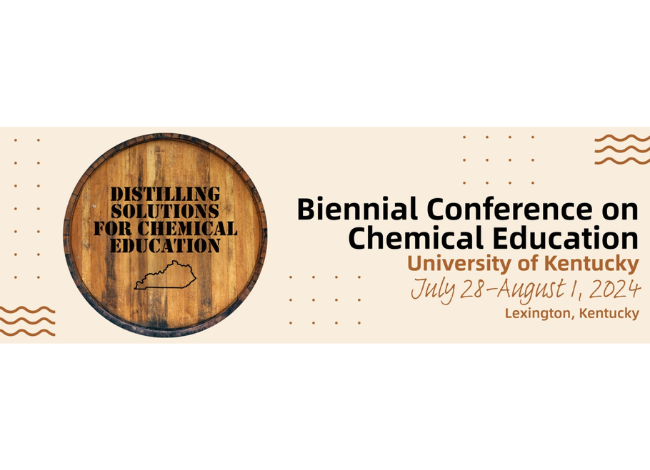
A wooden barrel is labelled in rugged font: Distilling Solutions for Chemical Education. Biennial Conference for Chemical Education, University of Kentucky, July 28- August 1st 2024. Lexington, KY.
Event Date
-
Event Type
Hosting Organization(s)
University of Kentucky

Event Description

The conference will be held on the beautiful campus of University of Kentucky in Lexington, Kentucky in the Summer of 2024. The 28th BCCE, like all of its predecessors, is designed to provide you with opportunities for interacting with chemistry instructors of all levels in formal and informal settings. There will be a mixture of symposia, workshops, poster sessions, exhibits, and tours of chemistry research areas.


Registration for BCCE 2024 is now live. Early bird pricing is available until May 31!  The registration form includes workshops, on-campus housing options, and more.  Those who have submitted abstracts will be notified in April about their submission.


The conference will be organized around four themes - Classroom Practice and Learning Environments, Curriculum and Cognition, Assessment and Research Methods, and Professional Development - within the K-12, two-year college, and university communities.

Instructions for presenters are available.


Connect with attendees and stay up to date with the conference on the GCTLC's BCCE 2024 forum thread!


Sunday

Workshop: Introduction to Integrating Green Chemistry and Sustainability in Undergraduate Teaching Laboratories
8:30am - 11:45am
Chaired by: John De Backere (University of Toronto)

Authors: Jonathon Moir, John De Backere, David Laviska, Jane Wissinger

Green Chemistry is a framework that helps “minimize or eliminate the use or generation of hazardous substances” in chemical processes and products. It is our responsibility as instructors to educate our students with respect to green chemistry, sustainability, and environmental issues to prepare them as future members of the workforce and agents of change in the world. Importantly, this has recently been recognized in the new ACS Guidelines for Bachelor's Degree Programs as a critical requirement, whereby curricula must provide students with a working knowledge of the Twelve Principles of Green Chemistry.

This interactive half-day (3h) workshop is aimed towards laboratory instructors at two- and four-year undergraduate institutions teaching curricula in all areas of specialization. We will illustrate the connection between fundamental principles of green chemistry, safety, and traditional teaching laboratory protocols (further examples provided in the accompanying symposium, see below for details). Participants will gain an understanding of not only practical aspects of greening undergraduate labs, but also ways of modifying assessments and content to improve pedagogical aspects of laboratory learning to include more topics around green chemistry and broader sustainability concepts. Participants will then divide into small sub-discipline specific groups to share experiments currently used in their courses, and discuss possible modifications to their own lab manuals to make them “greener”. After reflecting on current curricula, we will explore a number of useful resources for integrating theory into practice, such as the new online Green Chemistry Teaching and Learning Community (GCTLC). The workshop will conclude by creating personal action plans for implementing sustainable changes, both practically and pedagogically, to current experiments or potentially new experiments to be developed.

This workshop complements the symposium entitled “Frontiers in Integrating Green Chemistry and Sustainability into the Teaching Laboratory”, which will provide recent examples of "greener" teaching experiments.


Monday

Poster: Addressing the knowledge gap through professional education initiatives for educators to promote the global integration of sustainable chemistry into curricula

6:00pm - 6:55pm

Presented By: Monica Nyansa

The design for sustainable solutions to global challenges creates a critical need to develop a future workforce proficient in practicing and teaching the principles of sustainable chemistry. This entails equipping present and future scientists with the requisite skills in green chemistry and sustainability. The American Chemical Society (ACS) recently updated its Guidelines for Bachelor’s Degree Programs to incorporate green chemistry and sustainability into the learning outcomes as a normal expectation for coursework in ACS-approved degree programs.

Beyond Benign, an educational nonprofit that is a prominent advocate for green chemistry education worldwide plays a pivotal role in supporting the integration of green chemistry and sustainable practices into the chemistry curriculum. This support extends to the development and dissemination of curricular materials and resources created directly with educators and strategic partners through their Green Chemistry Commitment (GCC) and the Green Chemistry Teaching and Learning Community (GCTLC) platform. Another way Beyond Benign supports this endeavor is through the exploration of professional educational opportunities, empowering educators to integrate green chemistry and sustainability principles into the chemistry curriculum effectively, thus nurturing the next generation of scientists adept at addressing global challenges through sustainable chemistry practices.

This presentation aims to highlight the ongoing efforts of Beyond Benign, a champion of green chemistry education, to explore professional educational opportunities for educators, facilitating the integration of green and sustainable chemistry into the chemistry curriculum for a sustainable future.


Tuesday

Green Chemistry Education: Empowering the Global Community
in S60: Promoting Global Collaboration in Chemistry Education: Insights from International Initiatives |8:30am - 10:00am

Talk Presented By: Amy Cannon

The field of chemistry, providing the molecular building blocks of materials and products used throughout society, has a critical and foundational role in addressing the Sustainable Development Goals outlined by the United Nations. Green chemistry, the use and design of less hazardous chemical products, is essential in providing solutions in order to achieve these ambitious goals. As the global demand for greener, more sustainable chemicals and materials grows, the chemistry education system must shift in order to meet this demand. Green chemistry education is required to train scientists and professionals with the skills to address hazards and mitigate impacts at the earliest stages of the product lifecycle. Beyond Benign, a non-profit organization based in the USA, has been leading green educational initiatives aimed at empowering educators to change chemistry education for a sustainable future. As the organization has grown, so has the outreach and engagement with the global chemistry education community. With specific goals to scale the adoption of green chemistry within higher education systems globally, this presentation will share Beyond Benign’s approach to building community and engaging educators, empowering them to be transformative change agents. Specifically, the Green Chemistry Commitment (GCC) program, an institutional commitment towards including green chemistry in college level chemistry programs, and the Green Chemistry Teaching and Learning Community (GCTLC), an on-line platform supporting educators on their journeys, will be highlighted. Each program aims to build upon work in North America and authentically engage and empower the global community to adopt green chemistry in their teaching and practice.


Development of an open-access, community-driven, peer-reviewed library of green chemistry educational materials in Drupal 10: The Green Chemistry Teaching and Learning Community (GCTLC)

in S233: Computers in Chemical Education | 10:15am - 11:45 am

Talk Presented By: Jonathon Moir

The Green Chemistry Teaching and Learning Community (GCTLC) is a virtual space for higher education faculty and lecturers as well as K-12 teachers to find and share resources, participate in peer-to-peer learning, and connect and network with other users from around the world. The mission of the GCTLC is to help advance the integration of green chemistry across education systems worldwide to help train the next generation of scientists and workers with the knowledge and skills to address sustainability challenges across the globe. The platform allows users to connect with others through forums, group spaces, events, a job board, and more. Of particular note is the GCTLC’s open-access, peer-reviewed and community-driven library of over 190 curriculum resources. These include greener lab experiments, course modules, lecture slides, assessments and exams, journal articles, and more. Users can browse the existing collections via searching based on keyword terms, by contributor, by title, or by other filters, and can submit their own original work to the library or submit existing resources found elsewhere on the internet. Submitted resources undergo a simplified peer review process, managed by the GCTLC’s Chief Editor, and upon acceptance are published in the GCTLC’s searchable library (and, if warranted, added to new or existing curated collections on the platform). This presentation will overview the development and management of the GCTLC’s library and peer-review system using Drupal 10, including use of taxonomy terms, moderation states and workflows, and dynamic content displays. Ultimately this presentation will showcase the utility of open-source programming in creating inclusive spaces for educational communities of practice.


B19: Green Chemistry Teaching and Learning Community (GCTLC) Get-Together and Share-a-thon

1:00pm - 1:45pm
Chaired By: Jonathon Moir and Nimrat Obhi

This Birds of a Feather is a chance to come learn about the GCTLC and meet other GCTLC users (in-person!) from around the world. After some informal socializing, Beyond Benign's team members will walk through the basics of the GCTLC platform and jump into a group sharing session including an in-person resource upload (hackathon style)! We ask all attendees to bring their personal laptops to participate in the share-a-thon!

Attendees may ask for a "to go" container for their lunch from Champions Kitchen and bring it with you to the Birds of a Feather session.


Fostering a sense of belonging on the Green Chemistry Teaching and Learning Community (GCTLC) online platform

in S98: Effective Approaches to Inclusive Chemistry Education | 2:00 pm - 3:30 pm

Talk Presented by: Nimrat Obhi

Green chemistry education is essential in helping chemists and people with chemistry training to achieve global sustainability targets such as the United Nations Sustainable Development Goals. Inclusive communities of practice are needed to foster and facilitate transformative change in chemistry education for widespread knowledge and adoption of green chemistry. Beyond Benign – a non-profit organization advocating for global green chemistry education – has created the Green Chemistry Teaching and Learning Community (GCTLC), a free online platform that is the meeting place for a global green chemistry education community of practice. The GCTLC offers community-driven spaces and peer-to-peer mentoring, access to a searchable library of open-access green chemistry educational resources, an events calendar, a job board, and more.

Ensuring the GCTLC is and remains an inclusive community of practice for green chemistry educators involves interweaving diversity, equity, belonging, and respect principles throughout the entire development and sustenance of the platform. This presentation will outline our efforts to design an online space prioritizing educators’ feelings of belonging, community, and growth. We will discuss drafting a Code of Conduct for the platform, creating equitable and accessible community spaces, finding open-access resources for educators that include methods to decolonize and diversify green chemistry, running global community events, and creating an inclusive community engagement strategy for all users. Ultimately, we will discuss using open-access online platforms to strengthen a pipeline of green chemistry practitioners who are empowered to transform chemistry education.


Wednesday

B24: Green Chemistry Commitment (GCC) Program: Lunch and Learn about Professional Development and Grants
12:00pm - 12:45pm

Chaired By: Amy Cannon, Monica Nyansa

Join Beyond Benign staff and faculty from Green Chemistry Commitment (GCC) institutions for sharing green chemistry education best practices and networking over lunch. This session is open to all who are interested in incorporating green chemistry into their curriculum or interested in learning more about Beyond Benign’s Green Chemistry Commitment program and/or the Green Chemistry Teaching and Learning Community (GCTLC) online platform. Attendees will learn about the new benefits of the GCC program, including the GCTLC platform, green chemistry education challenge awards, and free on-demand professional development in green chemistry and toxicology for signing institution members to access through the GCC program only but open to all at a sustainable cost.

Attendees may ask for a "to go" container for their lunch from Champions Kitchen and bring it with you to the Birds of a Feather session.


S31: Current Research on the Undergraduate Chemistry Laboratory
Chaired by: Nikita Burrows (Monmouth University) , Monica Nyansa (Michigan Technological University, Beyond Benign) , Mary Ross (Central College)

This symposium will focus on current qualitative and quantitative research related to the undergraduate chemistry laboratory curriculum. Contributed papers should address research related to any aspect of the undergraduate laboratory. This includes, but is not limited to, general chemistry, organic chemistry, biochemistry, instructors, students, laboratory curriculum, pre-laboratory assignments, laboratory assessments, cognitive, affective or psychomotor factors, etc. Related research on laboratory design for exploring student’s engagement in chemistry laboratory may also be addressed.


Two-Day Symposium: Integrating Green Chemistry and Sustainability into Chemistry Education

Chaired By: Loyd Bastin (Widener University), and David Laviska (ACS Green Chemistry Institute)

This symposium will highlight the incorporation of green chemistry and sustainability principles throughout the chemistry curriculum as well as through co-curricular activities such as clubs, organizations and service-learning opportunities. The focus will be on green chemistry and sustainability materials and models rooted in the Twelve Principles of Green Chemistry that are designed to educate high school, community college, four year college and graduate students. These materials will include classroom teaching modules/courses, learning methods, educational research, laboratory experiments and experiences, the integration of toxicology into the chemistry curriculum, and the use of systems-thinking.

16th European Conference on Research in Chemical Education

The logo shows a beaker with a plant growing inside with an arrow pointing to a molecule, to a book, and back to the beaker as a closed cycle. To the right, text reads ECRICE 2024, 16th European Conference on Research in Chemical Education, Nova School of Science and Technology- Campus da Caparica, Lisbon. September 05-07,2024. Chemical Education for Sustainable Development: Empowering Education Communities.
Event Date
-
Event Type

Event Description

“Dear colleagues,

We are happy to welcome you to the ECRICE 2024, the 16 European Conference on Research in Chemical Education, to be held at NOVA School of Science and Technology, Campus da Caparica, Lisbon, September 5-7, 2024.


This conference on research in chemical education, recognised by EuChemS, is an important event to disseminate new research and developments. It is important to know how learners acquire knowledge, how to facilitate this acquisition and trigger it. It is relevant to examine different learning environments, new educational tools, and new ways in which neuroeducation, technology and artificial intelligence, can be integrated into chemical education, and promote the engagement of students in the learning process. But nowadays this is not enough. It is necessary to do this through the lens of sustainability, having in mind the 17 SDGs. Therefore, ECRICE 24’s theme is “Chemical Education for Sustainable Development: Empowering Education Communities”


The ECRICE24 Committees of this International conference invite all chemistry education researchers and teachers to come to the conference and challenge them to showcase presentations, submit abstracts, and present work, regarding new developments in Chemical Education, through the lens of sustainable goals, and participate in the ECRICE 2024 meeting.


We are looking forward to welcoming you in Lisbon.


Enjoy the conference!


Sincerely,


Isabel Ribau, Conference Chair

A. Jorge Parola, Secretary General of the Portuguese Chemical Society

Juaquim Luís Faria, President of the Portuguese Chemical Society"

38th Philippine Chemistry Congress (38PCC) and 2024 International Conference on Chemistry (IC2)

38th Philippine Chemistry Congress (38PCC) and 2024 International Conference on Chemistry (IC2)
Event Date
Annually on the 21st of July, 8am - 5pm
Recent
  • -
  • -
Upcoming
  • -
Lead Organizers
Additional Host Organizations
Integrated Chemists of the Philippines, Kapisanang Kimika ng Pilipinas

Event Description

The Philippine Chemistry Congress is the biggest annual conference of chemists, chemistry educators and chemistry researchers in the Philippines. This brings chemists from academe, industry and government together in one venue to interact, share new knowledge and to collaborate. The 38PCC&2024IC2 will also feature technical exhibitors who will be able to showcase new products that can improve your performance and productivity, create partnerships, and generate new ideas.

Biomimicry Thinking: Innovation inspired by Nature's chemistry - Register by July 15

Come on adventure to learn about Nature's chemistry
Event Date
-
Lead Organizers
Hosting Organization(s)
Biomimicry 3.8
Additional Host Organizations
NatuR&D

Event Description

Registration closes Monday, July 15, 2024

On the territories of the lək̓ʷəŋən and W̱SÁNEĆ First Nations of the Pacific Northwest, the trees are deep in conversation and negotiation via mycelial networks. The salmon return to make the stream bed fresh and cool for the next generation, while coastal nurseries provide a place to rest where old meets new and salty meets sweet.

Join us for a week to observe and explore how Nature creates the richness and complexity of life through chemistry. Adventure through the ecotones to learn the ways in which Nature operates at the molecular scale to communicate, assemble/ disassemble, purify, clean, colorize, protect, detect, repair, and a host of other functionalities that parallel those needed in commerce.  

Tune your senses through exploration, experience, and experts to understand the critical ways in which Nature’s chemistry differs from modern commercial chemistries to achieve the same functional end, and how this learning can broaden and benefit your approach to Nature-positive R&D.

The fields of chemistry and biomimicry will converge to explore the profound lessons nature offers for shaping a world characterized by high-performing chemistry strategies and materials that benefit the people and places in which they are made, used, and managed. Sip tea and watch the eelgrass sway while you practice Biomimicry Thinking with Nature’s recipes and methods.


While the content is designed with the non-chemist in mind, chemistry professionals will gain valuable insights into Nature’s life-friendly chemistry principles and hands-on training using the biomimicry research methodology.

Throughout this workshop, our world-renowned biomimicry instructors will teach participants to: 

  • Recognize the roles chemistry plays in the natural world and their relevance to the roles chemistry plays in commerce and industry,
  • Distinguish between biotic and abiotic chemistries in the natural world,
  • Discover the principles underlying Nature’s elegant and sophisticated life-friendly chemistries,
  • Understand the principles underlying Nature’s multifunctional, life-friendly chemistry-based materials,
  • Use Biomimicry Thinking tools to abstract chemistry design principles and deep patterns from specific, function-based natural strategies, and
  • Apply Biomimicry Thinking tools to solve a chemistry-related challenge.

This workshop is open to professional and university-level participants from all backgrounds and levels of experience with biomimicry. The agenda is designed for:

  • Innovators within commercial sectors touched by chemistry, such as chemicals, cosmetics, packaging, textiles, electronics, personal care, medical, and energy, who are interested in bringing Nature’s Chemistry and materials genius to their project work and innovation strategies through Biomimicry Thinking.
  • Innovators without chemistry training who are interested in gaining the knowledge that would allow them to be productive partners alongside professional chemists as they work to bring Nature’s Chemistry and materials genius to their project work and innovation strategies.
  • Sustainability champions who want to be inspired by the natural world at the molecular scale as they work to solve humanity’s toughest sustainability challenges.
  • Educators who want to bring Nature’s Chemistry and materials genius into the classroom.
  • Students enrolled in the Graduate Certificate in Biomimicry program with Arizona State University interested in the Biomimicry Specialist Certification. This Immersion Workshop counts as one of two required in-person units. Learn more about the requirements for the Biomimicry Specialist Certification here.

MIDDLE SCHOOL AND HIGH SCHOOL TEACHER COURSE: Sustainable Science: Contextualizing Chemistry Through Safer Hand-On Labs

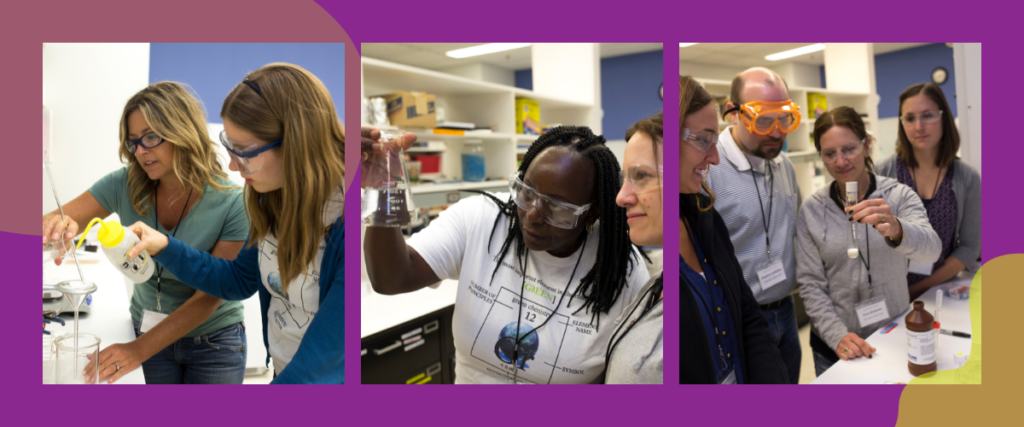
A square image with rounded edges has a thick yellow border. Two scientists are intently adding liquid into glass lab-ware. The image sits against a bright purple background with abstract yellow shapes. White texts reads: middle and high school teacher course: sustainable science: contextualizing chemistry through safer hands-on labs
Event Date
-
Lead Organizers
Hosting Organization(s)
Beyond Benign, Inc.

Event Description

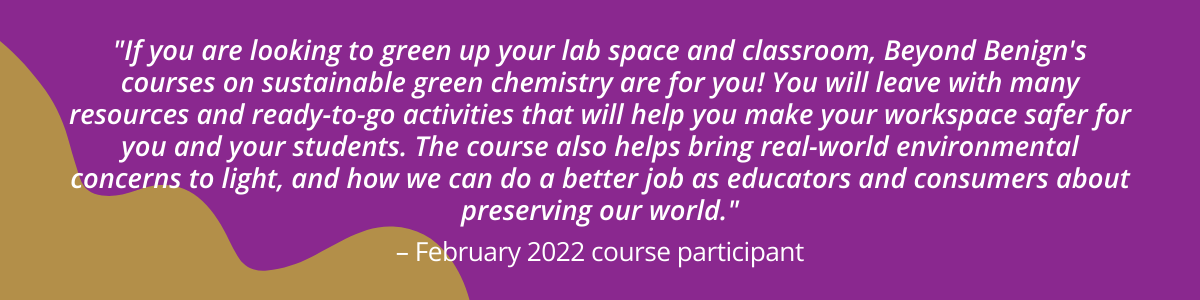
If you’re a science teacher looking to create a safer, more engaging learning environment for your students, this is the course for you!

ABOUT THIS COURSE

Are you a science teacher looking to create a safer, more engaging learning environment for your students? Learn how to weave Next Generation Science Standards (NGSS) sustainability content into your classrooms in this remote learning course for middle school and high school science teachers.

Beyond Benign Lead Teacher Erin Mayer will teach this course through a combination of synchronous and asynchronous learning. Participants will leave with a toolkit of resources and access to a network of other like-minded educators in the region.

*Discounts available for NY teachers, Environmental Justice Communities and other states with code

THIS COURSE IS RIGHT FOR YOU IF:

•  You’re interested in engaging strategies for NGSS-aligned chemistry labs

•  You want to foster a safe and engaging classroom environment

•  You’re interested in how problem-solving with chemistry helps create solutions for sustainability challenges

BY ENROLLING YOU’LL LEARN:

•  How to weave NGSS sustainability content into your classroom

•  How to spark student interest and increase self-efficacy in your classroom

COURSE TOPICS INCLUDE:

•  NGSS aligned labs featuring easily accessible and safe materials

•  Plug and play lessons for physical science in chemistry classrooms

•  Lessons based on real-world innovations


Funding provided by the NYS Pollution Prevention Institute through a grant from the Environmental Fund as administered by the NYS Department of Environmental Conservation.

Event Format
Event Address

United States

Eastern STANYS

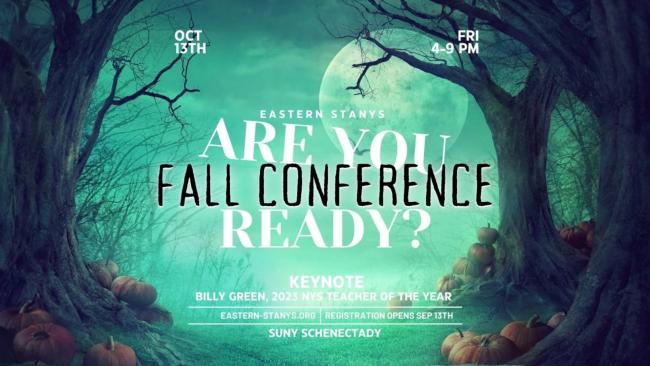
Image background shows a foggy forest with barren trees, pumpkins, and a large full moon. Text at the top left and right read Oct 13th, Fri 4-5PM. Center text reads: Eastern Stanys: Are you Fall Conference Ready? Keynote: Billy Green, 2023 NYS Teacher of the year. Eastern-stanys.org, Registration opens Sep 13th. SUNY Schenectady.
Event Date
-
Event Type

Event Description

The 40th Fall Conference will showcase innovative lessons, provide networking with fellow science teachers and a place check out the latest resources from our many exhibitors. The conference includes two 50-minute workshop sessions, a keynote speaker, exhibitors, dinner and door prizes.


Featured Presentation

Using Green Chemistry to Implement NYSSLS Based Labs

Lead Teachers Annette Sebuyira and Stefanie Loomis

Session 1 5:00-5:50


In this activity, we are going to capitalize on it being Halloween season and sticking with the conference theme of scary. These green labs have been tweaked so as to include a storyline. That has a link to forensics and a murder mystery and poisonous lemonade... Participants will be able to use their investigative skills as chemistry practitioners to explore how to implement the 12 Principles of Green Chemistry through these two fun activities!


This session is designed to empower Educators with green chemistry practices which will aid in acquiring the knowledge, skills and opportunity to engage and collaborate with parents, families and other community members. Educators will learn how to practice more sustainable methods to improve instruction and student achievement in a respectful, trusting and safe environment.


Event Details
  • Who: K-12 Educators,:Elementary, Intermediate, High School Chemistry, General Science, Applied Science, Environmental Science, Engineering, Forensics Etc. 
  • When: October 13th, 2023
  • Where: Schenectady Community College
  • How: Registration here.
Event Format
Event Address

78 Washington Ave
Schenectady, NY
United States

STANYS 2023: The Matter and Energy of STANYS

Dark blue and light blue text with lightbulb and cog graphics. The text reads: The Matter and Energy of STANYS
Event Date
-
Event Type

Event Description

128th Annual Conference Theme: The Matter and Energy of STANYS

Since the release of the Statewide Strategic Plan for Science, we have made enormous strides implementing best practices shifting towards sensemaking. The materials, lessons, activities, storylines, performance tasks (matter) we have collected and developed over time, through professional learning/sharing, and networking (energy) has transformed our pedagogy.

More general information about the conference is forthcoming. Visit the STANYS official site for registration and updates.


Image
Blue bar with white text. text reads: conference workshop.


Inspiring Students with Sustainable STEM and Green Chemistry

Lead Teachers Stefanie Loomis and Scott Carlson

Time and Date TBD

Are you teaching science and looking to create a safer, more engaging learning environment for your students? Learn how to weave NYSP12SLS suitability content into your classrooms. Participants will learn about the 12 green chemistry principles, as they immerse in hands on activities/labs, which will guide them into safer practices in the lab and classroom. Participants will be introduced to the Green Chemistry Teaching and Learning Community (GCTLC) and the book: Green Chemistry And Sustainable Science – A Green Approach to Sustainable STEM authored by Beyond Benign’s New York Lead Teachers.

Event Format
Event Address

100 E Onondaga St
Syracuse, NY
United States

Observe, Wonder, Think: An Interactive Green Chemistry Webinar

Against a dark blue background patterned with green molecules, a white dialogue bubble contains a blue beaker and multicolor text reading: Observe, Wonder, Think: An Interactive Green Chemistry Webinar
Event Date
-
-
-
-
-
-
-
Event Type
Lead Organizers
Hosting Organization(s)
Beyond Benign, Inc.

Event Description

Calling all K-12 teachers! Create safer, more engaging learning environments by integrating green chemistry and sustainable science principles into your classroom. Join your peers at our monthly professional development series: Observe, Wonder, Think: A Green Chemistry Interactive Webinar Series to learn how! Register to stay in the loop about upcoming speakers.


This year, the monthly Observe, Wonder, Think webinar series will highlight the 12 Principles of Green Chemistry!  Each webinar will focus on 1-2 Green Chemistry Principles. We will bring the focus principles to life with a short, engaging classroom learning activity. Our guest speakers will share how they incorporate the focus principles into their classroom learning activities and labs. Opportunities for discussion will be integrated throughout each webinar.   


This dedicated monthly time is designed to bring the green chemistry community together to advance the field and share ideas and resources for inspiring students through green chemistry!  We encourage you to invite your colleagues and friends to join these virtual discussions. We will provide a certificate of participation at the end of each webinar that may be used for PD hours. 


A long oval button with the text, register now, followed by two green arrows


September

Chemical Storage, Lab Safety, and Lab Waste

09/21/2023; 6PM EST
 

Presented by Mr. William McMahon, Lab Technician, State University of New York (SUNY) Jefferson Community College

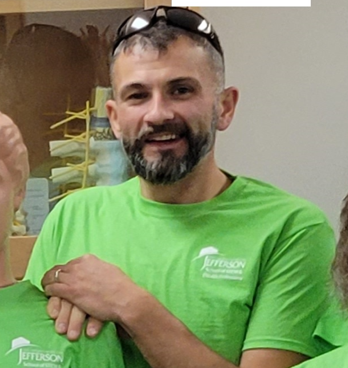
A white man in a bright green shirt has his hand on someone's shoulder, he is smiling.


Mr. McMahon has spent 20 years running the academic science labs and stockrooms at SUNY Jefferson. He will be presenting on chemical storage, lab waste disposal and lab safety. He will share many of the best practices that Jefferson has adopted to promote safety culture in the science division. He will share materials and devote time to a question & answer session.


More information is forthcoming.