Modeling Solar Disinfection with Turmeric and an LED Lamp

Modeling Solar Disinfection with Turmeric and an LED Lamp
Contributors

Professor | Bradley University
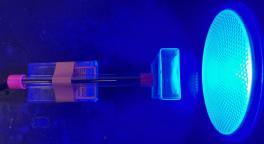
Vernier light sensor, Tic Tac sample holders, and blue light source used to study the photochemical decolorization of curcumin.
Summary
In this activity, participants use a blue LED light to decolorize a yellow solution containing curcumin compounds extracted from the spice turmeric. They will learn how this an analogy for solar disinfection of water, how an LED can be more efficient than other light sources, and how to examine whether a reaction process is 0th, 1st, or 2nd order.
Keyword Tags
Digital Object Identifier (DOI)
https://doi.org/10.59877/ZOGR4847
Learning Goals/Student Objectives
The objectives for this activity are for students to:
- implement chemical change using light
- measure light absorbance of solutions using a Vernier light sensor
- measure the order and rate constant for a chemical reaction process
- compare LEDs with other light sources
Object Type
Laboratory experiment
Activities/Technology (e.g., in-class activities, online games, hands-on activities/manipulatives, outreach, virtual tools, etc.)
Audience
High School (Secondary School)
Introductory Undergraduate
Upper/Advanced Undergraduate
Common pedagogies covered
Context-based learning
Hands-on learning
Problem-based learning
Green Chemistry Principles
Safer Solvents and Auxiliaries
Design for Energy Efficiency
Use of Renewable Feedstocks
Design for Degradation
U.N. Sustainable Development Goals (SDGs)
Clean Water and Sanitation
Responsible Consumption and Production
Safety Precautions, Hazards, and Risk Assessment
curcumin CAS # 458-37-7
PubChem describes curcumin as causing skin and eye irritation, and it may cause respiratory irritation.

ethanol CAS # 64-17-5
PubChem describes ethanol as flammable. At sufficiently high concentrations in the bloodstream, is can cause “CNS depression, nausea, possible vomiting, impaired cognition and impaired motor and sensory function.” Additionally, “Ethanol is considered a teratogen (causing fetal alcohol syndrome) and a Group 1 carcinogen because of the carcinogenicity of acetaldehyde (a major metabolite of alcohol).” Even so, the sample solutions used in these experiments are not ingested and have only a few drops of ethanol per 20 mL sample.

In all cases, precautions, including proper personal protective equipment such as goggles and gloves, should be used when working with these substances. Avoid spilling the compounds on clothing. Always wash your hands after completing the experiments and demonstrations.
Teacher Recommendations or Piloting Data (if available)
This activity was piloted in collaboration with Dean Campbell’s research students and then in his CHM440: Materials Chemistry course. For more piloting data, see the attached Instructor Guide.
NGSS Standards, if applicable
N/A

Share This

Submitted by

Reviewed by
Published on
Moderation state
Published
Time required (if applicable)
90 minutes
Other notes/information
See Student Instructions and Instructor Guide for more information.
I would like for this to be considered for the Green Chemistry with Vernier project.
Creative Commons License