- "Students are given the opportunity to assess chemical products and processes and design greener alternatives when appropriate."
- "Students understand and can evaluate the environmental, social, and health impacts of a chemical product over the life cycle of the product, from synthesis to disposal."
At the highest level of the ACS guidelines, students are expected to have a deeper understanding of and critical thinking skills around developing and designing greener chemical products and processes. This can include the various environmental, social and health aspects of a chemical product, in particular as it pertains to life cycle analysis.
GCTLC Library
Below are resources from the GCTLC library that are tagged with any of the following Green Chemistry Principles:
- #3 (Less Hazardous Chemical Syntheses)
- #4 (Design Safer Chemicals)
- #5 (Safer Solvents and Auxiliaries)
OR have been tagged with keyword "Life Cycle Assessment".
The variety of resources below should provide educators with numerous options to help tailor their lectures and courses with more green and sustainable chemistry content. However, if you have additional suggestions for resources, you can always submit them for inclusion in the GCTLC library, or you can post them in the forum "Green Chemistry Resources for Addressing the ACS Guidelines" on the GCTLC.

The Massive Problem of Microplastics
This article explores the significant environmental impact of microplastics, tiny plastic particles less than 5mm in size. These particles originate from larger plastic debris breaking down and microbeads from cosmetic products. Microplastics are pervasive in marine environments, posing threats to wildlife through ingestion and chemical contamination. The article highlights the urgent need for ...
The Olin Chemical Superfund Site Case Study
The Olin Chemical Superfund Site case study module consists of four lesson units and a classroom follow-up activity, designed to introduce students to the U.S. EPA’s Superfund Program and the history of the chemical industry. It also delves into the toxicology of chemicals released into the environment, while helping students explore green chemistry innovations that aim to eliminate the use of ...
The Reaction of Carbon Dioxide with Water
The experiment uses exhaled breath to explore the reaction between carbon dioxide and water. Students blow into a flask containing water and an indicator, causing a color change as carbon dioxide dissolves and forms carbonic acid, a weak acid. The experiment illustrates concepts of gas-liquid reactions, pH indicators, and the impact of carbon dioxide on water chemistry.
The safer chemical design game. Gamification of green chemistry and safer chemical design concepts for high school and undergraduate students
A green chemistry educational game was developed by the authors to engage undergraduate and advanced high school students in sustainability concerns while designing a hypothetical chemical product. This free game is suitable for any chemistry course that covers sustainability and the Principles of Green Chemistry, encouraging students to think like professional chemical designers. The computer ...
The Synthesis of N-Benzyl-2-azanorbornene via Aqueous Hetero Diels–Alder Reaction. An Undergraduate Project in Organic Synthesis and Structural Analysis
This lab demonstrates a pericyclic reaction that is popular in undergraduate texts, the Diels-Alder reaction, and does so in the context of using water as a safe, alternative solvent. Adapted from work published by Larsen and Grieco in 1985, this experiment makes use of the synthesis of N-benzyl-2-azanorbornene to present green chemistry to students. Not only is this very atom-economical reaction ...
The Synthesis of Zinc Copper Indium Sulfide Quantum Dots
In this experiment, ZnCuInS2 quantum dots of differing sizes are prepared and analyzed by UV-Vis and fluorescence spectroscopy. The ZnCuInS quantum dot synthesis is inherently greener than common nanoparticle syntheses, e.g. CsPbX3 or CdSe, because the use of Pb and Cd is avoided. Due to their tunability and excellent optical properties, quantum dots have allowed for the development of QLED ...
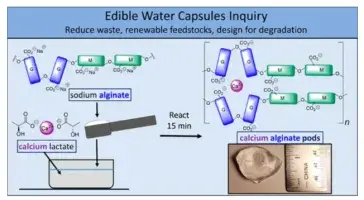
Thirst for a Solution: Alginate Biopolymer Experiments for the Middle and High School Classroom
Middle and and high school curricula is described based on the synthesis of biodegradable calcium alginate capsules prepared from food-safe chemicals. Green chemistry principles are shared through the use of renewable and degradable materials and the application to new innovations in the design of environmentally friendly alternatives to plastic water bottles.
Emma R. Corcoran, Cassandra Lydon ...
Tools and techniques for solvent selection: green solvent selection guides
This review article overviews solvent selection guides and explains their role in helping to choose appropriate solvents as well as highlights their similarities and differences. Provides an overview of data from (and comparison between) solvent selection guides by GSK, Sanofi, Pfizer, ACS Green Chemistry Institute, and CHEM21.
Full citation: Byrne, F.P., Jin, S., Paggiola, G. et al. Tools and ...
Toward the Greening of Our Minds: A New Special Topics Course
A special topics course on "Towards the Greening of Our minds" is offered every other spring at Washington College. This course is designed for science majors who have taken general and organic chemistry and are interested in the future of the planet. The ultimate goal of the class is for students to use green chemistry as a way to critically evaluate environmental policy. Over the course of the ...
Toxicology
This module is part of a collection of nine green chemistry teaching modules developed in the early 2000s by a team of faculty (Donna Narsavage-Heald, Trudy Dickneider, David Marx, Timothy Foley, Joan Wasilewski) led by Michael Cann at the University of Scranton and has been migrated to the GCTLC. The subjects of the modules are based on winners of the Green Chemistry Challenge Awards. The modules ...