- "Students are given the opportunity to assess chemical products and processes and design greener alternatives when appropriate."
- "Students understand and can evaluate the environmental, social, and health impacts of a chemical product over the life cycle of the product, from synthesis to disposal."
At the highest level of the ACS guidelines, students are expected to have a deeper understanding of and critical thinking skills around developing and designing greener chemical products and processes. This can include the various environmental, social and health aspects of a chemical product, in particular as it pertains to life cycle analysis.
GCTLC Library
Below are resources from the GCTLC library that are tagged with any of the following Green Chemistry Principles:
- #3 (Less Hazardous Chemical Syntheses)
- #4 (Design Safer Chemicals)
- #5 (Safer Solvents and Auxiliaries)
OR have been tagged with keyword "Life Cycle Assessment".
The variety of resources below should provide educators with numerous options to help tailor their lectures and courses with more green and sustainable chemistry content. However, if you have additional suggestions for resources, you can always submit them for inclusion in the GCTLC library, or you can post them in the forum "Green Chemistry Resources for Addressing the ACS Guidelines" on the GCTLC.

Octanol–Water Partition Coefficient Measurement by a Simple 1H NMR Method
This article describes a simple approach for measuring the octanol-water partition coefficient (Kow) of organic compounds using a simple miniature variation of the shake-flask method in an NMR tube, which can be quickly analyzed using a benchtop 1H NMR spectrometer. The article also details the scope and limitations of the method. Kow is an important metric for understanding bioaccumulation and ...
One-Pot Synthesis of 7-Hydroxy-3-carboxycoumarin in Water
Coumarins represent an important class of natural and synthetic derivatives with interesting biological activities. The 3-carboxycoumarins have been intensely studied because new functionalities can be easily added via the carboxyl group. During this laboratory exercise, students prepare 7-hydroxy-3-carboxycoumarin using a one-pot, multi-step procedure in the absence of organic solvents. By using ...
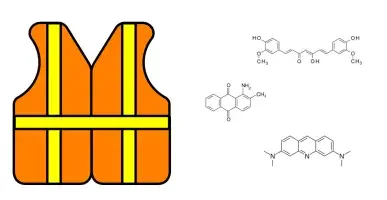
Orange is the Color of Warning
Orange is widely used in safety and warning contexts due to its high visibility. Traffic cones, life vests, and hazard signs feature orange to signal caution. It appears in construction zones, biohazard labels, and emergency signals. Its association with fire and urgency makes it a universal color for alertness and danger.
Although their colors may appear the same, the dyes and pigments used to ...
Organic Chemistry
This module is part of a collection of nine green chemistry teaching modules developed in the early 2000s by a team of faculty (Donna Narsavage-Heald, Trudy Dickneider, David Marx, Timothy Foley, Joan Wasilewski) led by Michael Cann at the University of Scranton and has been migrated to the GCTLC. The subjects of the modules are based on winners of the Green Chemistry Challenge Awards. The modules ...
Organic Chemistry II Lesson Plans
The lesson outlines for the second semester of organic chemistry (Klein, Organic Chemistry, 4th ed) contain lesson objectives, homework problems (H) and in-class problems (B) to engage students. Selected lessons feature "green" organic reactions specific to the chapter coverage.
Organic Nomenclature and Safety of Chemical Products
This is a discussion prompt where students find a molecule they use in a personal care product, cleaning product, or processed food. They find the structure, relate components of the name to aspects of the structure, look up the product on the Environmental Working Group (EWG) or FDA websites, and look up the molecule in PubChem. At the end, they need to decide whether they are happy with their ...
Organic-Solvent-Free Phase-Transfer Oxidation of Alcohols Using Hydrogen Peroxide
An organic chemistry laboratory experiment illustrating the oxidation of primary and secondary alcohols to their corresponding aldehyde or ketones, respectively, is described. The procedure uses 30% aqueous hydrogen peroxide in the presence of a tungsten catalyst (sodium tungstate) using phase transfer catalysis. The described experiments illustrate basic organic reaction chemistry and techniques ...
Oxidation of Aromatic Aldehydes Using Oxone
One of the main advantages of doing green chemistry is that it can often be done on the benchtop without the need for a fume-hood. In this experiment water and ethanol are the only solvents used for both the reaction and purification steps and oxone is a safe oxidant whose only by-product is potassium sulfate.
The oxidation of aromatic aldehydes using oxone allows instructors to discuss green ...
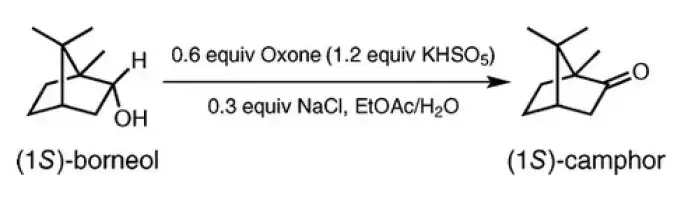
Oxidation of Borneol to Camphor Using Oxone and Catalytic Sodium Chloride: A Green Experiment for the Undergraduate Organic Chemistry Laboratory
A new green oxidation procedure was developed for the undergraduate organic teaching laboratories using Oxone and a catalytic quantity of sodium chloride for the conversion of borneol to camphor. This simple 1 h, room temperature reaction afforded high quality and yield of product, was environmentally friendly, and produced negligible quantities of hazardous waste. The experiment was performed ...
Patterning Self-Assembled Monolayers on Gold. Green Materials Chemistry in the Teaching Laboratory
Applications of organic chemistry to modify the structure and surface properties of materials are becoming increasingly important and interdisciplinary as the dimensions of modern materials decrease. This laboratory exercise illustrates how macroscopic material properties can be modified with self-assembled monolayers and organic thin-film patterning. Using an inexpensive gold on vinyl substrate ...