Orange is the Color of Warning
Contributors


Summary
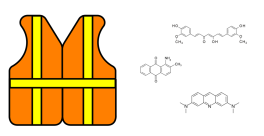
Orange is widely used in safety and warning contexts due to its high visibility. Traffic cones, life vests, and hazard signs feature orange to signal caution. It appears in construction zones, biohazard labels, and emergency signals. Its association with fire and urgency makes it a universal color for alertness and danger.
Although their colors may appear the same, the dyes and pigments used to create orange hues vary significantly in their chemical properties. Due to this, they present different hazards based on their composition, structure, and bioavailability.
In this activity, you will evaluate different historical and modern pigments and dyes to determine their hazards, relate them to specific health and environmental impacts, and suggest which settings, scenarios, and applications they can be used for without things going wrong. Though we can’t determine the safety of a substance from the number of GHS hazard statements alone, deciphering these statements on safety data sheets provides helpful information. Orange is vibrant and widely used in pigments and dyes, but its safety varies. Some, like cadmium orange and benzidine-based colorants, are toxic and carcinogenic, requiring careful handling or ideally being eliminated or substituted with a less hazardous chemical.
In addition to the activity, supplemental resources are attached.
Although their colors may appear the same, the dyes and pigments used to create orange hues vary significantly in their chemical properties. Due to this, they present different hazards based on their composition, structure, and bioavailability.
In this activity, you will evaluate different historical and modern pigments and dyes to determine their hazards, relate them to specific health and environmental impacts, and suggest which settings, scenarios, and applications they can be used for without things going wrong. Though we can’t determine the safety of a substance from the number of GHS hazard statements alone, deciphering these statements on safety data sheets provides helpful information. Orange is vibrant and widely used in pigments and dyes, but its safety varies. Some, like cadmium orange and benzidine-based colorants, are toxic and carcinogenic, requiring careful handling or ideally being eliminated or substituted with a less hazardous chemical.
In addition to the activity, supplemental resources are attached.
File (PDF, PPT, image, etc)
Digital Object Identifier (DOI)
https://doi.org/10.59877/MDAU5127
Creative Commons License
