Is your lab safety training - safe?

Is your lab safety training - safe?
Contributors
Director of Educational Content and Learning | The Laboratory Safety Institute
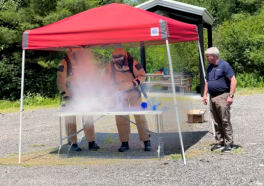
Screenshots from the Boston Department of Fire Services. Two demonstrators produce a dangerous explosion during a police safety training.
Summary
The article "Is Your Lab Safety Training — Safe?" from the Lab Safety Institute emphasizes that safety training itself must adhere to rigorous safety standards. It highlights a real incident where a chemical demonstration led to an unintended explosion, underscoring the need for thorough risk assessments, appropriate personal protective equipment (PPE), and strict adherence to safety protocols. Key learning objectives include conducting comprehensive risk evaluations, ensuring all participants use suitable PPE, following established safety procedures during demonstrations, providing clear communication and training to all involved, opting for safer simulation methods when possible, and maintaining preparedness for emergency responses. The article serves as a reminder that safety training must exemplify the very precautions it seeks to instill.
Learning Goals/Student Objectives
1. Conduct Risk Assessments Before Demonstrations -
Learners will be able to evaluate potential hazards and conduct thorough risk assessments before planning or executing laboratory safety training demonstrations.

2. Implement and Model Proper Safety Protocols -
Learners will understand the importance of consistently using appropriate personal protective equipment (PPE) and following established safety procedures during training to model best practices.

3. Choose Safer Alternatives and Plan for Emergencies -
Learners will identify safer methods or simulations for demonstrating scientific principles and will be able to prepare for potential emergencies by having appropriate response protocols in place.
Object Type
Case studies
Other
Audience
Upper/Advanced Undergraduate
Graduate or Professional Training (e.g., Postdoctoral Fellows, Early-Career Professionals)
Other Faculty Educators/Teachers
Environmental Health & Safety (EH&S)
Common pedagogies covered
Context-based learning
Work-based learning
Green Chemistry Principles
Safer Chemistry for Accident Prevention
U.N. Sustainable Development Goals (SDGs)
Quality Education
Safety Precautions, Hazards, and Risk Assessment
This article discusses and justifies the need for safety precautions, hazard and risk assessments.

Share This

Submitted by

Published on
Moderation state
Published
Collection
Creative Commons License