
Thermo-rheological and tribological properties of low- and high-oleic vegetable oils as sustainable bio-based lubricants†
Thermo-rheological and tribological properties of low- and high-oleic vegetable oils as sustainable bio-based lubricants†
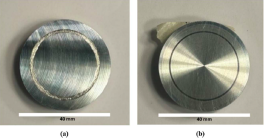
Wear of the bottom aluminum plate from the tribology tests.
Summary
This learning object explores the thermo-rheological and tribological behavior of various vegetable oils—specifically low- and high-oleic soybean oil, high-oleic sunflower, safflower, and canola oils—as sustainable alternatives to petroleum-based lubricants in metal machining. The study evaluates key properties such as viscosity index, flow behavior index, flow activation energy, specific heat capacity, thermal conductivity, coefficient of friction, contact angle, and thermal-oxidative stability. These properties are benchmarked against mineral oil, a conventional emulsion coolant (CEC), and a commercial bio-based lubricant (Acculube LB-2000).

The findings reveal that vegetable oils, particularly those with high oleic acid content, exhibit superior rheo-thermal stability and lubrication performance across various lubrication regimes. While CEC demonstrates better cooling capacity due to its high water content, vegetable oils offer better friction reduction and environmental benefits. The study supports the use of vegetable oils as biodegradable, non-toxic, and renewable lubricants, contributing to sustainable manufacturing and aligning with multiple UN Sustainable Development Goals (SDGs).

Summary
Authors/Contributors:
Abiodun Saka
Tobechukwu K. Abor
Anthony C. Okafor
Monday U. Okoronkwo
Affiliations:
Missouri University of Science and Technology, USA

Citation:
Saka, A., Abor, T. K., Okafor, A. C., & Okoronkwo, M. U. (2025). Thermo-rheological and tribological properties of low- and high-oleic vegetable oils as sustainable bio-based lubricants. RSC Sustainability. https://doi.org/10.1039/d4su00605d

Learning Goals/Student Objectives
Learning Goals
Students will:
1. Understand the physical and chemical properties of vegetable oils and their relevance to lubrication and thermal management.
2. Explore sustainable alternatives to petroleum-based lubricants and their environmental implications.
3. Analyze how molecular structure affects rheological and tribological behavior in fluids.
4. Apply scientific methods to evaluate material performance in engineering contexts.
5. Connect scientific research to real-world applications in sustainable manufacturing and environmental stewardship.

Student Objectives
By the end of this lesson or unit, students should be able to:
1. Describe the role of vegetable oils as bio-based lubricants and compare them to conventional petroleum-based fluids.
2. Explain key thermo-rheological properties such as viscosity index, flow activation energy, and thermal conductivity.
3. Interpret tribological data including coefficient of friction and lubrication regimes (boundary, mixed, hydrodynamic).
4. Use FTIR spectroscopy data to identify functional groups in organic compounds.
5. Evaluate the environmental benefits of biodegradable lubricants in terms of sustainability and alignment with SDGs.
6. Discuss how oleic acid content influences the performance of vegetable oils in industrial applications.
7. Propose modifications (e.g., nanoparticle additives) to enhance the thermal and lubrication properties of bio-based fluids.
8. Reflect on the importance of material selection in engineering design for sustainability.
Object Type
Case studies
Journal articles
Audience
Upper/Advanced Undergraduate
Common pedagogies covered
Blended learning
Multimedia-based learning
Green Chemistry Principles
Designing Safer Chemicals
Design for Energy Efficiency
Use of Renewable Feedstocks
Design for Degradation
Real-Time Pollution Prevention
U.N. Sustainable Development Goals (SDGs)
Good Health and Well-Being
Clean Water and Sanitation
Sustainable Cities and Communities
Responsible Consumption and Production
Climate Action
Safety Precautions, Hazards, and Risk Assessment
Safety Precautions
1. Personal Protective Equipment (PPE):
--Wear safety goggles during tribology and rheology tests to protect against fluid splashes.
--Use gloves when handling oils, solvents, and cleaning agents to prevent skin contact.
--Lab coats or aprons should be worn to protect clothing and skin from spills.

2. Chemical Handling:
--Store vegetable oils and reference fluids (e.g., mineral oil, Acculube LB-2000) in sealed, labeled containers.
--Avoid direct inhalation of vapors from heated oils or coolants during thermal analysis.

3. Instrument Safety:
--Operate rheometers, calorimeters, and thermal analyzers according to manufacturer guidelines.
--Ensure proper calibration and maintenance of equipment to prevent malfunction or inaccurate readings.

3. Thermal Safety:
--Use heat-resistant gloves when handling crucibles or fluid containers during thermogravimetric analysis.
--Maintain safe distances from heating elements and hot surfaces during experiments.

4. Spill Management:
--Clean up oil spills immediately using absorbent materials to prevent slip hazards.
--Dispose of waste fluids and cleaning materials in accordance with local environmental regulations.

Hazards
1. Thermal Burns:
--Heated oils and equipment used in TGA and calorimetry can cause burns if mishandled.
2. Skin Irritation:
--Prolonged contact with oils or additives may cause irritation or allergic reactions.

3. Slippery Surfaces:
--Spilled oils can create slip hazards in the lab environment.

4. Fire Risk:
--Although vegetable oils have high flash points, they are still flammable under certain conditions. Keep away from open flames.
5. Chemical Exposure:
--Reference fluids like mineral oil and synthetic coolants may contain additives that pose inhalation or dermal risks.

Risk Assessment
1. Low to Moderate Risk for most vegetable oils due to their non-toxic and biodegradable nature.
2. Moderate Risk associated with thermal analysis due to high temperatures and potential for burns.
3. Higher Risk when handling synthetic coolants or petroleum-based fluids due to chemical additives and lower flash points.
4. Mitigation Strategies include proper PPE, ventilation, spill containment, and adherence to lab protocols.
NGSS Standards, if applicable
Disciplinary Core Ideas (DCIs)
PS3.A: Definitions of Energy
The study explores thermal conductivity and specific heat capacity of vegetable oils, helping students understand how energy is transferred and stored in materials.

PS3.B: Conservation of Energy and Energy Transfer
Investigations into heat absorption and dissipation in lubricants illustrate energy transfer mechanisms in real-world applications.

PS1.A: Structure and Properties of Matter
FTIR spectroscopy and rheological analysis reveal molecular structures and how they influence physical properties like viscosity and flow behavior.

ETS1.A: Defining and Delimiting Engineering Problems
The research addresses the environmental and performance limitations of petroleum-based lubricants, proposing vegetable oils as sustainable alternatives.

ESS3.C: Human Impacts on Earth Systems
The paper discusses the environmental benefits of biodegradable lubricants, directly connecting to human impacts on ecosystems and sustainability.

Science and Engineering Practices (SEPs)
Planning and Carrying Out Investigations
The study involves controlled experiments measuring viscosity, thermal stability, and tribological performance across various temperatures.

Analyzing and Interpreting Data
Data from rheometers, calorimeters, and tribometers are analyzed to compare vegetable oils with conventional lubricants.

Constructing Explanations and Designing Solutions
The research constructs evidence-based explanations for the superior performance of high-oleic vegetable oils and proposes their use in sustainable manufacturing.

Engaging in Argument from Evidence
The authors use comparative data to argue for the adoption of vegetable oils in industrial applications based on performance and environmental impact.

Crosscutting Concepts (CCCs)
Cause and Effect
The paper links molecular composition (e.g., oleic acid content) to physical properties like viscosity and thermal stability.

Energy and Matter
It explores how energy is absorbed, transferred, and dissipated in lubricants, and how matter (oil composition) affects these processes.

Systems and System Models
The lubrication system is treated as a model to understand interactions between fluid properties and mechanical performance.

Stability and Change
The study examines how temperature affects fluid stability and how chemical composition influences degradation and performance.

Share This

Submitted by

Published on
Moderation state
Published
Other notes/information
Interdisciplinary Integration: This resource is ideal for chemistry, environmental science, materials science, and engineering courses. It bridges molecular chemistry with mechanical performance and sustainability.

Experimental Techniques Covered:
FTIR spectroscopy
Rheometry and viscosity modeling
Thermogravimetric analysis (TGA/DTG)
Calorimetry for specific heat capacity
Thermal conductivity testing
Tribology and contact angle measurement
Data Literacy: The paper includes rich datasets and graphs that can be used to teach data interpretation, modeling, and scientific reasoning.

Real-World Relevance: The study addresses industrial challenges in machining and lubrication, making it a strong example of applied green chemistry.