Introduction to Green and Sustainable Chemistry Syllabus

Introduction to Green and Sustainable Chemistry Syllabus
Contributors

Assistant Professor | Prairie View Agricultural & Mechanical University
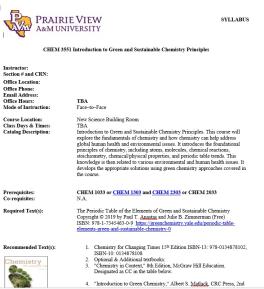
Page 1 of Green Chemistry Syllabus image
Summary
Green and Sustainable Chemistry syllabus adopted from Beyond Benign-Yale UNIDO syllabus template for Prairie View A&M University. Syllabus was updated to include LCAs and Toxicology for Chemist modules.
https://www.beyondbenign.org/curriculum_topic/he-green-chemistry/
https://www.beyondbenign.org/curriculum_topic/he-toxicology/
Digital Object Identifier (DOI)
https://doi.org/10.59877/USPY8111
Learning Goals/Student Objectives
1. Define Green and Sustainable Chemistry and connect the 17 United Nations Sustainability Goals
2. Connect Green and Sustainable Chemistry principles to foundational topics in periodic table trends, electronegativity, stoichiometry, molecular structure, reactivity, and nomenclature
3. Understand the historical and current role of chemicals in our society and economy
4. Understand the transformational role of Green Chemistry in the global economy and the associated material and Energy benefits
5. Qualitatively and quantitatively examine the impacts on human health and the environment of chemical products and processes, and their impacts throughout the lifecycle
6. Analyze the efficiency of various approaches to chemical design
Relate Green and Sustainable Chemistry principles to waste and pollution prevention by understanding the history of chemical accidents
7. Examine global human health and environmental issues with Green and Sustainable Chemistry principles by understanding how Green Chemistry can be used to design safer products and industrial systems without causing harm to the environment and human health
8. Recognize the tools available to scientists and engineers in designing and synthesizing new chemical products and processes, including energy efficiency
9. Gain basic knowledge of toxicity and the molecular basis of hazard
Object Type
Syllabi
Audience
Upper/Advanced Undergraduate
Common pedagogies covered
Context-based learning
Problem-based learning
Student-centered learning
Green Chemistry Principles
Waste Prevention
Atom Economy
Design for Energy Efficiency
Use of Renewable Feedstocks
Reduce Derivatives
Catalysis
Design for Degradation
Safer Chemistry for Accident Prevention
U.N. Sustainable Development Goals (SDGs)
Good Health and Well-Being
Quality Education
Affordable and Clean Energy
Industry, Innovation and Infrastructure
Responsible Consumption and Production
Climate Action
Safety Precautions, Hazards, and Risk Assessment
N/A
Teacher Recommendations or Piloting Data (if available)
Not currently available

Share This

Submitted by

Published on
Moderation state
Published
Other notes/information
Future updates will include an experiential learning module connected to new study abroad program connecting green and sustainable chemistry principles, cultural awarness and global education in STEM.