Greener bromination of alkenes using sodium bromide and sodium perborate

Greener bromination of alkenes using sodium bromide and sodium perborate
Contributors
Associate Professor of Chemistry | Saint Mary's College of California
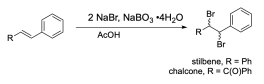
general reaction scheme for the bromination of an alkene
Summary
Co-author: Alyssa Gauna

This experiment uses sodium bromide and sodium perborate to generate bromine for the electrophilic bromination of either stilbene or chalcone. Students will then use melting point to determine the stereochemistry of their reaction. They will also use green chemistry metrics to compare the greenness of the procedure.
Digital Object Identifier (DOI)
https://doi.org/10.59877/EKBU3163
Learning Goals/Student Objectives
-Perform an electrophilic bromination of an alkene using a greener method that generates Brâ‚‚ in situ.

-Analyze the stereochemistry of the brominated product using melting point data.

-Apply green chemistry principles to evaluate the safety and environmental impact of the procedure.

-Calculate percent yield and assess product purity based on experimental data.

-Use metrics to evaluate and compare the greenness of a synthetic method
Object Type
Laboratory experiment
Audience
Introductory Undergraduate
Common pedagogies covered
Hands-on learning
Work-based learning
Green Chemistry Principles
Waste Prevention
Less Hazardous Chemical Syntheses
Designing Safer Chemicals
Design for Energy Efficiency
Safer Chemistry for Accident Prevention
U.N. Sustainable Development Goals (SDGs)
Good Health and Well-Being
Quality Education
Reduced Inequalities
Responsible Consumption and Production
Climate Action
Safety Precautions, Hazards, and Risk Assessment
The chemicals used in this experiment present moderate health and safety hazards. Stilbene, chalcone, sodium bromide, and sodium perborate are all harmful if swallowed and can cause eye, skin, or respiratory irritation. Sodium perborate is a reproductive toxin. Acetic acid poses a more significant risk as a corrosive and flammable liquid that can cause severe skin burns and eye damage. Personal protective equipment must be worn, and care should be taken to handle all substances in a well-ventilated area.
Teacher Recommendations or Piloting Data (if available)
The bromination reaction with chalcone takes a bit longer than the one with stilbene. We tried using cinnamic acid but were not successful. The equivalents of NaBr and SPB were optimized so that the whole experiment can be completed in under 3 hours. The pre-laboratory assignment is optional; our students complete it one week before the experiment. The metrics worksheet is optional and can be completed during a second lab period or as a take-home assignment.

Share This

Submitted by

Reviewed by
Published on
Moderation state
Published
Creative Commons License