Explore Material Efficiency and Sustainability with Green Chemistry Metrics
Contributors

Summary
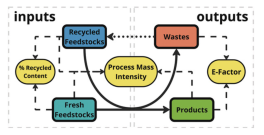
This short communication explores using simple sustainability metrics to explore data from mass balances (e.g. amount of products, feedstocks, and wastes). It explores how educators and researchers can easily calculate three metrics (process mass intensity, recycled content, and e-factor) to discuss efficiency and circularity together.
Within the article, there is also a case study exploring how these metrics are applied to papermaking to select the greenest process.
These metrics can be used to explore both production and consumption addressing UN SDG#12: Ensure sustainable consumption and production patterns.
The article was co-authored by Julian SIlverman (Contributor to GCTLC), Andie Zion and Austin Marshalek.
Citation: Austin Marshalek, Andie Zion, Julian R. Silverman. Relating Sustainability Metrics to Evaluate Circularity and Material Efficiency. Sustainability & Circularity NOW 2025; 02: a25297214.
DOI: 10.1055/a-2529-7214
Within the article, there is also a case study exploring how these metrics are applied to papermaking to select the greenest process.
These metrics can be used to explore both production and consumption addressing UN SDG#12: Ensure sustainable consumption and production patterns.
The article was co-authored by Julian SIlverman (Contributor to GCTLC), Andie Zion and Austin Marshalek.
Citation: Austin Marshalek, Andie Zion, Julian R. Silverman. Relating Sustainability Metrics to Evaluate Circularity and Material Efficiency. Sustainability & Circularity NOW 2025; 02: a25297214.
DOI: 10.1055/a-2529-7214
Keyword Tags
Related Learning Objects
Creative Commons License
